Nongshim Brand Guidelines
The Seoul ramyun maker behind Shin Ramyun.
Aa
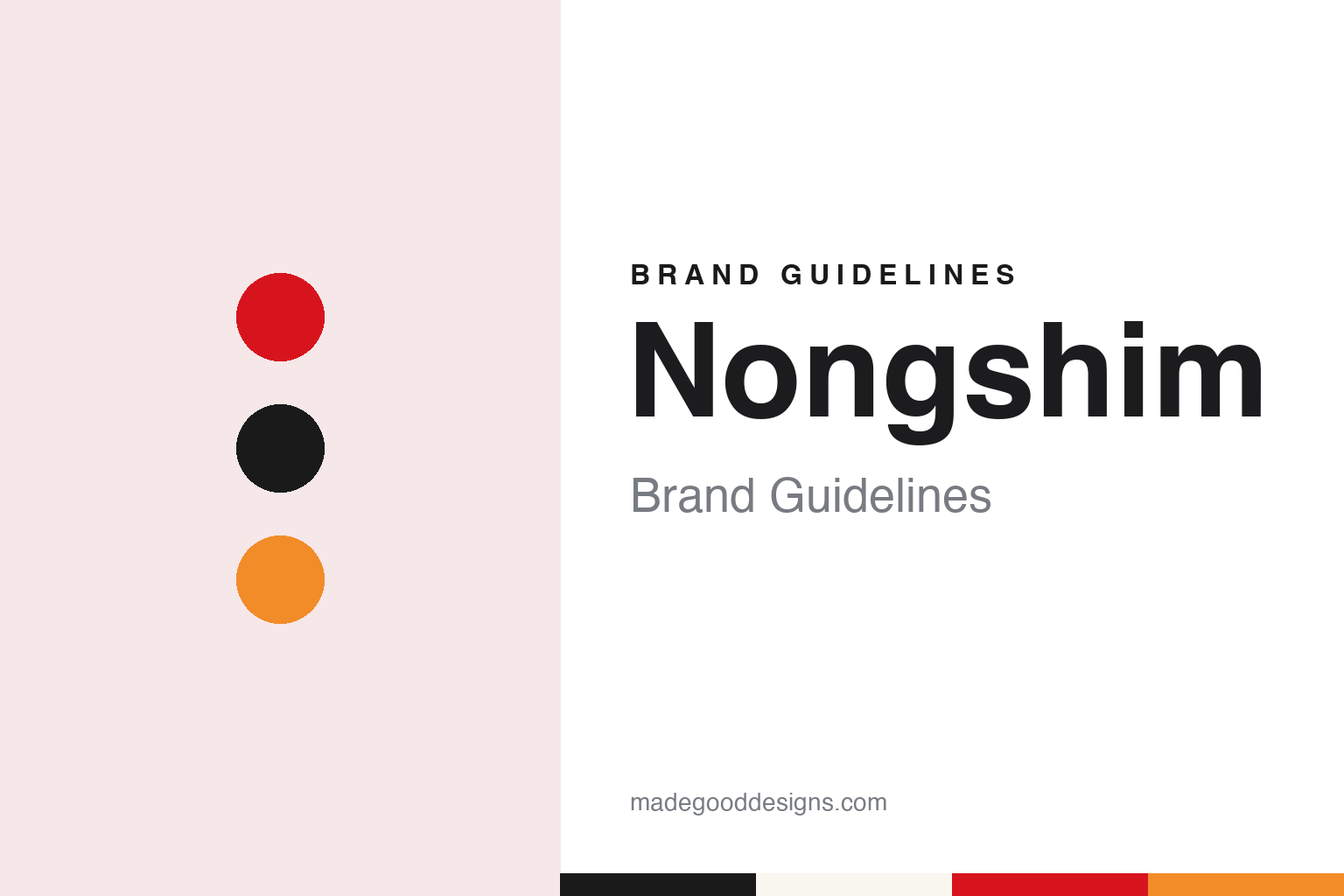
Two constants: a Shin red, ramyun black and earth orange palette and a bold Korean display sans register. Abstract homage — not a Nongshim product or mark; no pack, logo or character is reproduced.
Lotte Food Industrial
A younger brother, a second-mover and a new name.
Nongshim began in Seoul on 18 September 1965 under the name Lotte Food Industrial Company, English Wikipedia says. Its founder, Shin Choon-ho, was a younger brother of Shin Kyuk-ho, who founded the Lotte group, but the two businesses were separate, the Korea JoongAng Daily and The Korea Herald reported in 2021. Shin had worked for his brother’s confectionery business in Japan before setting up on his own to make ramyun, Korea’s instant noodles, the JoongAng Daily reported.
The company was not first into the market. When it launched its first noodles, Lotte Ramyun, in 1965, seven other companies were already selling ramyun, according to English Wikipedia, citing the Korean news site Mediapen and the company’s own history. It followed with a Beef Ramyun in 1970; with the Saeukkang snack in 1971, which the Korea JoongAng Daily has called the first commercialised packaged snack in South Korea; and with a Nongshim Ramyun in 1975.
The name came last. On 6 March 1978, after a dispute with his brother, Shin changed the company’s name to Nongshim, written 農心 in Chinese characters and meaning “farmer’s heart,” the 2021 reports say. English Wikipedia lists Shin as chief executive until 1992 and chairman from then until 2021; he died in March 2021, at the age of 91, the Korea JoongAng Daily reported, and his eldest son, Shin Dong-won, became chairman that July, The Korea Herald reported.
The 1980s brought the products that still carry the company. English Wikipedia dates Neoguri to 1982, Ansungtangmyun to 1983 and Chapagetti to 1984, with cup and bowl noodles arriving in the same decade.
Colour
Shin Ramyun and one red character.
Nongshim’s best-known product arrived on 1 October 1986. Shin Ramyun was a spicy beef-broth noodle inspired by sogogi jangguk, a Korean beef and cabbage soup, the Korea Economic Daily reported in 2016. Its name means, roughly, “spicy ramyun,” and its pack, in red and black, is built around a large calligraphic form of the Chinese character 辛, meaning “spicy.” The same character is the surname shared by Shin Choon-ho and his brother, the Korea Economic Daily noted.
The product reshaped the company’s position. Nongshim’s share of the Korean instant noodle market passed half for the first time in 1988, the Herald Corporation reported in 2016. By 2015 Shin Ramyun had sold 28 billion units since its launch, Money Today reported, and English Wikipedia, citing Edaily, says it is exported to more than 100 countries and made in South Korea, the United States and China.
The brand has been extended rather than replaced. A premium Shin Ramyun Black, with an extra beef-bone stock, followed in April 2011, Maeil Business Newspaper reported. In August 2014 Nongshim changed the noodle recipe and the pack design together, the first such change in 28 years, the Sports Chosun reported.
Its Korean advertising has leaned on one long-running line, “Shin Ramyun can make a man cry,” as Nongshim USA translates it, and on short jingles at the end of its commercials, the Dong-A Ilbo reported in 2014. Famous faces have included the footballer Park Ji-sung in 2009 and the singer Psy in 2012. Abroad the company has localised: in Japan it has marked 10 April as a Shin Ramyun day since 2010, a date chosen for a pun on the word “hot,” The Korea Herald reported in 2016, and in China it has sponsored the annual Nongshim Cup for the board game baduk, known in the West as Go.
Typography
Design and documentation.
The seven brands in this group all make instant noodles, and they come from Japan, Indonesia, Thailand, Britain, South Korea and Singapore: Nissin, Maruchan, Indomie, Mama, Pot Noodle, Nongshim and Koka. Instant noodle brands in general sit at many different points in the trade, from family firms that still carry a founder’s name to names that now belong to much larger food groups, and a single brand can be sold everywhere from a corner shop to a supermarket shelf on another continent.
An instant noodle brand’s identity is usually carried less by a single product than by a pack, a name and the quick meal it promises, because the company behind the name may have changed hands, opened factories abroad or grown far beyond the city where it started. That makes the questions behind each name worth asking plainly: who started it, who owns it now, and where its noodles are actually made and packed.
Each guide separates what independent sources record from what the company says about itself — its founding story, its owners over time, where its noodles are made and how its packaging has changed — and marks plainly what rests only on the company’s own word.
Aa
A bold Korean display sans, standing in for a pack built on one brushed character. (Specimen set in Black Han Sans, a sans STAND-IN; NOT the Nongshim logo.)
Nongshim
A seed symbol, a holding company and factories on three continents.
Nongshim’s corporate mark dates from 1 January 1991, when it introduced a new identity built around a symbol it calls the “Nongshim Seed,” English Wikipedia says, citing the company. Nongshim’s own description of the mark, archived from its English website in 2016, says the seed stands for the belief that “as you sow, so shall you reap”; that two ellipses, inside and outside, stand for growth and for the stability of nature; and that the outer ellipse should never be reproduced smaller than 4mm across. The same page names a primary red as the company’s “business color” and a secondary orange standing for a warm earth, without publishing exact values.
The founder was wary of letting advertising lead. Shin Choon-ho is quoted as saying “Advertisements should not be prioritized over quality products,” according to English Wikipedia, citing the magazine Shin Dong-A in 2012, and Nongshim has tended to advertise individual products rather than its corporate name.
The company today is listed on the Korea Exchange and, since a switch to a holding-company structure in 2003, has been a subsidiary of Nongshim Holdings, English Wikipedia says. Its own site listed eleven factories in 2016: six in South Korea, including Anyang, Ansung, Asan, Busan, Noksan and Gumi, which The Korea Herald described in 2024 as home to Nongshim’s largest factory; one in Rancho Cucamonga, California, where the company says it opened a Los Angeles-area plant in 2005; and four in China, at Shanghai, Qingdao, Shenyang and Yanbian. Besides noodles, it makes snacks such as onion rings and bottles Baeksan water, which it began producing in 2012, The Korea Times reported.
For a design guide, Nongshim shows how a single brushed character on a red and black pack can carry a company’s name abroad more than its corporate mark does. Compare Nissin, the Japanese maker that invented instant noodles, and Indomie, Indonesia’s best-known noodle brand. For this guide we use Shin red, ramyun black and an earth orange with a bold sans, an unofficial interpretation; no product or logo is reproduced.
Explore & save
Keep Nongshim’s identity on hand — save it to a board in the Made Good inspiration library.
Nongshim identity set
Pin the Nongshim Shin red, ramyun black and earth orange palette and the bold Korean display sans register to your own board.