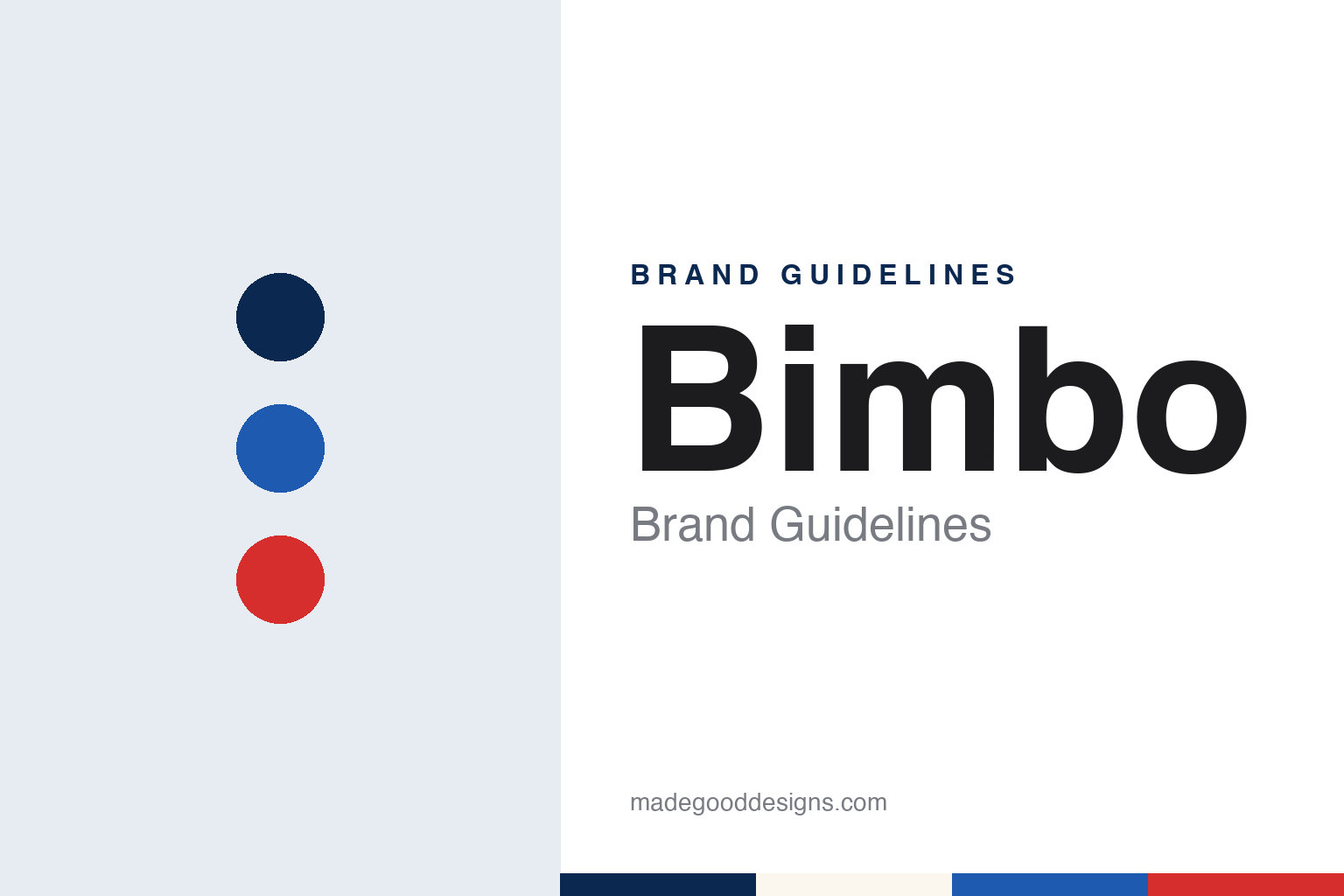
Bimbo Brand Guidelines
The Mexico City bakery and its bear, from cellophane bread to Sara Lee.
Aa
Two constants: a bakery blue, apron red and crumb white palette and a rounded friendly sans register. Abstract homage — not a Bimbo product or mark; no pack, logo or mascot is reproduced.
Panificación Bimbo
A pastry-shop family, a wrapped loaf and a bear on a Christmas card.
Bimbo began in Mexico City on 2 December 1945, when Panificación Bimbo, S.A. started baking with 34 employees. Its first products were white loaves in large and small sizes, rye bread and toast bread, wrapped in cellophane; Grupo Bimbo’s own history calls the wrapped “Super-Pan Bimbo” an innovation in the Mexico City market.
The bakery came out of a family business. Spanish Wikipedia says Lorenzo Servitje Sendra, born in Mexico City in 1918 to Catalan parents, had run sales and then management at El Molino, the pastry shop his father Juan Servitje opened in the late 1920s, and conceived a bakery of his own in 1944 with his uncle Jaime Sendra Grimau, who ran El Molino’s production. English Wikipedia lists the partners who started Bimbo as Lorenzo Servitje, José T. Mata, Jaime Sendra Grimau, Jaime Jorba Sendra and Alfonso Velasco; Spanish Wikipedia also names Lorenzo’s brother, Roberto Servitje. Lorenzo Servitje led the group from 1963 to 1993, Spanish Wikipedia says.
The name was chosen over candidates including PanRex, Sabrosoy, Pan Lirio and Pan Azteca. English Wikipedia’s article on Grupo Bimbo says it combined the Disney films Bambi and Dumbo, favourites of Servitje’s daughter Marinela; its article on Bimbo Bakeries USA gives the blend as “bingo” and “Bambi.” Both agree it was meant to sound childlike.
The mascot arrived the same year. Grupo Bimbo says the Osito Bimbo began as a bear cub that Jaime Jorba drew for a Christmas card; his wife, Anita Mata, added the baker’s hat, the apron and the loaf under the bear’s arm, and Alfonso Velasco adjusted its nose. Spanish Wikipedia adds that the early company advertised on radio with sung slogans and published comic strips starring the bear.
Colour
Gansito, Marinela, Barcel and a market listing.
Bimbo grew out from the capital quickly. By 1948 it made nine products, and in 1949 it opened its first branch outside Mexico City, in Puebla. In the 1950s a loudspeaker delivery truck known as “the 38” promoted the bread on the street, and the range widened to doughnuts and to buns for hamburgers and hot dogs, sold as Bimbollos and Medias Noches. A plant in western Mexico, Bimbo de Occidente, opened in 1956 under Roberto Servitje, and in 1958 the company launched Gansito, a chocolate-covered snack cake filled with strawberry jelly and cream. The company dates its sweet-cake brand Marinela to the same decade.
The 1960s brought Monterrey and a first corporate reorganisation in 1963; in 1964 Bimbo acquired the Mexican rights to Sunbeam, the bread brand of Quality Bakers of America. The salty-snack business Barcel began in 1971, and in 1972 the company opened a plant in Azcapotzalco, Mexico City, which English Wikipedia describes as the largest in Latin America and one of the ten largest in the world at the time. The sweets brand Ricolino followed in 1978.
In the 1980s the company listed 15% of its shares on the Mexican Stock Exchange, and in 1984 it began exporting to the United States. A plant in Guatemala, finished in 1990, started a Central American business, and Argentina followed in the 1990s. Daniel Servitje became chief executive in 1997 and has been chairman since 2013.
The Bimbo family of brands kept changing in Mexico too. Grupo Bimbo bought chocolate maker Chocolates La Corona and the El Globo pastry shops in 2005, and in 2022 sold Ricolino to Mondelēz International for about US$1.3 billion, a sale completed that November, English Wikipedia says.
Typography
Design and documentation.
The seven brands in this group are all food brands, and all of them come from Mexico and the United States: Goya, Herdez, Bimbo, Maseca, Jumex, Sabritas and Gamesa. Food brands in general sit at many different points in the trade, from family firms that still carry a founder’s surname to names that now belong to much larger food groups, and a single brand can be sold everywhere from a corner shop to a supermarket shelf.
A food brand’s identity is usually carried less by a single product than by a pack, a name and the meal or snack it promises, because the company behind the name may have changed hands, moved its factory or grown far beyond the town where it started. That makes the questions behind each name worth asking plainly: who started it, who owns it now, and where its food is actually made and packed.
Each guide separates what independent sources record from what the company says about itself — its founding story, its owners over time, where its food is made and how its packaging has changed — and marks plainly what rests only on the company’s own word.
Aa
A rounded friendly sans for a bakery fronted by a bear in a baker’s hat. (Specimen set in Nunito, a sans STAND-IN; NOT the Bimbo logo.)
Grupo Bimbo
Tortillas, Weston, Sara Lee and Canada Bread.
Bimbo’s move into the United States began with tortillas. English Wikipedia says the group bought La Hacienda, a California tortilla maker, in 1994, entered the US bread market with Pacific Pride Bakeries of San Diego in 1997, and in 1998 bought Mrs Baird’s Bakeries of Texas, then the country’s largest family-owned bakery; the combined business was renamed Bimbo Bakeries USA, now based in Irving, Texas.
The big purchases came from other bakers. In 2002 Bimbo Bakeries USA bought the western US baking business of George Weston Ltd., with Oroweat, Entenmann’s, Thomas’ and Boboli, and in 2008–09 Grupo Bimbo bought the rest of Weston’s US fresh bakery business, including Arnold, Freihofer’s and Stroehmann. In 2011 it completed the purchase of Sara Lee’s North American fresh bakery business, which English Wikipedia calls its largest acquisition to date and says doubled the US company in size. Grupo Bimbo’s timeline adds Fargo in Argentina and Bimbo Iberia the same year, Canada Bread in 2014, Vachon in Canada in 2015, the foodservice baker East Balt in 2017, and the Manchester bakery St Pierre in 2022.
Bimbo is now a brand within a much larger group. English Wikipedia counts more than 100 brands, 196 bakery plants and operations in 33 countries, and says Grupo Bimbo is considered the world’s largest bakery, a title it notes some sources give to Japan’s Yamazaki; the company itself says it is the world’s largest baking company.
For a design guide, Bimbo shows how a single mascot drawn for a Christmas card can carry a bread brand across eight decades and many countries. Compare it with Maseca, another Mexican staple that became a multinational, and Pepperidge Farm, an American sliced-bread name. For this guide we use bakery blue, apron red and crumb white with a rounded sans, an unofficial interpretation; no product or logo is reproduced.
Explore & save
Keep Bimbo’s identity on hand — save it to a board in the Made Good inspiration library.
Bimbo identity set
Pin the Bimbo bakery blue, apron red and crumb white palette and the rounded friendly sans register to your own board.