Maseca Brand Guidelines
Gruma’s “dry dough” corn flour from Cerralvo, Nuevo León.
Aa
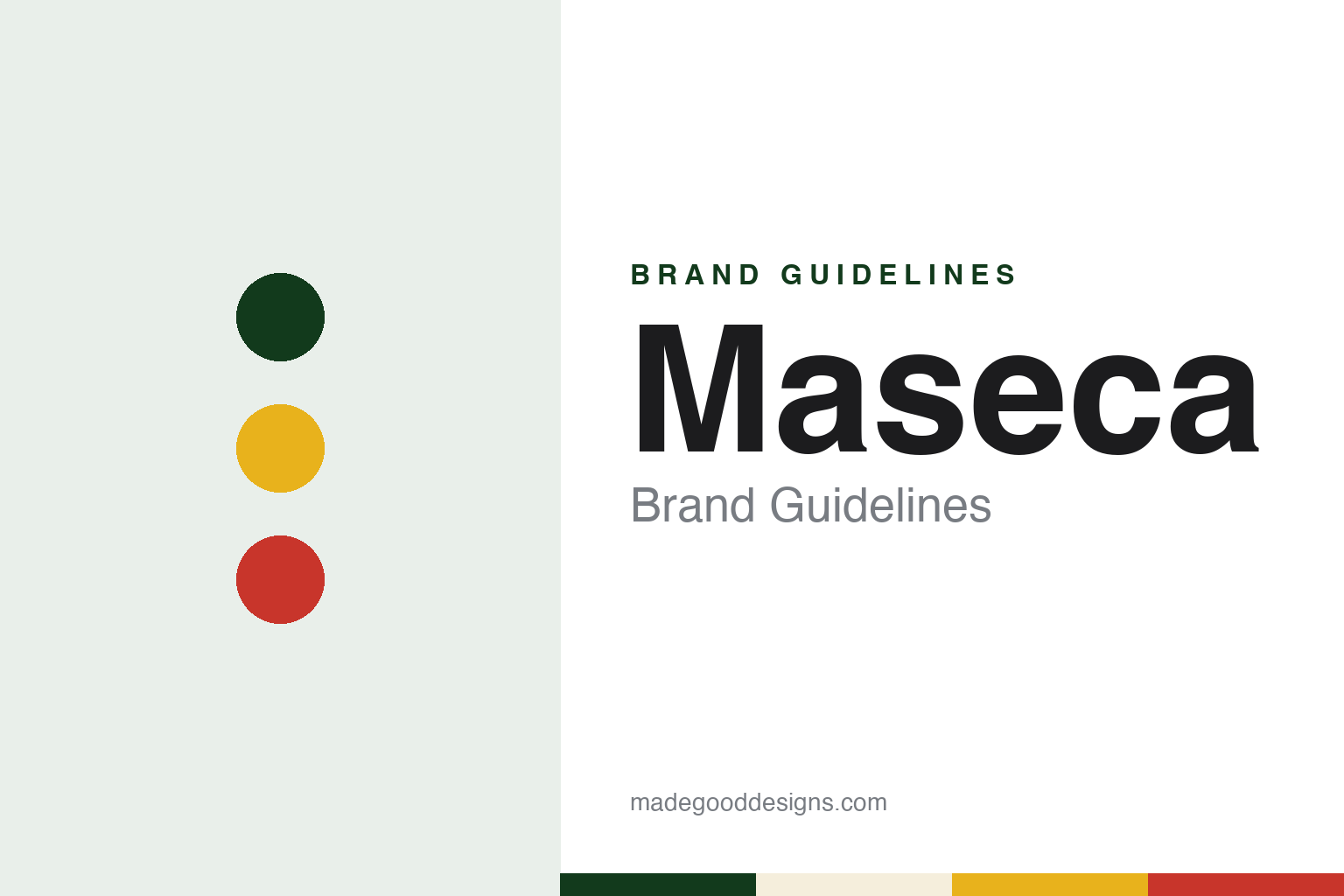
Two constants: a maize yellow, husk green and masa cream palette and a sturdy grotesque register. Abstract homage — not a Maseca product or mark; no bag, logo or tortilla is reproduced.
Masa seca
A rustic mill in Reynosa, a father and son, and a word game.
Maseca is a corn flour, but not an ordinary one. It is made from nixtamalised maize — corn cooked and then steeped in water with lime, a process whose name, Spanish Wikipedia says, comes from the Nahuatl words for ash and maize dough — which is then dried and milled. Add water and the flour becomes masa again, ready to press into tortillas, sopes or tostadas. Its maker, Gruma, says the name comes from “masa seca,” dry dough, and that it was coined by Roberto González Barrera.
The business started in Cerralvo, a small town in Nuevo León, in northern Mexico. Gruma’s own history tells it as a discovery: on a trip to Reynosa, Tamaulipas, the young González Barrera found a rustic machine that ground dry nixtamal and produced 18 tonnes of tortilla flour a month, and took the idea to his father, Roberto M. González Gutiérrez, whom the company describes as an engineer and a natural researcher. Spanish Wikipedia also credits an engineer, Manuel Rubio Portilla. English Wikipedia’s biography of González Barrera says father and son bought their first corn mill in 1948, selling their other businesses to do it, and set it up in Cerralvo.
The company was founded in 1949 under the name Molinos Azteca, S.A. de C.V., both English and Spanish Wikipedia say, and was later known as Grupo Maseca before becoming Gruma. Gruma calls its Cerralvo mill the world’s first plant producing nixtamalised corn flour, and English Wikipedia repeats the claim. The point of the product, Spanish Wikipedia explains, was to solve a practical problem: fresh nixtamal dough spoils quickly, while the dried flour keeps far longer.
González Barrera, born in Cerralvo in 1930, led the group as chairman. English Wikipedia says he was nicknamed “El Maseco” and the “King of Tortillas,” and that from 1992 he was also the main shareholder of the bank Banorte.
Colour
Acaponeta, Costa Rica and Mission Foods.
The Maseca brand came in the 1950s, Spanish Wikipedia says, along with a second plant at Acaponeta, Nayarit, built to persuade tortilla makers and distributors to treat the flour as a raw material. Seven more mills opened across Mexico in the 1960s. Today Grupo Industrial Maseca, known as GIMSA, the Gruma subsidiary that makes the flour in Mexico, has plants in 15 states, from Sonora and Chihuahua to Yucatán and Chiapas, English Wikipedia says.
The company went abroad early. English Wikipedia says the government of Costa Rica invited it to invest there in 1973, and Gruma says Maseca has been sold in Central America since 1987, first in Costa Rica and then in Honduras, El Salvador, Guatemala and Nicaragua. In 1977 the group set up a subsidiary in California to make and sell tortillas under the name Mission Foods; a tortilla plant in Dallas followed in 1982, and in Texas the same year it opened what English Wikipedia calls the first nixtamalised corn flour plant in the United States. In the 1980s Gruma also bought Guerrero, a Southern California tortilla brand, Spanish Wikipedia says.
Gruma says Maseca has been on sale in the United States for more than 40 years, and that in Europe, Africa and the Middle East the brand also sells corn grits to makers of snacks, cereals and beer. Mission became the group’s other global brand, with tortilla and wrap plants in Coventry, England, from 2000 and in Shanghai from 2006, and Mission Foods is now headquartered in Irving, Texas. Gruma lists 72 plants in all, including 25 in Mexico and 26 in the United States.
Typography
Design and documentation.
The seven brands in this group are all food brands, and all of them come from Mexico and the United States: Goya, Herdez, Bimbo, Maseca, Jumex, Sabritas and Gamesa. Food brands in general sit at many different points in the trade, from family firms that still carry a founder’s surname to names that now belong to much larger food groups, and a single brand can be sold everywhere from a corner shop to a supermarket shelf.
A food brand’s identity is usually carried less by a single product than by a pack, a name and the meal or snack it promises, because the company behind the name may have changed hands, moved its factory or grown far beyond the town where it started. That makes the questions behind each name worth asking plainly: who started it, who owns it now, and where its food is actually made and packed.
Each guide separates what independent sources record from what the company says about itself — its founding story, its owners over time, where its food is made and how its packaging has changed — and marks plainly what rests only on the company’s own word.
Aa
A sturdy grotesque for a staple sold by the sack. (Specimen set in Archivo, a sans STAND-IN; NOT the Maseca logo.)
Gruma
A family-led company listed in Mexico.
Maseca belongs to Gruma, S.A.B. de C.V., which is based in San Pedro Garza García, near Monterrey, and has been listed on the Mexican Stock Exchange since 1994; English Wikipedia says it also had a New York Stock Exchange listing through American depositary receipts from 1998 to September 2015. The company describes itself as the world’s largest maker of corn flour and tortillas, and its global brands are Maseca and Mission, with local names such as Guerrero in the United States and Tortiricas and Tosty in Costa Rica.
The founding family still leads it. In 2012 Juan González Moreno became chairman, Spanish Wikipedia says, and that year Gruma bought back the stake held by the US agribusiness Archer Daniels Midland for US$450 million; English Wikipedia says ADM had held 23% of the company. In 2014 Gruma sold its Mexican wheat-flour business to Grupo Trimex. The tortilla machinery it designs and builds through its subsidiary Tecnomaíz is sold under names including Tortec.
Maseca is an ingredient rather than a finished food. Spanish Wikipedia says it is commonly used to make tortillas at home, and Gruma says that in the United States it leads the corn-flour business in both the industrial channel, selling to tortilla makers, and the supermarket channel, where it speaks to Hispanic shoppers.
For a design guide, Maseca shows how a coined word that explains the product — dry dough — can carry a staple from one town in Nuevo León to more than 100 countries. Compare it with Bimbo, Mexico’s other staple-food multinational, and Old El Paso, a US-born name for Mexican-style food. For this guide we use maize yellow, husk green and masa cream with a sturdy sans, an unofficial interpretation; no product or logo is reproduced.
Explore & save
Keep Maseca’s identity on hand — save it to a board in the Made Good inspiration library.
Maseca identity set
Pin the Maseca maize yellow, husk green and masa cream palette and the sturdy grotesque register to your own board.