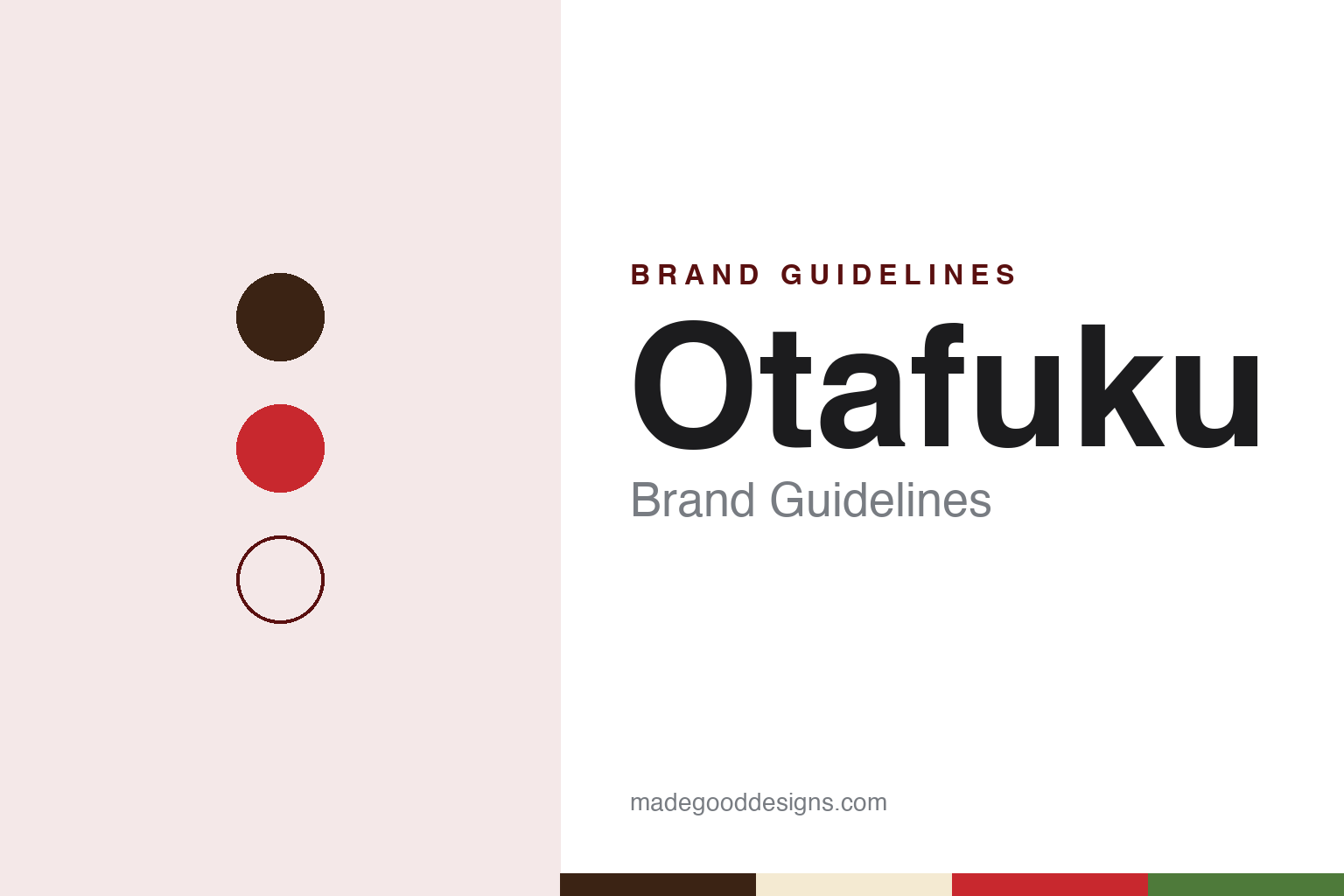
Otafuku Brand Guidelines
Hiroshima’s okonomi sauce and the smiling face of fortune.
Aa
Two constants: a sauce brown, lantern red and rice cream palette and a rounded friendly sans register. Abstract homage — not an Otafuku product or mark; no bottle, face or logo is reproduced.
Sasaki Shoten
A Hiroshima shop, a vinegar and a city rebuilt.
Otafuku began in Hiroshima in November 1922. That month, the company says, Sasaki Seiichi opened Sasaki Shoten in the city’s Yokogawa district, a business that wholesaled soy sauce and sold sake. The firm moved into making its own products in 1938, when it began brewing vinegar and gave it the brand name Otafuku-su, or Otafuku vinegar. The company says the name carries its founder’s wish to “spread good fortune to many people.”
The war nearly ended the business. In 1945 the atomic bombing of Hiroshima burned the premises to the ground, the company says, and in 1946 it restarted vinegar brewing in a sake brewery it rented at Nagatsuka, in the city’s Gion district. Sauce came next: according to the company it began making sauce in 1949 and selling it in 1950, while Japanese Wikipedia gives 1950 for the start of both.
The product that made the name came in 1952. That year the company moved its works to Oshiba in Hiroshima, incorporated as Otafuku Zosu (Otafuku Vinegar Brewing), and launched a sauce made “for okonomiyaki,” the savoury griddle pancake. Japanese Wikipedia says the thick, sweet okonomi sauce was first sold to the trade and mainly in western Japan before it became known across the country and abroad. Its first product for home kitchens, Otafuku Okonomi Sauce, followed in 1957, the company says, then a yakisoba sauce in 1960 and a takoyaki sauce in 1964. In 1975 the company took the name Otafuku Sauce, and in 1978 it moved its head office and main factory to the Shoko Center district in Hiroshima’s Nishi ward, where both remain.
Colour
A smiling face, a hidden date and a squeezable bottle.
The brand takes its name and its face from Otafuku, the round-cheeked, smiling woman of Japanese folk tradition. The company reads that face feature by feature: narrow eyes that never stop smiling, a low nose for humility, a small mouth that avoids idle talk, large ears that listen, full cheeks for good health and a broad forehead for wisdom, which together, it says, express beauty of heart. It adds that it chose the name in the hope of being loved for a long time by people who know life’s sweet and bitter sides, as a sauce brings together the basic tastes. In 2018, the company says, it changed its logo to Latin-alphabet lettering, spelling the name “Otafuku” as it set its sights on markets abroad.
One ingredient became part of the brand story. Okonomi sauce was first sweetened with sugar, but from 1975, when sugar prices rose, Otafuku began using dates instead, and it kept them for depth of flavour after sugar became cheaper again, the business site SankeiBiz reported in 2020. The company set up a dedicated dates department in 2019 and in March 2020 launched dried dates as a product of their own.
Packaging changed with the kitchen. In 1978, the company says, it was the first in its industry to put sauce in paper cartons, and in 1982 it adopted the Fuku Bottle, a 500-gram resin bottle it describes as designed to protect quality and be easy to use.
Much of Otafuku’s communication is about okonomiyaki itself. It opened an okonomiyaki training centre in Tokyo in 1987 to support restaurants, and Japanese Wikipedia lists such centres in seven cities from Tokyo to Fukuoka. In 1998 it formed an Okonomiyaki Section, and from 2006 it has run an in-house qualification with three grades, from instructor to meister, for which staff sit written and practical tests. In June 2008 it opened Wood Egg Okonomiyaki-kan, a museum of okonomiyaki culture and history in Hiroshima’s Nishi ward, and in October 2018 the cooking studio OKOSTA at Hiroshima Station, the trade paper Shokuhin Sangyo Shimbun reported. During the G7 summit in Hiroshima in May 2023, the British prime minister Rishi Sunak made okonomiyaki at OKOSTA, the Chugoku Shimbun reported.
Typography
Design and documentation.
The seven brands in this group all make condiments and seasonings, and all of them come from Japan: Mizkan, Ajinomoto, S&B, Kagome, Otafuku, Bull-Dog and Yamasa. Japanese condiment and seasoning brands in general sit at many different points in the trade, from family firms that still carry a founder’s name to companies that have grown into much larger food groups, and a single brand can be sold everywhere from a neighbourhood shop to a restaurant kitchen.
A condiment brand’s identity is usually carried less by a single product than by a bottle, a label, a name and the dish it promises, because the company behind the name may have changed hands, moved its production or grown far beyond the town where it started. That makes the questions behind each name worth asking plainly: who started it, who owns it now, and where its products are actually made and bottled.
Each guide separates what independent sources record from what the company says about itself — its founding story, its owners over time, where its products are made and how its packaging has changed — and marks plainly what rests only on the company’s own word.
Aa
A rounded friendly sans for a brand named after a smiling face. (Specimen set in M PLUS Rounded 1c, a sans STAND-IN; NOT the Otafuku logo.)
Otafuku
A family group, a charter and factories on three continents.
Otafuku has never been listed on a stock exchange. Japanese Wikipedia describes it as a business run by the Sasaki family since its founding, with eight cousins of the third generation in its management. In 2015 the family wrote down its rules in a family charter, Forbes Japan reported: shares are held equally by eight branches of the family and may not be sold outside it, only one member of each branch may join the company, family members retire from executive roles at 65, and more than half of each operating company’s board must come from outside the family.
The corporate structure has been reshaped around the sauce business. The vinegar operation was spun off in 1999 as Otafuku Jozo, and in October 2009 the old Otafuku Sauce company became a holding company, with a newly created Otafuku Sauce Co., Ltd. taking over the sauce business; the holding company took its current name, Otafuku Holdings, in 2014. In 2005 Otafuku took a 51% stake in Union Sauce, a seasoning maker based in the Kanto region, Japanese Wikipedia says, and it merged that company into Otafuku Sauce in April 2021, the trade paper Shokuhin Shimbun reported; Union Sauce’s plant became the Otafuku Nikko factory. In October 2021 the group acquired Nakagawa, a maker of tenkasu, the crisp batter bits used in okonomiyaki.
The company says the group runs seven production sites. In Japan they are the head-office factory in Hiroshima, the Nikko factory in Tochigi, a vinegar brewery at Daiwa in Mihara and Nakagawa’s works in Omura, Nagasaki. Abroad, Otafuku Foods, set up in 1998, opened a factory in the Los Angeles area in 2013, the same year a factory in Qingdao, China, began production; a factory in Malaysia, run by a joint venture formed in 2016, makes halal-certified sauces for export. Branches followed in Taipei in 2018 and Paris in 2024. The company marked its centenary in 2022.
For a design guide, Otafuku shows how a folk face, a single regional dish and a bottle designed for home cooks can carry a sauce from Hiroshima to the world. Compare Bull-Dog, the Tokyo sauce maker, and Kikkoman, the soy sauce brand. For this guide we use sauce brown, a lantern red and a rice cream with a rounded sans, an unofficial interpretation; no product or logo is reproduced.
Explore & save
Keep Otafuku’s identity on hand — save it to a board in the Made Good inspiration library.
Otafuku identity set
Pin the Otafuku sauce brown, lantern red and rice cream palette and the rounded friendly sans register to your own board.