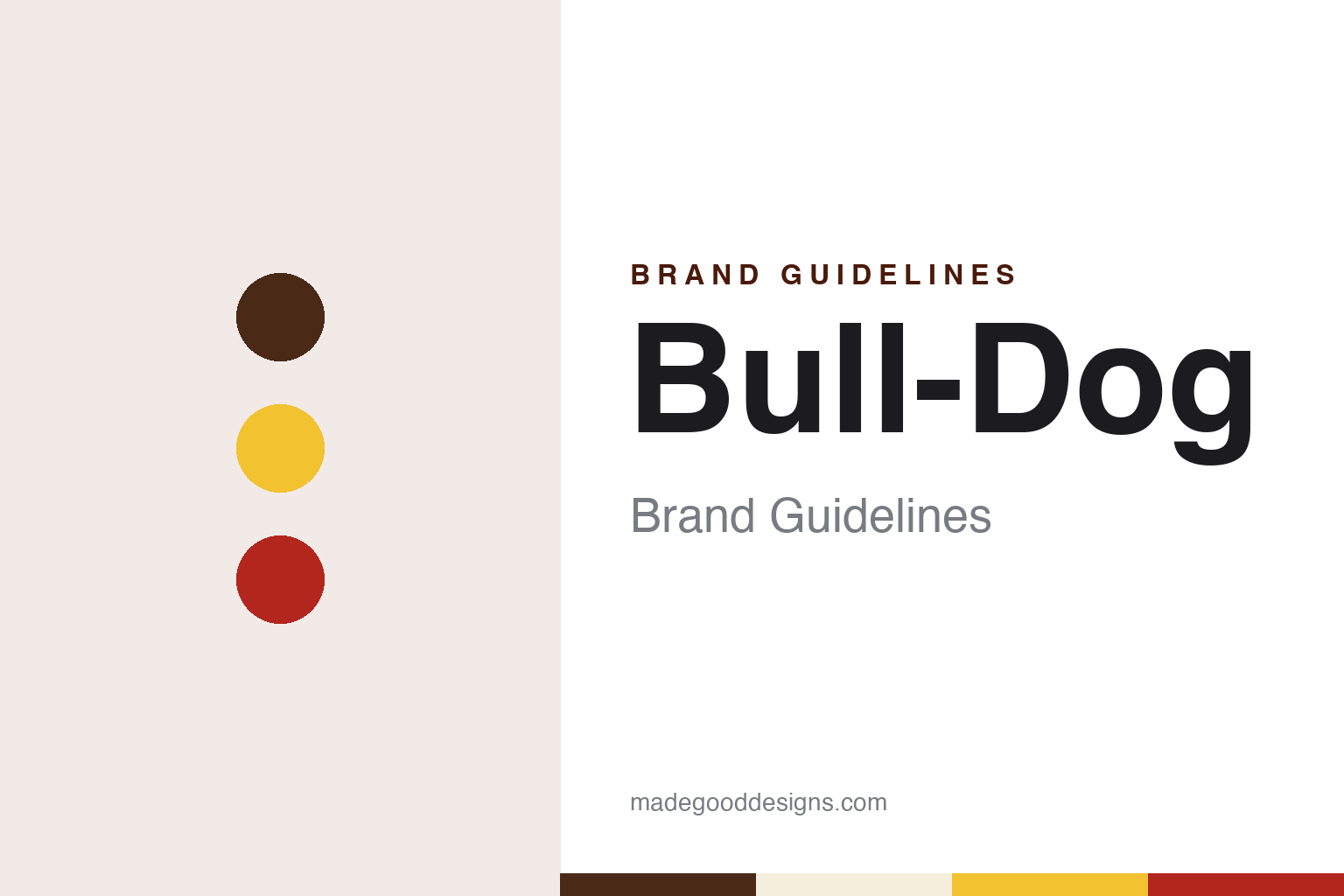
Bull-Dog Brand Guidelines
The Tokyo sauce maker with a bulldog on the label.
Aa
Two constants: a Worcester brown, label yellow and bulldog red palette and a sturdy slab serif register. Abstract homage — not a Bull-Dog product or mark; no bottle, dog or logo is reproduced.
Misawaya Shoten
A Tokyo wholesaler, a private label and a popular pet.
Bull-Dog began in Tokyo in 1902 as Misawaya Shoten, a food wholesaler, the company says; Japanese Wikipedia names its founder as Kojima Nakasaburo. In 1905 it began making and selling sauce. Its first sauces did not carry its own name. The company says that in the Meiji and Taisho eras it made Niko Sauce, a label commissioned by wholesalers that today would be called a private brand, with the lettering written from right to left.
The bulldog arrived in the 1920s. By the end of the Taisho era, the company says, its labels already carried a bulldog mark, even though the company was still called Misawaya Shoten. It explains the choice twice over: in Britain, where sauce came from, the bulldog was a much-loved national symbol, and in Japan the breed had become a fashionable pet, so the company hoped its sauce would be loved as widely as the dog. In Japanese the name is written “Burudokku” rather than the expected “Burudoggu”; according to a 2014 report on News Post Seven, the founder chose it to avoid a run of voiced consonants.
On 21 September 1926 the company was incorporated in Tokyo as Bull-Dog Sauce Shokuhin. It moved its head office to Nihonbashi Kabutocho, in 1934 and built a factory at Hatogaya in Saitama in 1935. Until about 1955, the company says, it also made vinegar, ketchup, pepper, mustard and curry powder. It became Bull-Dog Shokuhin in 1940, but in March 1944, with foreign words banned in wartime, it was renamed Misawa Kogyo; it took back the Bull-Dog name in December 1945 and became Bull-Dog Sauce Co., Ltd. in 1962.
Colour
A mark refined decade by decade, and a sauce for every dish.
Bull-Dog publishes its own history of its labels, and it reads like a short course in brand consolidation. Japanese Wikipedia says the Bull-Dog Sauce name was registered as a trademark in 1949. On the company’s account, labels from around 1950 show a more refined bulldog mark, with the character for “brand” in “Bull-Dog brand sauce” printed noticeably smaller. By 1957 and 1958 that character had disappeared altogether, which the company reads as a sign that the Bull-Dog Sauce name had become firmly established, and a chef illustration appeared on its labels. By the late 1960s, it says, the design and colours were already close to those of recent years.
The range grew around the Japanese table. Japanese Wikipedia dates the launch of Boa Sauce, the forerunner of today’s tonkatsu sauce, to 1949, and says Bull-Dog’s chuno sauce — the name means “medium-thick” — followed in 1966; Kikkoman had launched a chuno sauce two years earlier. Chuno has become Bull-Dog’s main product, Japanese Wikipedia says, and in September 2026 the company released a commemorative product for chuno’s 60th anniversary. In 1969 the company changed its bottles from glass to PVC, according to a 2011 article in the online magazine Dream Mail, and in September 2023 it carried out what it calls a major renewal of the containers for its three core sauces, Worcester, chuno and tonkatsu. In February 2018 it launched a separate brand, &Bull-Dog, for dressings and tare sauces.
Japanese Wikipedia lists past advertising faces including the cookery writer Harumi Kurihara and the singer Iyo Matsumoto, and notes that Bakabon’s Mama, from the cartoon Tensai Bakabon, fronted a Tokyo okonomiyaki sauce. The company is credited for its cooperation on the 1976 film Tora-san’s Sunrise and Sunset, in which its sauce appears.
Typography
Design and documentation.
The seven brands in this group all make condiments and seasonings, and all of them come from Japan: Mizkan, Ajinomoto, S&B, Kagome, Otafuku, Bull-Dog and Yamasa. Japanese condiment and seasoning brands in general sit at many different points in the trade, from family firms that still carry a founder’s name to companies that have grown into much larger food groups, and a single brand can be sold everywhere from a neighbourhood shop to a restaurant kitchen.
A condiment brand’s identity is usually carried less by a single product than by a bottle, a label, a name and the dish it promises, because the company behind the name may have changed hands, moved its production or grown far beyond the town where it started. That makes the questions behind each name worth asking plainly: who started it, who owns it now, and where its products are actually made and bottled.
Each guide separates what independent sources record from what the company says about itself — its founding story, its owners over time, where its products are made and how its packaging has changed — and marks plainly what rests only on the company’s own word.
Aa
A sturdy slab serif for a sauce named after a sturdy dog. (Specimen set in Zilla Slab, a slab-serif STAND-IN; NOT the Bull-Dog logo.)
Bull-Dog
A listed company, a landmark takeover case and a factory in Gunma.
Bull-Dog listed its shares on the second section of the Tokyo Stock Exchange in May 1973, moved to the first section in January 2021 and to the Prime market in April 2022, the company says. Japanese Wikipedia, citing the company’s securities report, lists the Kowa group as its largest shareholder, with 5.3% in March 2021.
That open register made Bull-Dog the subject of one of Japan’s best-known corporate cases. On 18 May 2007 a fund affiliated with the American investment firm Steel Partners launched a tender offer for all of Bull-Dog’s shares. Bull-Dog’s board opposed the bid on 7 June and proposed a defence: every shareholder would receive three stock-acquisition rights per share, but the Steel Partners group could not exercise its rights and would be paid cash for them instead, cutting its stake. Shareholders approved the plan on 24 June with about 88.7% of the votes present. Steel Partners sought an injunction; the Tokyo District Court rejected it on 28 June and the Tokyo High Court on 9 July, and on 7 August 2007 the Supreme Court’s Second Petty Bench unanimously upheld those decisions, finding that the measure did not breach the principle of shareholder equality. Japanese Wikipedia calls it the first use of a “poison pill” takeover defence in Japan.
Bull-Dog has grown by buying regional sauce makers. In November 2005 a subsidiary took over the business of Ikari Sauce, then under corporate rehabilitation; the Fuji Sankei Business i newspaper reported in 2005 that the deal was meant to expand Bull-Dog’s sales in the Kansai region, where its name and market share were weaker. In October 2019 it bought Sun Foods, the Hiroshima maker of Mitsuwa Sauce. It set up companies in Beijing in 2009 and Shanghai in 2019.
Production has moved to Gunma. Bull-Dog opened a factory at Tatebayashi in 1998, completed a development facility there, the Tatebayashi Creation Center, in December 2023, and ended production at its original Hatogaya factory in September 2023, selling the site in May 2025, the company says. Its head office remains in Nihonbashi Kabutocho.
For a design guide, Bull-Dog shows how a borrowed British symbol and a label trimmed decade by decade can make a Western sauce feel native. Compare Lea & Perrins, the original Worcestershire sauce, and Otafuku, the Hiroshima okonomi sauce maker. For this guide we use Worcester brown, a label yellow and a bulldog red with a slab serif, an unofficial interpretation; no product or logo is reproduced.
Explore & save
Keep Bull-Dog’s identity on hand — save it to a board in the Made Good inspiration library.
Bull-Dog identity set
Pin the Bull-Dog Worcester brown, label yellow and bulldog red palette and the sturdy slab serif register to your own board.