Mang Tomas Brand Guidelines
The lechon sauce that became an all-around sarsa.
Aa
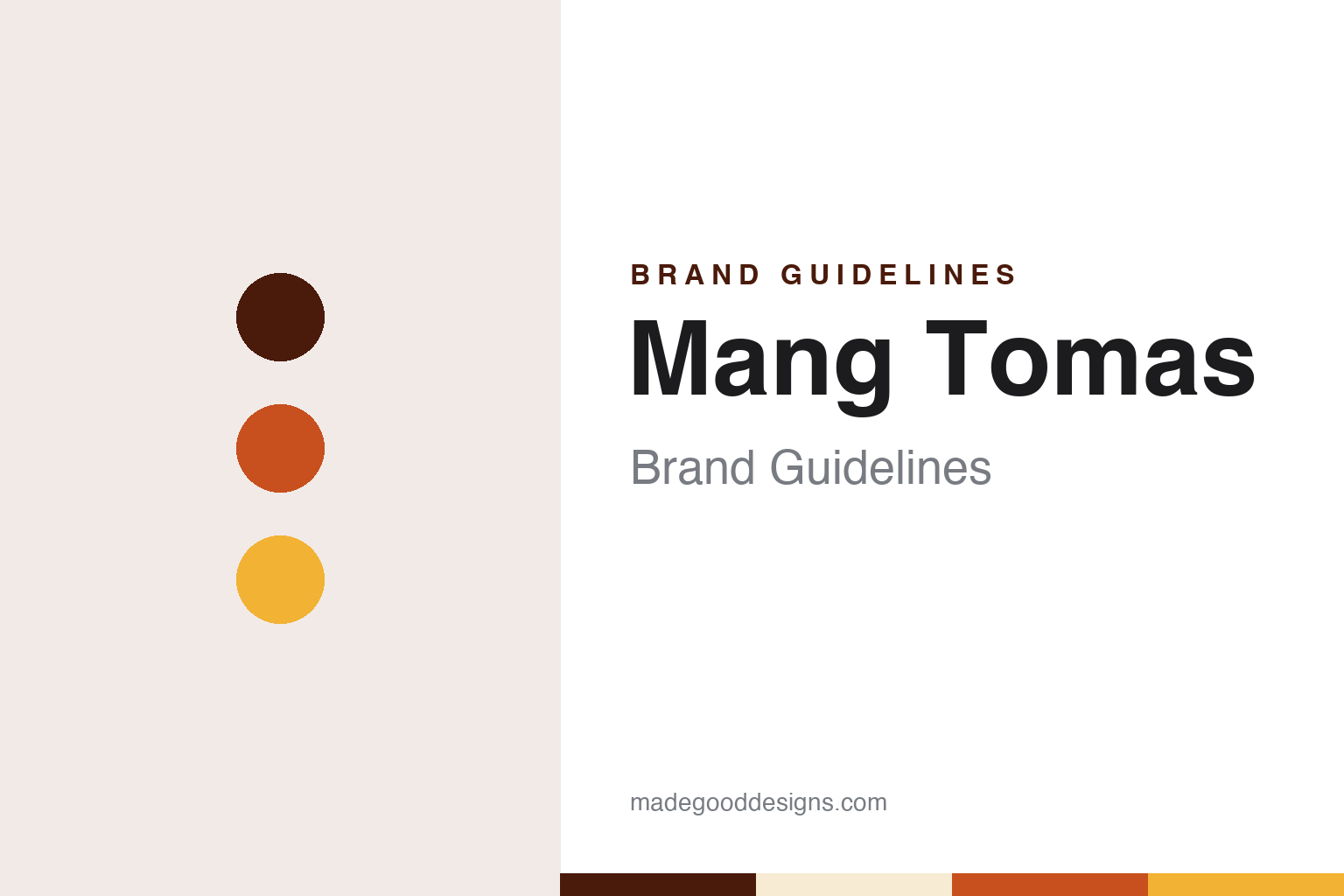
Two constants: a roast brown, chili red and golden amber palette and a bold slab serif register. Abstract homage — not a Mang Tomas product or mark; no bottle, label or logo is reproduced.
A lechon stall
A sauce made for roast pig, from a stall in Manila.
Mang Tomas began as a sauce for one dish. NutriAsia, the Filipino condiment company that owns the brand today, says it was created in the late ’80s at a small lechon stall in Manila “as a sauce specifically for lechon,” the whole roast pig served at Filipino feasts. English Wikipedia gives the brand’s introduction as 1986, so the two accounts agree on the decade if not on the exact year.
English Wikipedia also gives a fuller origin story. It credits Hernan and Ismael Reyes with developing the product, says they bought the lechon-sauce recipe of the Aling Pitang lechon shop in Quiapo, Manila, and says the brand was named after a well-known lechon shop in La Loma. The same encyclopedia credits Hernan and Ismael Reyes with introducing Datu Puti vinegar in 1975. The name itself is a familiar Filipino form of address: “Mang” is the respectful title for an older man, so the brand reads as “Mister Tomas.”
The family of brands soon became part of something larger. NutriAsia’s own heritage page says the company started out as Enriton Natural Foods, with a single regional condiment brand, Nelicom, and then bought the Jufran and Mafran sauces. It next formed a joint venture with Acres & Acres, the maker of Datu Puti vinegar, Papa banana catsup and Mang Tomas, and the combined business was named Southeast Asia Food, Inc., or SAFI. NutriAsia dates that step to 1991, and English Wikipedia records SAFI as the owner of Mang Tomas from 1991.
Colour
From SAFI to NutriAsia.
Under SAFI the sauce became one brand among many. NutriAsia’s timeline says SAFI bought Amihan, a regional vinegar and sauce brand, in 1994, and set up First Sheridan as its distribution affiliate. In 1996 it acquired UFC, the banana-catsup brand, and NutriAsia Inc. was founded as the holding company that bought it. Between 1998 and 2000, the company says, SAFI cut its factory sites from fifteen to five, and in 2000 it entered a joint venture with its first foreign partner, H. J. Heinz of the United States.
English Wikipedia names Joselito D. Campos Jr., the eldest son of Unilab founder José Yao Campos, as NutriAsia’s founder, and records the ownership of Mang Tomas passing from SAFI to NutriAsia in 2010. The group widened further in later years: it bought the Silver Swan soy-sauce company from the Suan family in 2014, according to English Wikipedia, and in 2013 moved its head office to the JY Campos Centre in Bonifacio Global City, Taguig. Between 2001 and 2013, the company says, it also opened two new categories, cooking sauces and cooking oils.
Today Mang Tomas sits in a NutriAsia portfolio that the company lists as Datu Puti, Silver Swan, UFC, Papa, Golden Fiesta, Jufran, Locally and Mafran, alongside a separate foodservice business.
As for where it is made, NutriAsia says it consolidated and expanded its plants between 2006 and 2009 in Marilao (Bulacan), Cabuyao (Laguna), Cebu and Davao, and English Wikipedia lists the same four manufacturing sites.
Typography
Design and documentation.
The seven brands in this group are all Filipino food brands: Datu Puti, Silver Swan, Mang Tomas, Lucky Me!, Rebisco, Magnolia and Century Tuna. Food brands in the Philippines in general sit at many different points in the trade, from family firms that still carry a founder’s vision to names that now belong to much larger food groups, and a single brand can be sold everywhere from a neighbourhood sari-sari store to a supermarket shelf.
A food brand’s identity is usually carried less by a single product than by a pack, a name and the meal or snack it promises, because the company behind the name may have changed hands, moved its factory or grown far beyond the place where it started. That makes the questions behind each name worth asking plainly: who started it, who owns it now, and where its products are actually made and packed.
Each guide separates what independent sources record from what the company says about itself — its founding story, its owners over time, where its products are made and how its packaging has changed — and marks plainly what rests only on the company’s own word.
Aa
A bold slab serif for a sauce with a street-stall story. (Specimen set in Alfa Slab One, a slab-serif STAND-IN; NOT the Mang Tomas logo.)
Mang Tomas
From lechon sauce to all-around sarsa.
The most important change in Mang Tomas’ history is one of positioning rather than ownership. A sauce that began as a partner for lechon is now sold in the Philippines as Mang Tomas All-Around Sarsa. NutriAsia describes its taste as “distinctly sweet, salty and spicy” and suggests it with everyday dishes such as fried fish, vegetables and chicharon, the fried pork rind. The original role is not forgotten: the company’s export catalogue lists Mang Tomas as “The Philippines’ #1 Lechon Sauce,” a claim that is NutriAsia’s own.
The range is small. English Wikipedia lists three versions: the All-Around Sarsa, a Siga Hot & Spicy All-Around Sarsa and a Lechon Paksiw sauce, made for the vinegar-braised dish that Filipino cooks make from leftover lechon. Abroad, the same encyclopedia says, the product is marketed as an “All-Purpose Sauce” rather than a sarsa, and NutriAsia’s export catalogue files it under that heading, with regular and hot-and-spicy versions. English Wikipedia notes that it reaches shoppers overseas largely through Filipino retail channels, for example in the United States, and NutriAsia runs a dedicated export-operations arm that sells its condiments, table sauces and cooking sauces outside the Philippines.
Its advertising has leaned on Filipino-language lines. English Wikipedia records the taglines “Sarap espesyal araw-araw” (roughly, “special flavour every day”), “Macho Ganado” and “Sarsa ng Bayan”, “the nation’s sauce.”
For a design guide, Mang Tomas shows how a sauce made for one feast dish can widen into a national everyday condiment while keeping the friendly name of an older man behind a stall. Compare Datu Puti, the vinegar from the same family of NutriAsia brands, and Silver Swan, the soy sauce NutriAsia bought in 2014. For this guide we use roast brown, a chili red and a golden amber with a bold slab serif, an unofficial interpretation; no product or logo is reproduced.
Explore & save
Keep Mang Tomas’s identity on hand — save it to a board in the Made Good inspiration library.
Mang Tomas identity set
Pin the Mang Tomas roast brown, chili red and golden amber palette and the bold slab serif register to your own board.