Smith’s Brand Guidelines
The Sydney chip maker born of a London crisp firm.
Aa
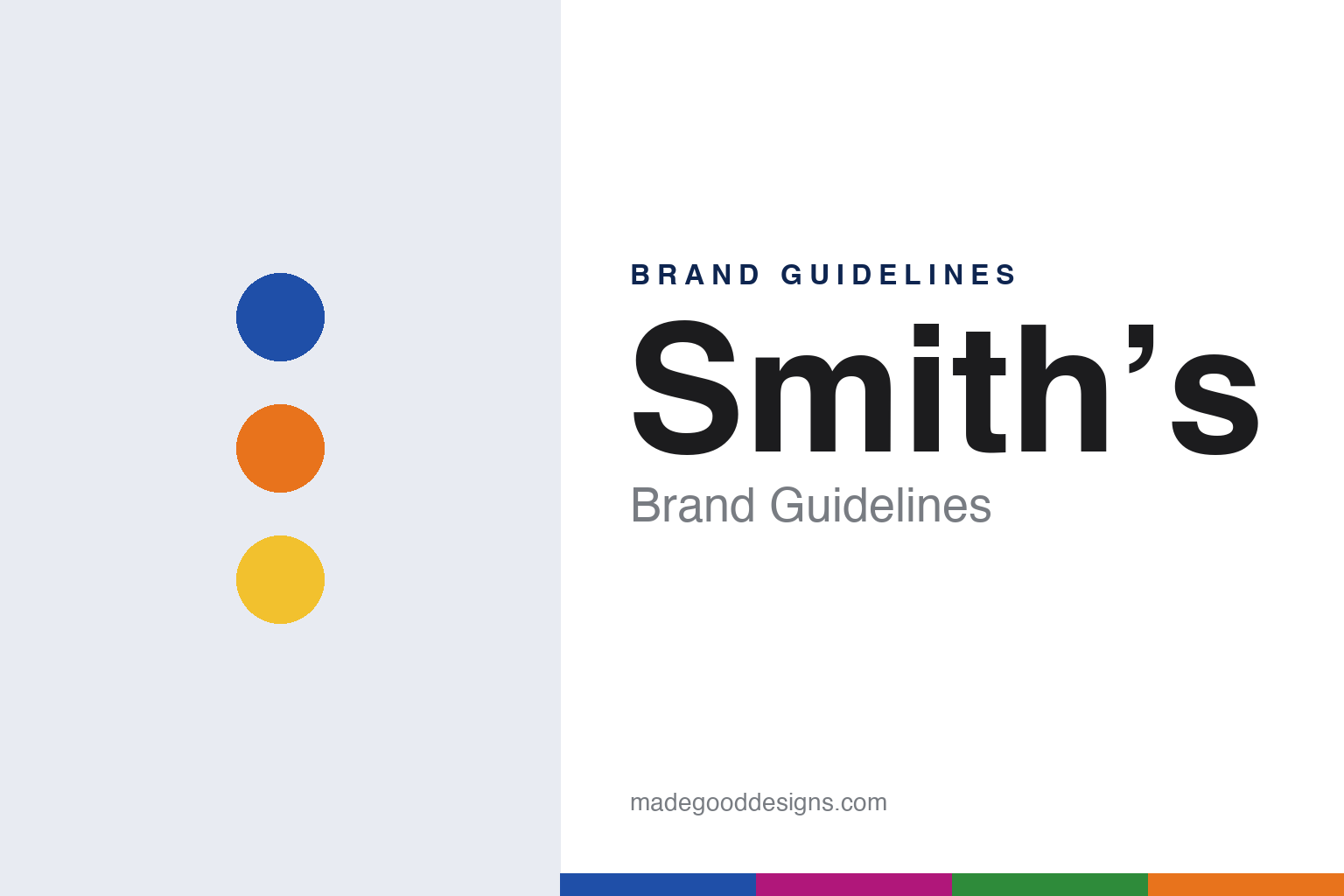
Two constants: a Smith’s flavour-coded blue, magenta, green, orange and yellow palette and a bold grotesque register. Abstract homage — not a Smith’s product or mark; no pack, logo or character is reproduced.
Surry Hills
A London crisp firm, an associate and a Depression-era rescue.
The Smith’s name came to Australia from London. English Wikipedia says the brand was founded in Britain in 1920 by Frank Smith and Jim Viney in Cricklewood, in north-west London. Smith had worked for a wholesale grocery business at Smithfield that sold potato crisps from 1913, and he turned garages into a crisp factory; by 1920, Wikipedia says, the business had twelve full-time staff and was producing half a million packets a week. Its selling point was a plain crisp packed with a small blue twist of salt, so the buyer seasoned it. Smith bought out Viney’s share and moved to a larger factory at Brentford in 1927, and the company became a private limited company in 1930. By 1934, Wikipedia says, citing British press histories, some 200 million packets of crisps were sold in Britain each year, and 95 per cent of them were made by Smith’s.
Having established the product and the name at home, Frank Smith set out to start a subsidiary in Australia. English Wikipedia says Smith’s Crisps were first made in Australia in 1931, with an associate, George Ensor, in leased premises in Surry Hills, the inner-Sydney suburb. Production was simple: the chips were cooked in twenty gas-fired pots, packed by hand and taken to shops in the vans of the confectioner Nestlé.
The timing was hard. In March 1932, in the depths of the Great Depression, Smith’s Potato Crisps Ltd went into voluntary liquidation. Three months later George Ensor tendered for the business, and on 13 May 1932 a new company, Smith’s Potato Crisps (Australia), was formed, Wikipedia says.
Colour
Flavours, colour codes and a chip-eating alien.
For its first three decades Smith’s in Australia sold plain salted chips. English Wikipedia dates the company’s first flavoured chip, chicken, to 1961. Other flavours followed, and by the 1980s each had its own pack colour, Wikipedia says: blue for Original salted, magenta for salt and vinegar, green for chicken, orange for barbecue and yellow for cheese and onion. That colour code is the source of the tones used in this guide.
The brand’s best-remembered advertising figure arrived late in that decade. English Wikipedia describes the Gobbledok as a chip-obsessed alien with a multicoloured mohawk and the catchphrase “chippie, chippie, chippie!” It was designed by the special-effects worker Warren Beaton and voiced by Dave Gibson, and it appeared in Smith’s advertising from 1987 to 1996. Smith’s brought the character back in 2021 for an advertisement marking the brand’s 90th anniversary in Australia, counted from the 1931 start in Surry Hills.
The Smith’s name now sits on several chip lines, among them Crinkle Cut, Thinly Cut and Popped, Wikipedia says. The same company also sells a wider snack range in Australia that includes Twisties, Doritos, Cheetos, Burger Rings, Grain Waves and Red Rock Deli. Twisties came to the company from the confectioner Darrell Lea, which had bought the brand from its creator, Isador Magid, in 1955, according to English Wikipedia’s Twisties article.
The name has a cousin overseas. In 1958, Wikipedia says, Frank Smith opened a branch in Broek op Langedijk in the Netherlands, where the product was sold as “Smiths Chips” because the word “crisps” was hard to pronounce in Dutch; Lay’s replaced the Smiths potato chips there in 2001, and the remaining Smiths-branded snacks in the Netherlands were renamed Lay’s or Cheetos in 2016.
Typography
Design and documentation.
The seven brands in this group all come from Australia, and between them they cover ice cream, confectionery, snacks and dairy: Peters, Streets, Allen’s, Twisties, Smith’s, Sanitarium and Pauls. Australian food brands in general sit at many different points in the trade, from names that grew out of a single local business to names that now belong to much larger food groups, and a single brand can be sold everywhere from a corner shop to a supermarket shelf.
A food brand’s identity is usually carried less by a single product than by a pack, a name and the treat or staple it promises, because the company behind the name may have changed hands, moved its factory or grown far beyond the town where it started. That makes the questions behind each name worth asking plainly: who started it, who owns it now, and where its products are actually made and packed.
Each guide separates what independent sources record from what the company says about itself — its founding story, its owners over time, where its products are made and how its packaging has changed — and marks plainly what rests only on the company’s own word.
Aa
A heavy, upright grotesque for a brand built on bold pack colours. (Specimen set in Archivo, a sans STAND-IN; NOT the Smith’s logo.)
Smith’s
Two Smith’s, one owner.
The Australian and British Smith’s went separate ways before ending up with the same owner. In Britain, where the brand is spelt Smiths, without an apostrophe, the company was bought by General Mills in 1966, sold to Associated Biscuits in 1978, and passed to Nabisco in 1982 when Nabisco bought Associated Biscuits — which put Smiths in the same group as Walkers, English Wikipedia says. PepsiCo bought the British Smiths business from the French food group BSN in 1989, The New York Times reported that July. In Britain the Smiths name now sits under Walkers, on lines such as Frazzles, Scampi Fries and Bacon Fries.
The Australian business stayed separate for longer. By 1998 it belonged to the British biscuit maker United Biscuits, which in January 1993 had also bought CCA Snackfoods, then owned by Coca-Cola Amatil, Wikipedia says. In 1998 PepsiCo bought the Smith’s Snackfood Company from United Biscuits, according to English Wikipedia’s United Biscuits article; Wikipedia’s Smith’s article says Smith’s was by then Australia’s largest producer of salty snack foods and dates the acquisition, by PepsiCo’s snack division Frito-Lay, to August 1998. The Australian Financial Review had covered the deal in November 1997 under the headline “PepsiCo munches up Smith’s.” Wikipedia’s Twisties article notes that Smith’s had originally been an Australian-owned company.
So the name Frank Smith took to Sydney in 1931 and the one he left in London are both PepsiCo brands today, but they remain different businesses with different ranges, and the Australian Smith’s keeps its apostrophe.
For a design guide, Smith’s shows how a plain family surname and a strict colour code — one pack colour for each flavour — can carry a snack brand for decades, with an advertising character doing the rest; compare Walkers, the British crisp maker that took over the UK Smiths name, and Doritos, which Smith’s sells in Australia. For this guide we use flavour-coded blue, magenta, green, orange and yellow with a bold sans, an unofficial interpretation; no product or logo is reproduced.
Explore & save
Keep Smith’s’s identity on hand — save it to a board in the Made Good inspiration library.
Smith’s identity set
Pin the Smith’s flavour-coded blue, magenta, green, orange and yellow palette and the bold grotesque register to your own board.