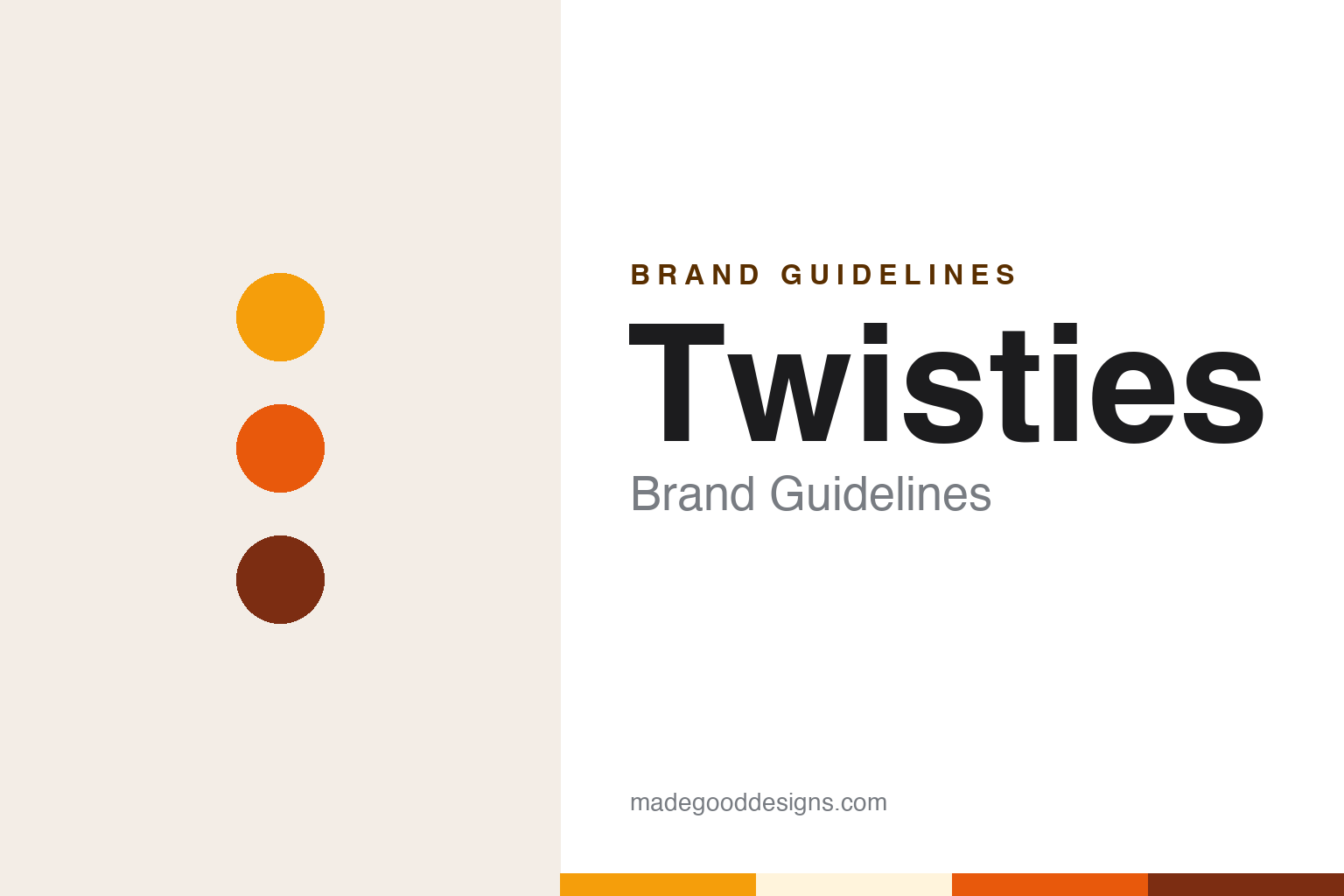
Twisties Brand Guidelines
Life’s pretty straight without them.
Aa
Two constants: a cheese orange, paprika and toast brown palette and a chunky playful sans register. Abstract homage — not a Twisties product or mark; no pack, logo or snack is reproduced.
An extruder from America
Two accounts of how the cheese snack began.
Twisties are a corn and rice snack, dusted with cheese flavouring, that has been sold in Australia since the 1950s. There are two published accounts of how it began. The Sydney Morning Herald, in a 2009 feature on how familiar foods are made, said Twisties were first made in 1950 by General Foods, and then by Smith’s from 1964; English Wikipedia gives the same 1950 launch by General Foods.
English Wikipedia’s history section tells a fuller story, citing a 1990 profile of the businessman in the magazine BRW. In the early 1950s, it says, the Melbourne businessman Isador Magid imported a rotary-head extruder from the United States which at first would not work. He brought out a technical expert from the US, took advice from the government science agency CSIRO, and began producing Twisties. The snack sold well, but large-scale distribution was hard, so in 1955 Magid sold the machine and the brand to Monty Lea of the Sydney confectioner Darrell Lea.
Monty Lea and his brother Harris experimented further with the machine, trying rice and different flavourings, the same account says. Some of the snack’s early success is credited to advertising on In Melbourne Tonight, the variety show hosted by Graham Kennedy with Bert Newton, which made Twisties one of the earliest products advertised on the program. After an unsuccessful attempt to launch the snack in Britain, and with competition for shelf space growing at home, the Lea brothers agreed to sell the brand to the Smith’s Snackfood Company, the Australian crisp maker founded in 1932.
The way Twisties are made explains their shape. The Herald described a thick paste of corn and rice meal pushed through an extruder with two plates, one moving and one stationary; as the paste is forced between them it expands under the heat of friction into random, knobbly lengths. The pieces are then baked until dry and crisp, coated with oil and tumbled in a seasoning of cheese and whey powders, which gives them their bright yellow-orange finish. In 2009 the paper reported that Twisties were made in factories in Adelaide and Perth.
Colour
A knitted jumper, a Viking ad and a straight Twistie.
Twisties have long leaned on offbeat advertising. Their largest campaign, English Wikipedia says, ran in 1982–83: the “Twisties jumper” ads showed an elderly woman knitting a Twisties jumper straight from a sheep, and the promotion handed out free knitting patterns along with bags of the snack. A Viking-themed commercial in 1986 drew a complaint from the Sydney politician Fred Nile to the Advertising Standards Council and a record 680 complaints in all; the ad came off air, which was attributed to marketing reasons rather than the campaign against it, the Sydney Morning Herald reported. In 1992 a young Natalie Imbruglia played a waitress in a Twisties ad filmed at Taronga Zoo.
In 1995 Twisties was the sole sponsor of Network Ten’s screenings of Melrose Place, with the brand describing itself as “fantasy in a pack,” the Herald reported. The same year its “Space Girls” campaign made it one of the first packaged-goods brands to launch on the internet, according to Marc Phillips’s 1997 book Behind Australia’s Most Successful Websites. A follow-up, “Space Girls Straighten Twisties,” screened in February 1997, with a website of mock eyewitness reports and a fictitious newspaper called the Twisted Examiner. From August to October 1997 buyers could win a cash prize by finding a straight Twistie in a pack; five were hidden among 13 million packs, and all five were found.
The brand’s best-known line plays on the same joke. Since a brand overhaul in the late 1990s, English Wikipedia says, Twisties advertising in Australia has used the slogan “Life’s pretty straight without…”, while in the Pacific Islands the line is “Life is fun with…”. Packs have also carried collectables over the years, from Oddbodz and Hypa Heads cards in the mid-1990s to Simpsons-themed “Pickers” discs in 2002, the Australian Financial Review reported.
Typography
Design and documentation.
The seven brands in this group all come from Australia, and between them they cover ice cream, confectionery, snacks and dairy: Peters, Streets, Allen’s, Twisties, Smith’s, Sanitarium and Pauls. Australian food brands in general sit at many different points in the trade, from names that grew out of a single local business to names that now belong to much larger food groups, and a single brand can be sold everywhere from a corner shop to a supermarket shelf.
A food brand’s identity is usually carried less by a single product than by a pack, a name and the treat or staple it promises, because the company behind the name may have changed hands, moved its factory or grown far beyond the town where it started. That makes the questions behind each name worth asking plainly: who started it, who owns it now, and where its products are actually made and packed.
Each guide separates what independent sources record from what the company says about itself — its founding story, its owners over time, where its products are made and how its packaging has changed — and marks plainly what rests only on the company’s own word.
Aa
A chunky, playful sans for a snack built on a crooked shape. (Specimen set in Baloo 2, a sans STAND-IN; NOT the Twisties logo.)
Twisties
Smith’s, Frito-Lay and a redesigned pack.
Twisties belong to The Smith’s Snackfood Company, which was itself bought by Frito-Lay, the snack division of the American group PepsiCo, in August 1998, according to English Wikipedia. Frito-Lay merged its existing Australian business, with brands such as Lay’s, Doritos and Cheetos, into Smith’s. A 2007 version of the Smith’s website listed Twisties alongside Smith’s chips, Doritos, Cheetos and Burger Rings, with Twisties Zig Zags and Toobs as variants.
The takeover coincided with the brand’s last big redesign. During the late 1990s, English Wikipedia says, citing Sydney’s Daily Telegraph in March 1998, Twisties went through an overhaul in which the packet was given a more modern look and the brand adopted its current logo; the texture of the snack itself was changed at the same time, to a smoother finish. Flavours began with cheese; chicken followed and became a fixture, and the brand has relied on limited-edition flavours since. In 2009 Smith’s cut the standard pack from 50 to 45 grams rather than raise the price, Hobart’s Mercury and the Herald Sun reported.
The Twisties name has also been tested in court. In December 2001, the Daily Telegraph reported, Frito-Lay lost a trademark case against Aldi over its “Chazoos” cheese twists, after the court found that the discount chain had used the words “cheezy twists” to describe the product rather than as a trade mark. Outside Australia the snack takes other forms: in New Zealand a cheese-only version is made by Bluebird Foods, with a penguin mascot and the line “It’s a straight world without Twisties!”, and in Europe a similar snack is sold as Fonzies, the business magazine BRW noted in 1991.
For a design guide, Twisties shows how a crooked shape and a bright orange coating can become the whole joke of a brand, from a knitted jumper to a hunt for the one straight piece. Compare Smith’s, its Australian owner, and Cheetos, PepsiCo’s other cheese snack. For this guide we use a cheese orange, a paprika and a toast brown with a chunky sans, an unofficial interpretation; no product or logo is reproduced.
Explore & save
Keep Twisties’s identity on hand — save it to a board in the Made Good inspiration library.
Twisties identity set
Pin the Twisties cheese orange, paprika and toast brown palette and the chunky playful sans register to your own board.