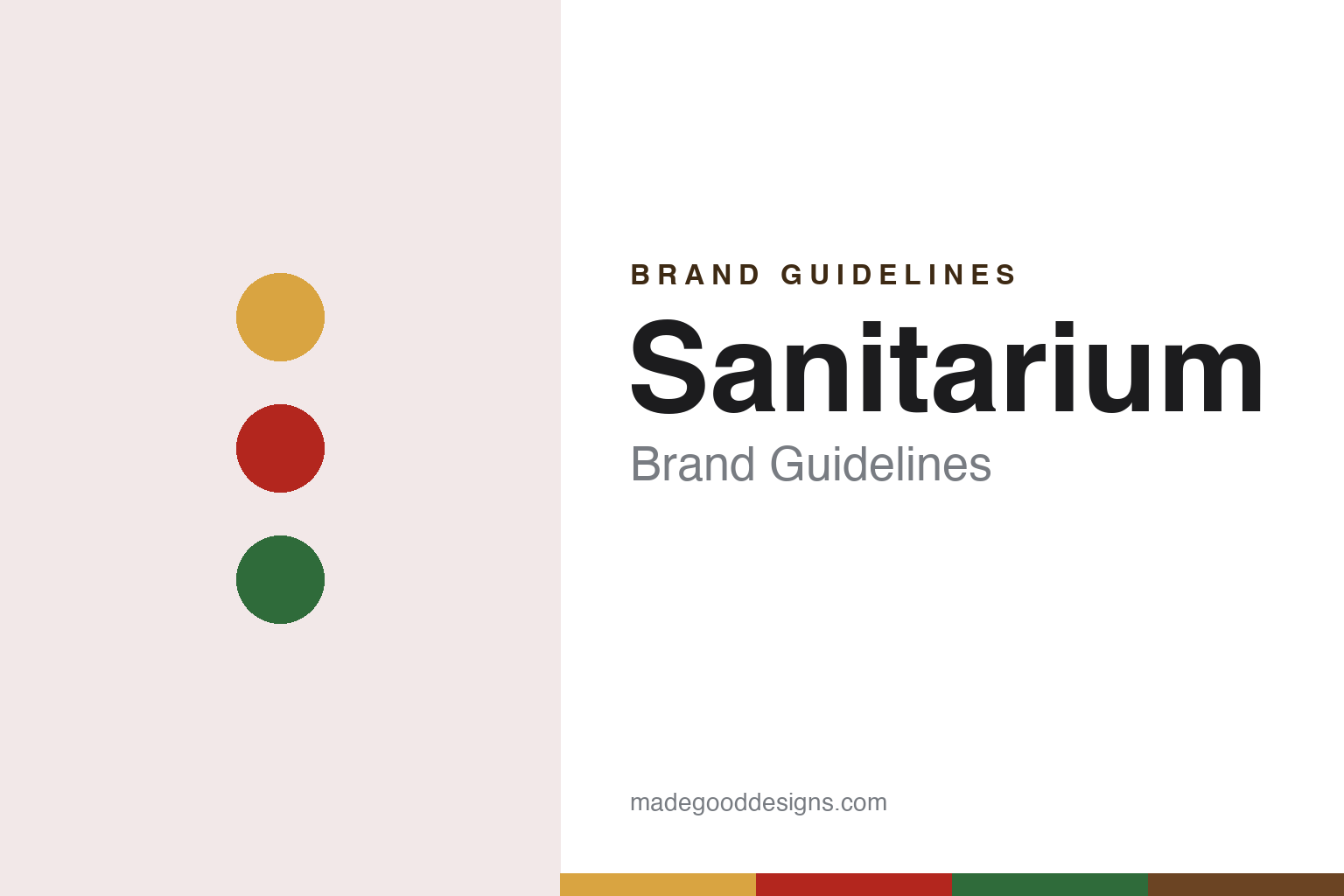
Sanitarium Brand Guidelines
The church-owned Melbourne food maker behind Weet-Bix.
Aa
Two constants: a Sanitarium wheat gold, cereal red and field green palette and a warm serif register. Abstract homage — not a Sanitarium product or mark; no pack or logo is reproduced.
Melbourne, 1898
A Battle Creek baker and a church food business.
Sanitarium is one of the oldest food companies in Australia, and one of the few owned by a church. The company says it was officially registered in Melbourne on 27 April 1898 as the Sanitarium Health Food Company, and that it took its inspiration from the food-reform ideas of Ellen G. White, a founder of the Seventh-day Adventist Church, and the American doctor John Harvey Kellogg.
English Wikipedia names the man who brought the recipes. Edward Halsey, a Seventh-day Adventist baker who had worked at Kellogg’s Battle Creek Sanitarium in Michigan, arrived in Sydney on 8 November 1897 and was making granola and Granose, an unsweetened cereal, in Melbourne by 1898. The company lists its first products as Granose biscuits and flakes, Caramel Cereal and Nuttose, and describes its first years, during an economic depression, as uncertain.
The business soon left Melbourne. Its factory moved to Cooranbong, in New South Wales, beside the Adventist college that became Avondale University College. In 1900 Halsey went on to New Zealand and set up production in Papanui, in Christchurch, where, Wikipedia says, he made the first batches of Granola, New Zealand’s first breakfast cereal; the company calls that venture a bakery. In 1902, the company says, it opened a vegetarian café in Pitt Street, Sydney, and in the 1960s it ran retail shops in Sydney and other cities.
Factories spread across Australia and New Zealand from the 1930s to the 1950s, the company says, with one in each capital city. The best known of them stood at Warburton, in the hills east of Melbourne: Wikipedia says a building of 1925 there was damaged by floods in 1934 and replaced by a factory completed in 1938 to designs by the architect Edward Billson, which is heritage-listed and made food until 1997.
Colour
Weet-Bix, bought in 1928.
Sanitarium’s best-known product was not invented there. English Wikipedia says that on 19 August 1926 Bennison Osborne applied for a trademark for an improved wheat biscuit he called Weet-Bix, with financial backing from Arthur Shannon, whose company Grain Products made it on Parramatta Road in Leichhardt, Sydney. Two years later, with Weet-Bix a success, Shannon sold the rights to Sanitarium, in October 1928, Wikipedia says; the company itself dates the purchase to 30 October 1928 and calls it a defining moment in its history. Wikipedia adds that Sanitarium’s Leichhardt site operated from 1928.
The biscuit travelled. Factories followed in Auckland and Christchurch, and a factory in Cape Town was later sold to Bokomo. In 1932 the British & African Cereal Company was registered in London to make the biscuit in Britain, where, to distinguish it legally from the product sold in Australia, New Zealand and South Africa, it was named Weetabix, Wikipedia says. The two brands have been separate ever since.
Much of Weet-Bix’s identity has been built through advertising and collectables. Sanitarium began issuing collectors’ cards in packs in 1942, Wikipedia says, later including All Blacks “Stat Attack” cards in New Zealand. Since 1985 the cereal has been sold in Australia with the line “Aussie kids are Weet-Bix kids,” with a New Zealand version, “Kiwi kids are Weet-Bix kids.”
Later products came from Sanitarium itself. The company dates So Good, its soy drink, to 1984, saying production tripled within months, and UP&GO to 1998, which it calls “a world-first liquid breakfast.” In 2019 it launched The Alternative Dairy Co., plant-based milks made for cafés. Not every line lasted: Honey Puffs, a puffed-wheat cereal, was discontinued in June 2025, Wikipedia says.
Typography
Design and documentation.
The seven brands in this group all come from Australia, and between them they cover ice cream, confectionery, snacks and dairy: Peters, Streets, Allen’s, Twisties, Smith’s, Sanitarium and Pauls. Australian food brands in general sit at many different points in the trade, from names that grew out of a single local business to names that now belong to much larger food groups, and a single brand can be sold everywhere from a corner shop to a supermarket shelf.
A food brand’s identity is usually carried less by a single product than by a pack, a name and the treat or staple it promises, because the company behind the name may have changed hands, moved its factory or grown far beyond the town where it started. That makes the questions behind each name worth asking plainly: who started it, who owns it now, and where its products are actually made and packed.
Each guide separates what independent sources record from what the company says about itself — its founding story, its owners over time, where its products are made and how its packaging has changed — and marks plainly what rests only on the company’s own word.
Aa
A warm, bookish serif for a company that dates from 1898. (Specimen set in Fraunces, a serif STAND-IN; NOT the Sanitarium logo.)
Sanitarium
Marmite, factories and church ownership.
In New Zealand, Sanitarium also makes Marmite, but not the British spread of the same name. English Wikipedia says Marmite has been made in New Zealand since 1919 under licence and to a different recipe, and that Sanitarium obtained distribution rights in 1908; the company’s own timeline says it began importing British Marmite in 1924 and repacking it in Christchurch and Melbourne. The New Zealand version is the only one sold as Marmite in Australasia and the Pacific Islands, Wikipedia says. Its Christchurch production line was shut in November 2011 after the earthquake of 22 February 2011 damaged a cooling tower; stocks ran out in March 2012, in a shortage that became known as “Marmageddon,” and the spread returned to shops on 20 March 2013.
The company’s factories have moved with the times. The company says it opened a manufacturing complex at Castle Hill, in Sydney, in 1987, and that its Berkeley Vale plant, on the New South Wales Central Coast, began production in 1992; it also recalls a research laboratory near Cooranbong from 1934 and a continuous flake-biscuit machine and semi-automatic packing at its Hobart factory in the 1940s and 1950s. Wikipedia lists other sites at Carmel, near Perth, Brisbane and Auckland, and records the closure of the Palmerston North factory in the late 1990s and of the Hackney factory in Adelaide in October 2010.
Sanitarium’s ownership is unusual. English Wikipedia says the name is the trade name of two sister companies, Australian Health and Nutrition Association Ltd and New Zealand Health Association Ltd, owned by the South Pacific Division of the Seventh-day Adventist Church, with headquarters at Berkeley Vale and in Auckland. Wikipedia adds that neither company pays company tax on its profits because of that religious ownership, an exemption that competitors and commentators have criticised.
For a design guide, Sanitarium shows how a company’s own name can sit quietly behind far better-known product brands — Weet-Bix, So Good, UP&GO — while those brands carry the slogans and the packs; compare Weetabix, the British biscuit that took a new name in 1932, and Vegemite, the Melbourne yeast spread. For this guide we use wheat gold, cereal red and field green with a serif, an unofficial interpretation; no product or logo is reproduced.
Explore & save
Keep Sanitarium’s identity on hand — save it to a board in the Made Good inspiration library.
Sanitarium identity set
Pin the Sanitarium wheat gold, cereal red and field green palette and the warm serif register to your own board.