Pauls Brand Guidelines
The South Brisbane dairy that began as an ice cream maker.
Aa
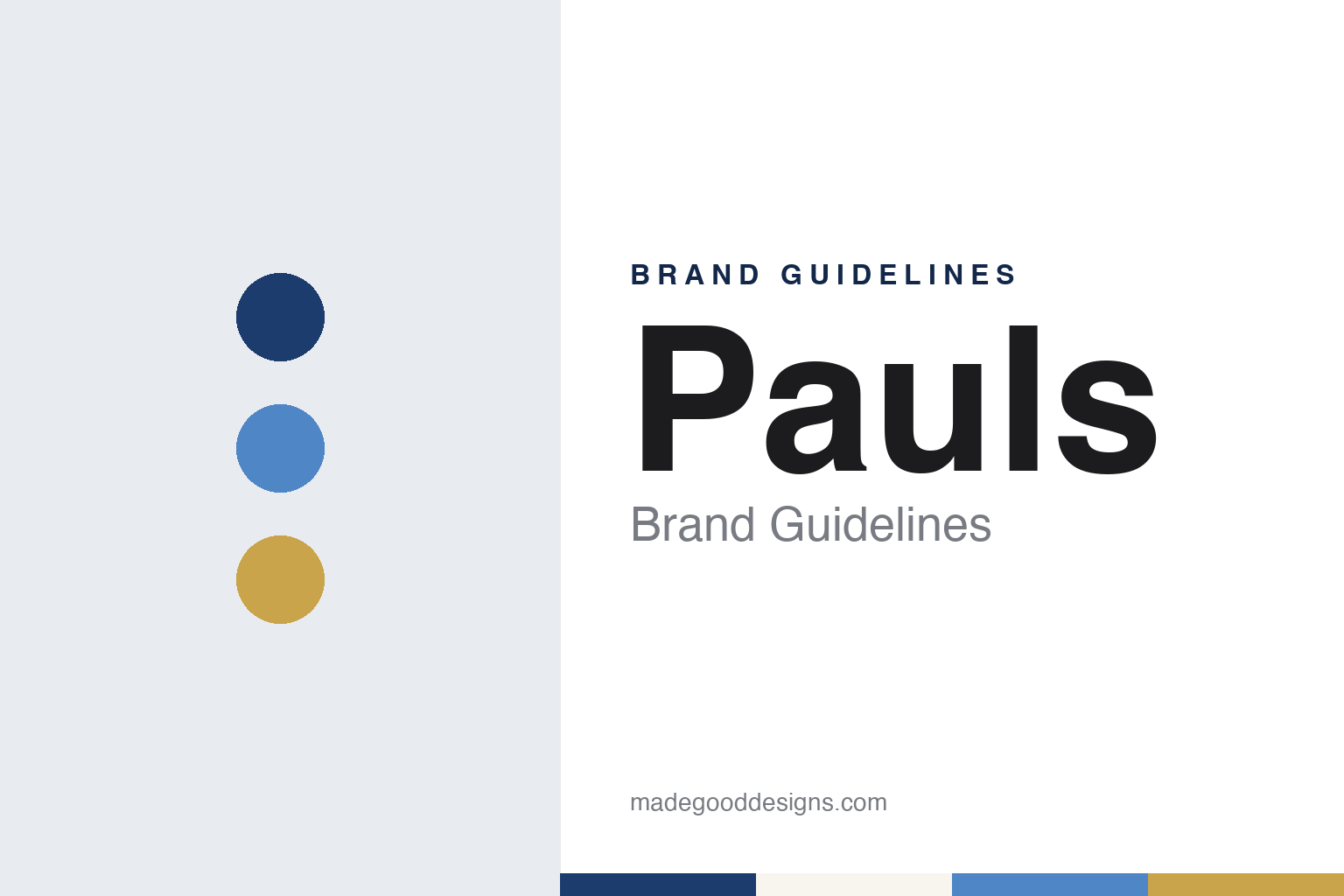
Two constants: a milk white, dairy blue and gold-cap palette and a sturdy grotesque sans register. Abstract homage — not a Pauls product or mark; no pack, logo or bottle is reproduced.
Polar Perfections
An ice cream venture in a South Brisbane cold store.
Pauls is best known today as a Queensland milk brand, but it began as an ice cream maker. The company was registered as Pauls Polar Perfections Pty Ltd on 13 June 1933, with paid-up capital of £900, according to English Wikipedia, which cites a 1951 report in Brisbane’s Courier-Mail. Its central figure was Edward Stokes, who was still managing director of the operating company in 1951. The history the company later published on its own website tells the start in more detail: in 1933 the cold-storage firm Birt and Co., which had decided to enter the ice cream trade with an old churn and other second-hand equipment, asked E. Stokes, then managing director of Pauls, to act as its distributor, and Stokes brought in S. McIntyre and G. Andrew as partners.
The business started in a small section of Birts Cold Stores in Stanley Street, South Brisbane. Unhappy with how manufacture was controlled, the company says, Pauls bought a small plant of its own and began making ice cream on the same premises in the middle of 1934. The name was written in several ways in its early years — Pauls, Paul’s and Pauls’ — Wikipedia notes, and in November 1933 the company sponsored a “Pauls’ 4BC Party” at Brisbane City Hall, according to an advertisement in the Sunday Mail.
Milk soon overtook ice cream. Pauls Polar Perfections became a public company in August 1938, and the following year it changed its name to Pauls Ice Cream and Milk Ltd, the company history says. In 1939 it bought the wholesale milk distribution business of G. Andrew and of Skinner and Co., which the company calls a major milestone; Brisbane’s Telegraph reported that year that Pauls was registered as a wholesale milk vendor under the Brisbane Milk Board. By 1946, after buying another milk round, Pauls was distributing nearly half of Brisbane’s milk receivals, the company says. A 1946 company booklet, Pauls Ice Cream & Milk Ltd.: a history, is held by the National Library of Australia.
Colour
Square bottles, tankers and Breaka.
Much of Pauls’ identity was built on how milk reached the customer. The company says it introduced bulk transport of milk in Queensland in 1942, using a 1,000-gallon stainless steel tanker, and homogenised milk in 1947. On 31 July 1948 it brought in square milk bottles with foil caps, which it describes as the first in Australia; Wikipedia, citing a 1950 advertisement in the Brisbane Telegraph, describes the late-1940s and 1950s Pauls bottle as squared glass with a gold-coloured metal cap. A 1947 notice in the Courier-Mail listed staff superannuation among the benefits of a job with the company, Wikipedia says, and QUF’s long-time chairman Rod Wylie later recalled that Pauls introduced superannuation in the 1940s, long before it was common.
Powdered milk followed. In 1948 Queensland Country Life reported a £150,000 plan for a plant to make it, and in 1953 Pauls began building powdered-milk plants at South Brisbane, Wikipedia says. The company history records the opening of a new milk products factory that year; by then the operating companies sat under a holding company, Pauls Ltd, formed in 1950. In the late 1960s it took on long-life milk: the company history records its first export orders for UHT milk in November 1968, and the Queensland Business Leaders Hall of Fame calls its UHT milk an Australian first.
From the 1980s the brand moved into the chilled cabinet. The company says it launched Breaka flavoured milk in June 1985 and the plastic-bottled Breaka range that August, when its 2-litre plastic milk bottle had won more than 30% of the Brisbane market; a Breaka promotion won the Queensland radio industry’s premier award in 1990. In 1984 the company won a gold award in the multipack class of the Packaging Council of Australia’s National Pack Competition for its Popper juice jug, it says. Pauls Lactaid, launched in June 1991, was Australia’s first fresh reduced-lactose milk, according to the company. Glass milk bottles ended in January 1996, and later launches included IceBreak in 1996 and Pauls Smarter White Milk in October 2002.
Typography
Design and documentation.
The seven brands in this group all come from Australia, and between them they cover ice cream, confectionery, snacks and dairy: Peters, Streets, Allen’s, Twisties, Smith’s, Sanitarium and Pauls. Australian food brands in general sit at many different points in the trade, from names that grew out of a single local business to names that now belong to much larger food groups, and a single brand can be sold everywhere from a corner shop to a supermarket shelf.
A food brand’s identity is usually carried less by a single product than by a pack, a name and the treat or staple it promises, because the company behind the name may have changed hands, moved its factory or grown far beyond the town where it started. That makes the questions behind each name worth asking plainly: who started it, who owns it now, and where its products are actually made and packed.
Each guide separates what independent sources record from what the company says about itself — its founding story, its owners over time, where its products are made and how its packaging has changed — and marks plainly what rests only on the company’s own word.
Aa
A sturdy grotesque sans for a dairy that built its name on bottles and cartons. (Specimen set in Archivo, a sans STAND-IN; NOT the Pauls logo.)
Pauls
From a Queensland public company to Parmalat and Lactalis.
In February 1960 Pauls Ltd merged with the Queensland Peters ice cream companies — Peters-Arctic Delicacy Co Ltd and its North Queensland associate — to form Queensland United Foods Ltd, the company history says. That side of the business traced back to Arctic Ice Creams Ltd, registered in Brisbane in 1923, which joined the Sydney-based Peters American Delicacy Co in 1927. The merged group listed on the Sydney, Brisbane and Melbourne stock exchanges in March 1960 and took the name QUF in 1969, according to the Queensland Business Leaders Hall of Fame, run by the State Library of Queensland. In the 1960s QUF spread well beyond food, the company history records, buying timber, seafood and brick businesses, and it became the Coca-Cola bottler for the top half of the Northern Territory in 1961.
QUF moved into Victoria in the 1990s, taking over Associated Dairies by public takeover bid in 1993; Wylie later said it reached 40% of the Victorian market-milk business. In 1998, after a takeover contest in which National Foods also made an offer, the Italian group Parmalat acquired all the shares in the company, renamed Pauls Ltd that year, through an on-market takeover bid. The Hall of Fame says Parmalat’s proposal was the higher return for shareholders and kept the business and its head office in Queensland. Pauls Ltd changed its name to Parmalat Australia Ltd in 2003, the State Library of Queensland says. In July 2011 the French dairy group Lactalis won control of Parmalat with a €2.5 billion takeover offer, English Wikipedia says, citing Reuters, and the Pauls website now carries a Lactalis Australia copyright line.
The South Brisbane factory on Kurilpa Point, by the William Jolly Bridge, had been part of the riverside landscape for sixty-five years in 2018, the State Library of Queensland wrote when it published a set of 2017 photographs of the working plant. QUF was inducted into the Queensland Business Leaders Hall of Fame in 2013. In January 2020 Pauls’ owner won a Queensland Health tender to supply milk and yoghurt to the Metro North hospital service, a decision criticised by supporters of the locally owned Maleny Dairies, which missed out, the ABC and SBS reported.
For a design guide, Pauls shows how a square bottle, a flavoured-milk name and one riverside factory can carry a dairy brand through several changes of ownership. Compare Peters, whose Queensland companies merged with Pauls in 1960, and Président, another Lactalis label. For this guide we use milk white, a dairy blue and a gold-cap yellow with a sturdy sans, an unofficial interpretation; no product or logo is reproduced.
Explore & save
Keep Pauls’s identity on hand — save it to a board in the Made Good inspiration library.
Pauls identity set
Pin the Pauls milk white, dairy blue and gold-cap palette and the sturdy grotesque sans register to your own board.