Peters Brand Guidelines
The American who built Australia’s ice cream empire.
Aa
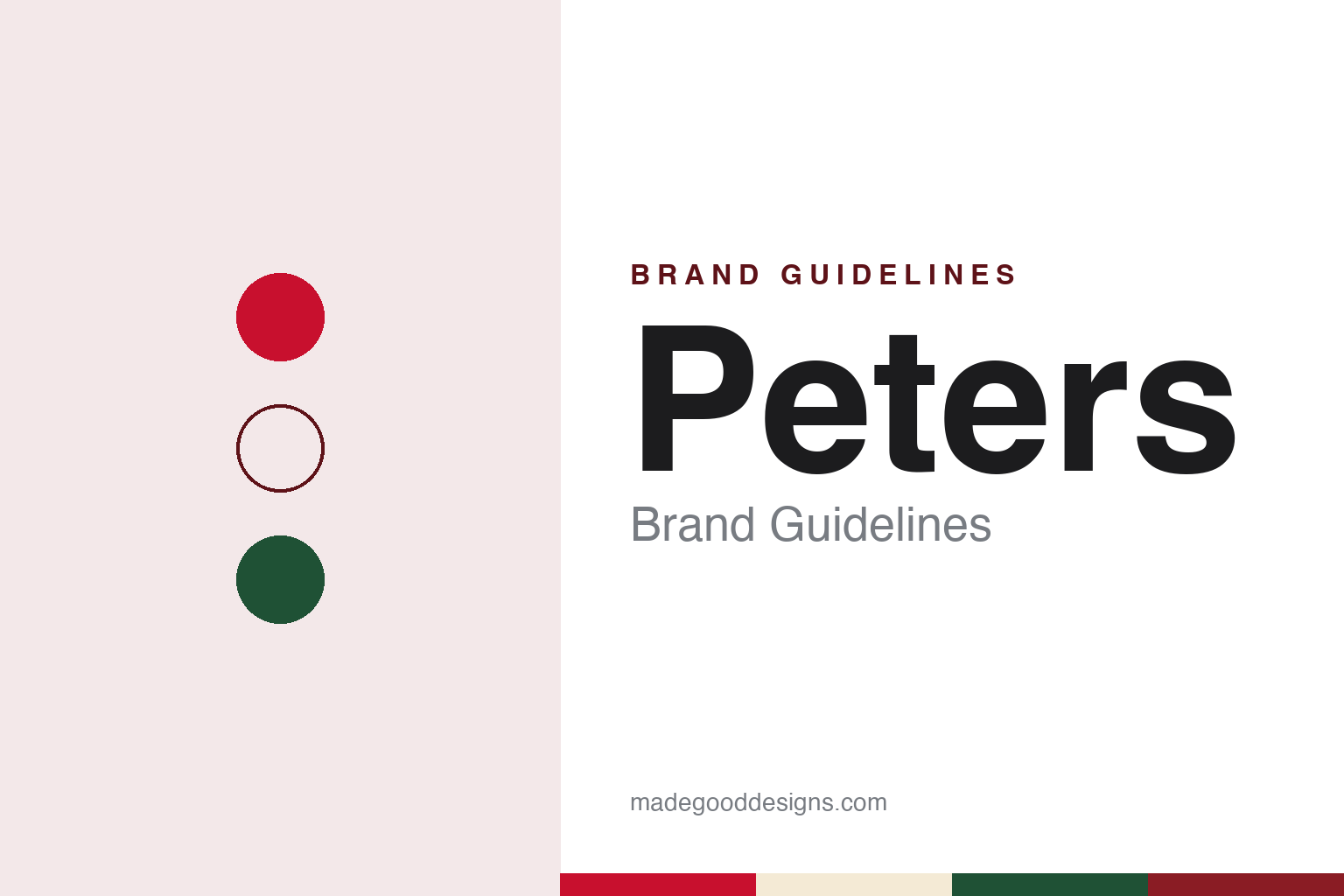
Two constants: a red, cream and green palette and a warm display serif register. Abstract homage — not a Peters product or mark; no pack, logo or ice cream is reproduced.
American Delicacy
A Michigan salesman, rented rooms and an ice factory.
The ABC has called Peters one of Australia’s oldest food makers, and it was started by an American. English Wikipedia says Fred Peters came from Scio, in Michigan, worked in sales for the Union Manufacturing Company of Toledo, Ohio, in the 1890s, and settled in Sydney in 1899 as that company’s agent, while building businesses of his own, among them a patent medicine. In 1907 he set up Peters’ American Delicacy Co. Ltd to make ice cream, a product that was not yet mass-produced in Australia, starting in rented rooms at an ice factory in Paddington, Sydney, according to Wikipedia; it adds that the recipe was his mother’s. The ABC, reporting the brand’s sale in 2014, placed its 1907 beginnings in the Sydney suburb of Manly.
The business grew quickly. Wikipedia says a new manufacturing plant opened in Redfern in 1923; in 1927 a sister company, Peters’ Arctic Delicacy Co. Ltd, was set up in Brisbane with a branch in Newcastle; and in 1929 associated companies followed in Victoria, Western Australia and Townsville, with a new plant in Rockhampton. By the time Fred Peters died in 1937, Wikipedia says, the business had eight factories in every state except Tasmania and more than 1,000 employees, and The Sydney Morning Herald described it as the largest ice cream business in the British Empire.
Peters also changed how ice cream was sold. Wikipedia credits him with largely introducing to Australia the small refrigerated cabinet, which he hired out to retailers.
Colour
Two colour schemes, a cyclist and a cone.
For much of its history Peters did not look the same everywhere. English Wikipedia, citing a 2009 Fonterra release, says the brand’s corporate identity was red and cream in New South Wales and Queensland and green and cream in Victoria and Western Australia.
Its advertising leaned on popular figures. A Peters advertisement in the Sporting Globe of 13 December 1939, held in the National Library of Australia’s Trove archive, featured the cyclists Hubert Opperman and Valda Unthank. Wikipedia also lists the clown duo Zig and Zag among the performers who advertised Peters. An old Peters advertisement survives on the side of the former Narracan General Store at Old Gippstown, in Moe, Victoria. Buildings carry the name too: Wikipedia notes that Perth’s Michelides Tobacco Factory served for a time as the Peters ice cream factory in Western Australia.
The brand’s best-known product today did not start in Australia. The Drumstick, a sugar cone filled with ice cream and topped with chocolate and nuts, was invented in 1928 by I. C. Parker of the Drumstick Company in Fort Worth, Texas, according to English Wikipedia, citing histories of American ice cream. The same article, citing Brisbane Times in 2017, says a later version with a chocolate-lined cone and a chunk of chocolate at the bottom was invented at a factory in West End, Brisbane. The Drumstick brand is now owned by Froneri, Wikipedia says. In Australia it is sold as Peters Drumstick; Froneri announced a Peters Drumstick Fudge in February 2022. The ABC named Drumstick, Maxibon and Connoisseur as Peters’ major brands in 2014.
Typography
Design and documentation.
The seven brands in this group all come from Australia, and between them they cover ice cream, confectionery, snacks and dairy: Peters, Streets, Allen’s, Twisties, Smith’s, Sanitarium and Pauls. Australian food brands in general sit at many different points in the trade, from names that grew out of a single local business to names that now belong to much larger food groups, and a single brand can be sold everywhere from a corner shop to a supermarket shelf.
A food brand’s identity is usually carried less by a single product than by a pack, a name and the treat or staple it promises, because the company behind the name may have changed hands, moved its factory or grown far beyond the town where it started. That makes the questions behind each name worth asking plainly: who started it, who owns it now, and where its products are actually made and packed.
Each guide separates what independent sources record from what the company says about itself — its founding story, its owners over time, where its products are made and how its packaging has changed — and marks plainly what rests only on the company’s own word.
Aa
A warm display serif for a brand founded in 1907. (Specimen set in Fraunces, a serif STAND-IN; NOT the Peters logo.)
Peters
Petersville, Nestlé, private equity and Froneri.
Peters has changed hands many times. English Wikipedia says that by the 1960s all production for the brand, except in Western Australia, was handled by the Melbourne-based Petersville Australia Limited. In the late 1980s those businesses were taken over by the Adelaide Steamship Company, and after AdSteam’s collapse they passed to Pacific Dunlop, which sold its ice cream division to Nestlé in the mid-1990s.
Western Australia went its own way. There the brand belonged to Peters and Brownes Foods, which the New Zealand dairy group Fonterra bought in 2006 and sold to Nestlé in 2009, Fonterra said in a release of 29 April 2009; that deal gave Nestlé the Peters brand nationwide. Three years later Nestlé sold the business. Nestlé announced on 29 June 2012 that it had sold Peters to the private equity firm Pacific Equity Partners, and Wikipedia says Peters kept an Australian licence to make sub-brands that Nestlé retained, such as Drumstick.
In May 2014 Pacific Equity Partners sold Peters to R&R Ice Cream, a European ice cream maker then owned by the French private equity firm PAI Partners, the ABC reported on 27 May 2014; the price was not disclosed. The ABC said Peters employed about 500 people in Australia, and its chief executive, Stephen Audsley, said manufacturing would continue at the company’s factory in Mulgrave, in Melbourne. In 2016 Nestlé and PAI Partners agreed to combine their ice cream businesses in a 50/50 joint venture, Froneri, based at Leeming Bar in North Yorkshire, England, and Peters became part of it, English Wikipedia says.
For a design guide, Peters shows how one name can carry different colours in different states and still read as a single national brand. Compare Streets, its old Sydney rival, and Häagen-Dazs, which Froneri also sells. For this guide we use a Peters red, cream and a southern green with a serif, an unofficial interpretation; no product or logo is reproduced.
Explore & save
Keep Peters’s identity on hand — save it to a board in the Made Good inspiration library.
Peters identity set
Pin the Peters red, cream and green palette and the warm display serif register to your own board.