Al Wadi Al Akhdar Brand Guidelines
The wartime Lebanese hummus brand of the Obegi group.
Aa
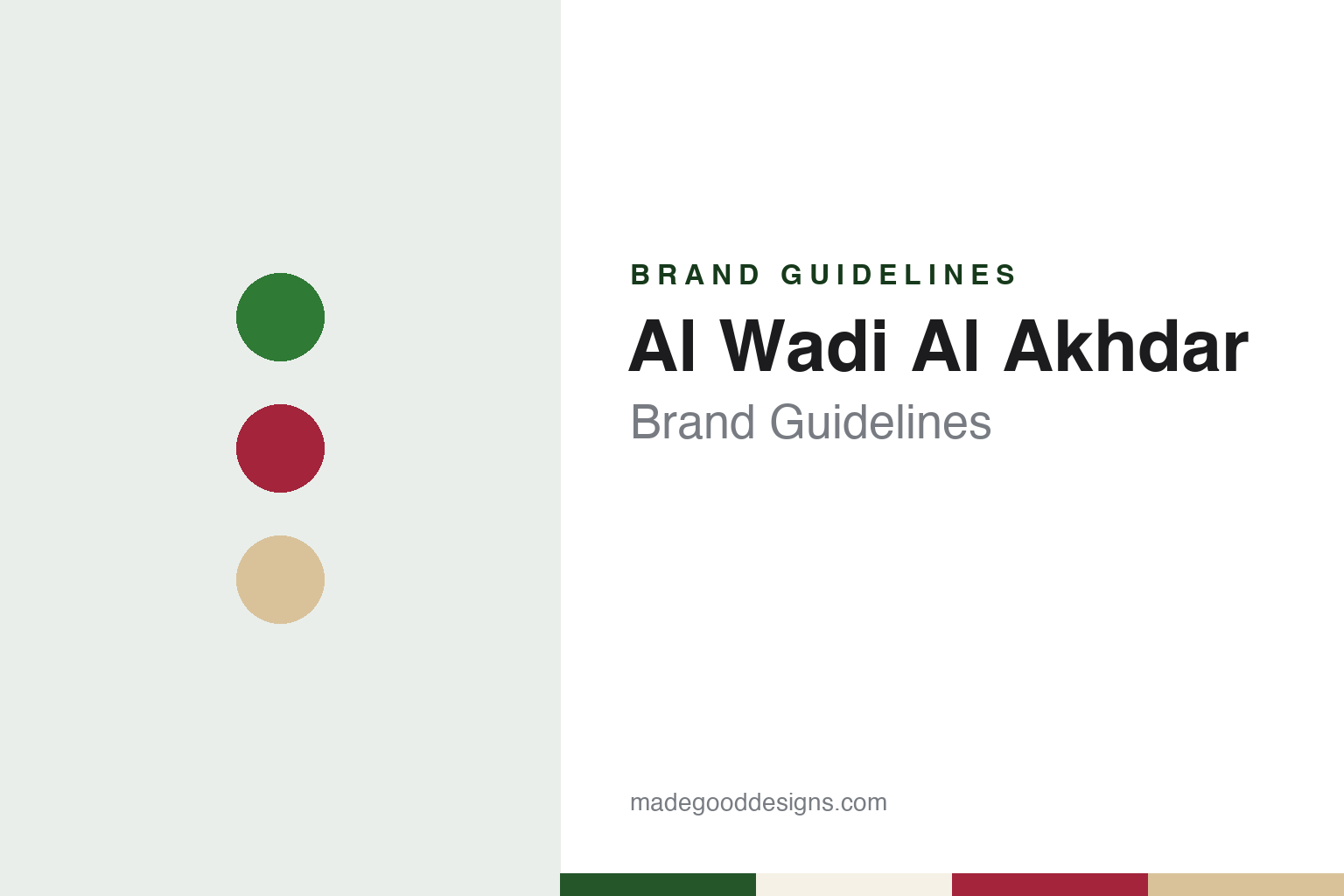
Two constants: a valley green, pomegranate red and sesame beige palette and a sturdy rounded sans register. Abstract homage — not an Al Wadi Al Akhdar product or mark; no can, jar, label or logo is reproduced.
A brand born in wartime
Two partners, three staples and a country short of food.
Al Wadi Al Akhdar — Arabic for “the green valley” — was launched in Lebanon in 1979. The company says it began at a time when Lebanon was at war and the food supply was running low, and it names its founders as Bechara Obegi and Frank Farage. The two partners started with three staples of the Lebanese table: hummus tahina, foul moudammas, the stewed fava beans, and chickpeas. The company says they chose a name that “speaks the language of the nation,” for a brand people could trust.
The brand belongs to an older business. Al Wadi Al Akhdar is the first in-house brand of Obegi Consumer Products Holding, or OCPH, the Lebanese consumer-goods distributor, according to OCPH’s own history. That history traces the group to 1958, when a company named after Yordan Obegi was incorporated to handle the sales and distribution of food and household goods across Lebanon; operations began in early 1959. OCPH built its business distributing international brands — it says Henkel consolidated its full Lebanese portfolio with the group in 1960, and that it launched Persil there in 1965 — before it launched Al Wadi Al Akhdar in 1979 as a brand of its own. OCPH describes itself as family-owned and independently managed, and as a member of the Obegi Group, a family-owned conglomerate active in consumer goods, chemicals, banking and finance, logistics and agriculture. It calls Al Wadi Al Akhdar its flagship owned brand; a second in-house brand, the Bihar kashkaval cheese, followed in 1988.
The early years are set out in the brand’s own timeline. Al Wadi Al Akhdar says that in 1984 the Dove Processing factory began full manufacture of its Middle Eastern specialities, that the same decade saw it launch its canned vegetables, and that it made its first exports, to the United States and France.
Colour
Hummus, roasted aubergine and a long pantry list.
The range grew outward from those first cans. In the late 1980s, the company says, it launched a baba ghannouge made the traditional way, and it says it was the only brand to roast its aubergines where others grilled them. Four jams followed, then tahini. In the 1990s, it says, it became the first brand to launch frozen vegetables in Lebanon. Its archived 2012 website listed a pantry that ran from condiments, butter and cheeses to frozen vegetables, canned fruit, jams, pickles, tahini and halawa, molasses, syrups, flower essences and ready-to-eat recipes, and described its tahini as made from sesame seeds that are roasted and slowly ground.
Today the company counts more than 200 products across more than 15 food categories, while OCPH puts the portfolio at over 150 SKUs. The current website leads with its Lebanese specialities — hummus tahina, baba ghannouge, several recipes of foul moudammas, fava beans and chickpeas — and the company says it has added an organic range. In 2014, it says, it launched a range of all-natural flower waters and pomegranate molasses, and its pomegranate molasses received a seal of approval from the American food magazine Bon Appétit.
The brand describes itself as a market leader at home. It says it led the Lebanese specialities category from 1992, canned vegetables from 1997 and frozen vegetables from 2004, and OCPH says the brand has held leadership positions in several product categories in Lebanon since 1992. Both are the companies’ own claims. Al Wadi Al Akhdar also says it was the first brand in Lebanon to establish a presence on social media, in 2013, and that its website won a gold award in the food category of the Pan Arab Web Awards. Its old web address, alwadi-alakhdar.com, now forwards to alwadi.com.
Typography
Design and documentation.
The seven brands in this group all make food, and they come from Saudi Arabia, Kuwait, Lebanon, the United States and Turkey: Almarai, Americana, Al Wadi Al Akhdar, Cortas, Ziyad, Tamek and Eti. Middle Eastern and Turkish food brands in general sit at many different points in the trade, from family firms that still carry a founder’s name to names that now belong to much larger food groups, and a single brand can be sold everywhere from a neighbourhood grocer to a supermarket shelf abroad.
A food brand’s identity is usually carried less by a single product than by a pack, a name and the meal or snack it promises, because the company behind the name may have changed hands, moved its factory or grown far beyond the town where it started. That makes the questions behind each name worth asking plainly: who started it, who owns it now, and where its food is actually made and packed.
Each guide separates what independent sources record from what the company says about itself — its founding story, its owners over time, where its products are made and how its packaging has changed — and marks plainly what rests only on the company’s own word.
Aa
A sturdy rounded sans for a hummus brand with a long pantry list. (Specimen set in Rubik, a sans STAND-IN; NOT the Al Wadi Al Akhdar logo.)
Al Wadi Al Akhdar
A Lebanese pantry sent abroad.
Exports have shaped the brand since its first decade. The company says its products are now exported to more than 30 countries; OCPH counts more than 20 international markets. Its partners page names importers including Sahadi Fine Foods in Brooklyn, New York, the French distributor Haudecoeur and Tema Fine Foods in the Netherlands, alongside OCPH’s own businesses in Lebanon and in Erbil, Iraq, and the company says it has begun distributing in Morocco, Jordan and the Gulf states.
The company sets out how it checks what goes into its cans and jars. It says every product undergoes physical, chemical, microbiological and sensory tests before release, that it monitors and audits production runs at its production unit’s premises, and that labels are checked against international labelling rules. It has opened what it calls a laboratory of innovation, with a pilot plant able to make almost all of its products in the same way as the factory and a kitchen for tasting sessions.
The brand also runs a community programme. Under the name “Men Qlb Al Wadi” — “from the heart of the valley” — it distributes food boxes and prepares meals for Lebanese families in need, with its own staff taking part, and it works with charities including Beit El Baraka and Smile in a Box, the company says.
For a design guide, Al Wadi Al Akhdar shows how a distributor’s own label, born in wartime around three tins, can become the name a diaspora reaches for. Compare Cortas, the older Lebanese maker of flower waters and molasses, and Soom, the American tahini brand. For this guide we use a valley green, a pomegranate red and a sesame beige with a sans, an unofficial interpretation; no product or logo is reproduced.
Explore & save
Keep Al Wadi Al Akhdar’s identity on hand — save it to a board in the Made Good inspiration library.
Al Wadi Al Akhdar identity set
Pin the Al Wadi Al Akhdar valley green, pomegranate red and sesame beige palette and the sturdy rounded sans register to your own board.