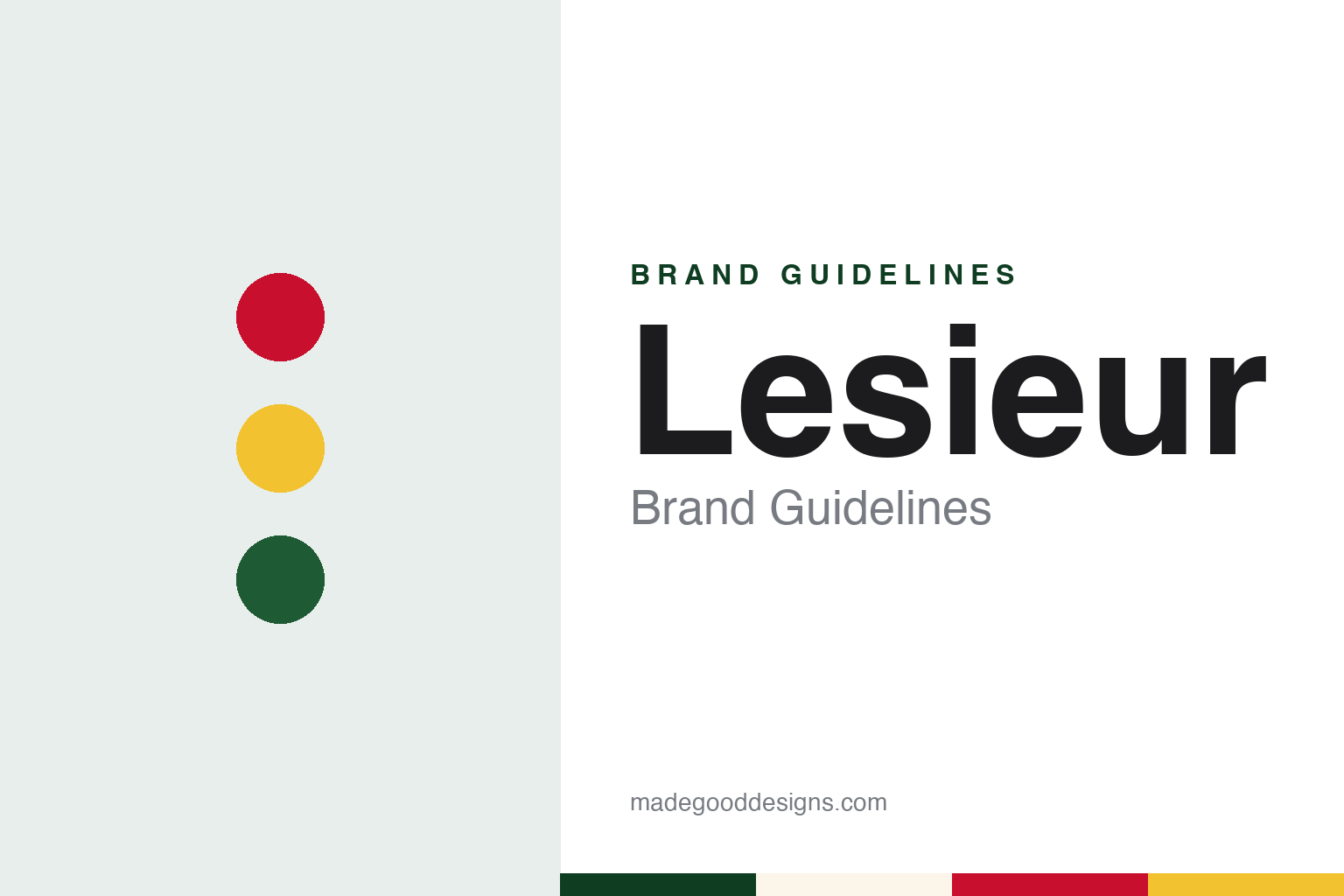
Lesieur Brand Guidelines
The Dunkirk oil mill behind France’s four red lozenges.
Aa
Two constants: a lozenge red, sunflower yellow and rapeseed green palette and a warm serif register. Abstract homage — not a Lesieur product or mark; no bottle, logo or label is reproduced.
Huileries Georges Lesieur
A sixty-year-old oil man, three sons and a port.
Lesieur was founded in 1908 by Georges Lesieur, a Parisian then aged 60, French Wikipedia says, citing La Voix du Nord. Born in Paris in 1848, he had joined the oil firm Desmarais Frères as a clerk at fifteen and spent more than forty years there, rising to co-manager; he also presided over the Paris Chamber of Commerce from 1905 to 1907, according to Tristan Gaston-Breton’s 1998 company history Lesieur, une marque dans l’histoire as cited by French Wikipedia. He left in 1908, which BFM Business’s radio programme À vos marques put down to the Desmarais brothers’ refusal to bring his sons into the business, and started his own company with his own money.
He built it with his three sons, Maurice, Paul and Henri, and three former Desmarais colleagues — a sales director, a lawyer and an engineer. The first oil mill, the Huileries Georges Lesieur, went up at Coudekerque-Branche, on the edge of Dunkirk. French Wikipedia’s biography of Georges Lesieur says Le Havre was ruled out because Desmarais already had a mill there, and that Dunkirk was then France’s third port for groundnut imports, after Marseille and Bordeaux. The mill pressed imported groundnuts. Sources differ on its start: the biography says production began in July 1910, while French Wikipedia’s company article, citing La Voix du Nord, says building began in 1909 and the factory started work in 1911.
The mark that still identifies the brand came early. French Wikipedia says the logo of four red lozenges dates from 1910 and has changed very little since, citing À vos marques. The mill had about 300 workers by 1914, and after 1918 the groundnut oil was refined to give it a more neutral taste, the same programme said.
Colour
Bottles, tubes and slogans.
Lesieur’s best-known contribution to French kitchens was a pack. Until the 1920s cooking oil was sold loose from wooden barrels, poured by the grocer into the customer’s own container. In 1924, Gaston-Breton’s history says, Lesieur became the first to sell oil in returnable glass bottles under its own name; the “Lesieur” mark had been registered at the Paris commercial court the year before. French Wikipedia’s company article gives 1924 for both the bottle and the registration. The company today says 1924 also brought the brand’s first national advertising.
Packaging stayed central after the Second World War. French Wikipedia says Lesieur introduced the first mayonnaise in a tube in 1960, citing the trade magazine LSA, and in 1963 launched a margarine and its first non-returnable plastic bottle, in PVC. Making those bottles led Lesieur to found Sidel in 1965 to develop bottle-making machines; it sold the company to Pont-à-Mousson in 1972. A PET bottle followed in 1985. The company says it launched a “stop goutte” bottle designed to stop drips in 2013, and in 2025 removed the cardboard box from its mayonnaise tubes.
The range grew from groundnut oil into other oils and sauces. French Wikipedia lists Lesieur sunflower-oil mayonnaise in 1974, maize and olive oils in 1976 and the first ready-made vinaigrettes in 1986. In 1990 came ISIO 4, which the company calls the first oil to combine four complementary seed oils, and in 1994 Frial, a frying oil. Advertising gave the brand its lines: the company dates its television slogan “Pas d’erreur, c’est Lesieur” (“No mistake, it’s Lesieur”) to 1985, and follows it with the 1986 campaign built on a woman saying “Je veux tout !” (“I want it all!”).
Typography
Design and documentation.
The seven brands in this group all make food, and all of them come from Germany or France: Dr. Oetker, Hengstenberg, Leibniz, Kühne, Seitenbacher, Bonduelle and Lesieur. German and French food brands in general sit at many different points in the trade, from family firms that still carry a founder’s surname to names that now belong to much larger food groups, and a single brand can be sold everywhere from a village grocer to a supermarket shelf.
A food brand’s identity is usually carried less by a single product than by a pack, a name and the meal or snack it promises, because the company behind the name may have changed hands, moved its factory or grown far beyond the town where it started. That makes the questions behind each name worth asking plainly: who started it, who owns it now, and where its food is actually made and packed.
Each guide separates what independent sources record from what the company says about itself — its founding story, its owners over time, where its products are made and how its packaging has changed — and marks plainly what rests only on the company’s own word.
Aa
A warm serif for a century-old French kitchen staple. (Specimen set in Fraunces, a serif STAND-IN; NOT the Lesieur logo.)
Lesieur
From a family firm to a farmers’ group.
The Lesieur family ran the business for decades. In 1931 his son-in-law Jacques Lemaigre Dubreuil became chairman and chief executive, French Wikipedia says, citing a 2004 Routledge biography by William A. Hoisington Jr. The Second World War halted the Dunkirk mill: according to Patrick Oddone’s 2005 history of Dunkirk’s liberation, the occupiers stopped production and dismantled equipment, and the plant’s power station was bombed in September 1944. Lesieur moved oil production to Africa, with mills at Dakar in 1943, Casablanca in 1944 and Algiers in 1948. The Moroccan business later became Lesieur Cristal, a separate company listed in Casablanca.
From the late 1960s the French group diversified into ready meals and household products, then was broken up. In 1988 the sugar company Saint Louis, which had taken control of Lesieur, sold the oils, sauces and margarine business to Eridania Béghin-Say, part of Italy’s Montedison, French Wikipedia says; in 1990 Lesieur was folded into Eridania’s oilseed arm, Cereol. In 1995 the sauces and mayonnaise were sold separately to the American group CPC, so the Lesieur name was split between two owners; the sauces passed to Campbell around 2001, after Unilever bought CPC’s food business, Bestfoods.
In 2003 the oils were bought by Sofiprotéol, the financial arm of France’s oilseed farmers, founded in 1983, through its crushing subsidiary Saipol; Les Échos headlined in November 2002 that Lesieur was passing under the control of the farming world. In 2008 Saipol bought the sauces back from Campbell, reuniting the brand, and in 2015 Sofiprotéol renamed itself Avril. The group bought the olive-oil brand Puget in 2004 and became the reference shareholder of Lesieur Cristal in 2011, Les Échos reported in 2015, as cited by French Wikipedia.
Lesieur, now headquartered in Paris, describes itself as an Avril subsidiary. The company says the historic Coudekerque site still makes and packs its seed oils, a plant at Grande-Synthe makes its sauces and condiments, Bassens, near Bordeaux, packs part of its seed oils and Vitrolles blends and packs Puget olive oils; the Bassens plant was inaugurated in January 2016, France Bleu reported.
For a design guide, Lesieur shows how a 1910 mark of four red lozenges and a branded bottle turned a bulk commodity into a household name. Compare Amora, another French condiment brand, and Bertolli, an oil name also split between owners. For this guide we use a lozenge red, a sunflower yellow and a rapeseed green on cream with a serif, an unofficial interpretation; no product or logo is reproduced.
Explore & save
Keep Lesieur’s identity on hand — save it to a board in the Made Good inspiration library.
Lesieur identity set
Pin the Lesieur lozenge red, sunflower yellow and rapeseed green palette and the warm serif register to your own board.