Felix Brand Guidelines
The Eslöv pickle and ketchup brand in white capitals on red.
Aa
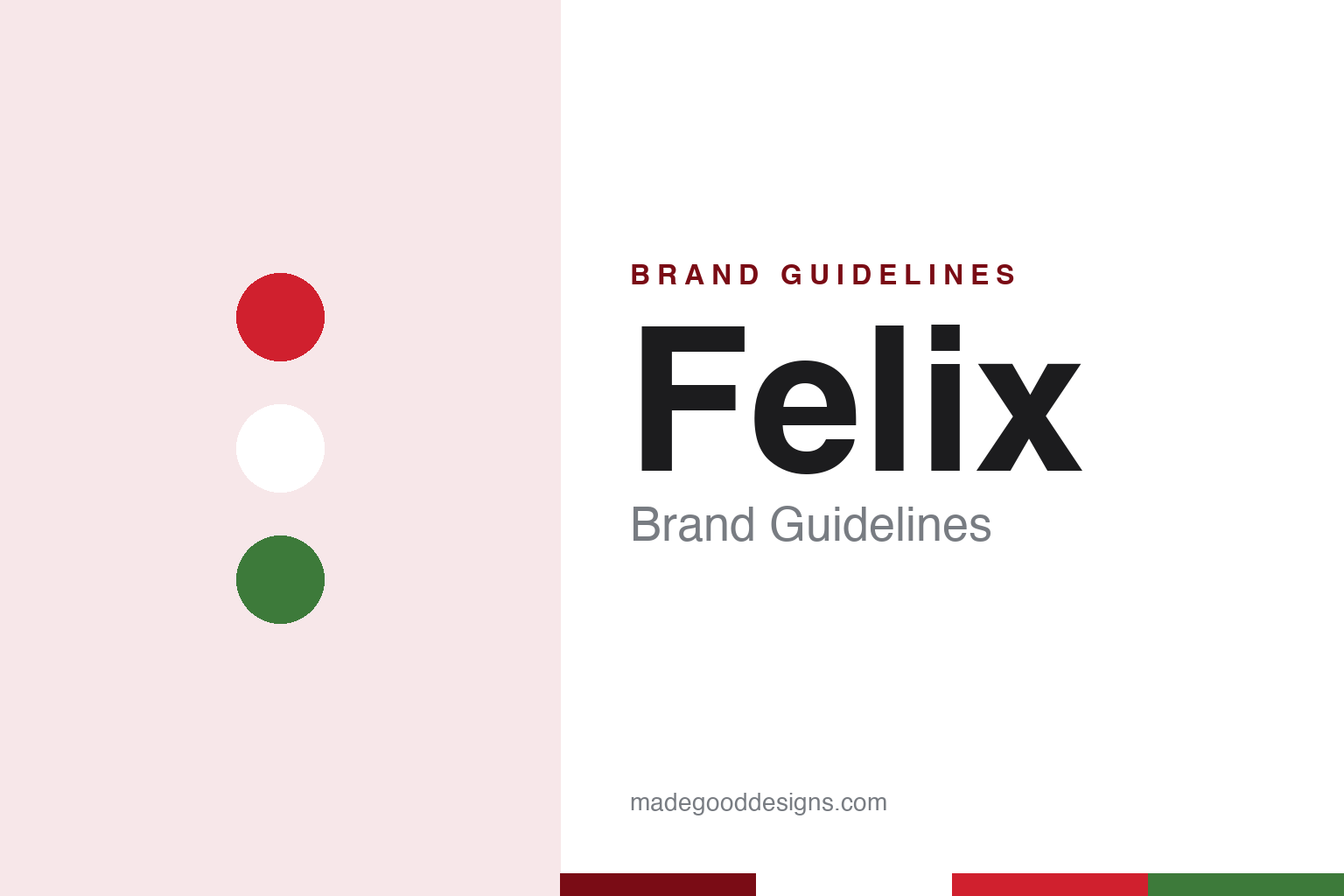
Two constants: a red, white and gherkin green palette and a heavy grotesque capitals register. Abstract homage — not a Felix product or mark; no bottle, pack or logo is reproduced.
Vinegar and cucumbers
A chemist’s vinegar works and a pickling family from Znaim.
Felix grew out of a vinegar works in Eslöv, in Skåne in southern Sweden. The company says the chemist Per Håkansson started the vinegar factory in the 1870s so that local households could preserve the vegetables they grew; Swedish Wikipedia dates the factory to 1874 and says that the business became AB P. Håkansson in 1919.
The man who gave the brand its name arrived in 1938. Herbert Felix came from Znaim — today Znojmo, in the Czech Republic — where his family’s firm, Löw & Felix, had been making and exporting the region’s pickled cucumbers, the Znaimer Gurken, since 1868, Swedish Wikipedia says. He came to Sweden as a refugee in 1938 with his Swedish wife, Kerstin. The company says he fled Czechoslovakia that year, that he was put in charge of building up a cucumber department at the Eslöv business, and that Kerstin Felix travelled to Prague to retrieve the recipe book that had been in the Felix family for generations.
Felix pickled cucumbers went on sale in 1939, the year the company gives as its start. Swedish Wikipedia says Herbert Felix began working at AB P. Håkansson that year and that the Felix name was taken up early as a trademark for the products. In 1948 Felix and Ivar M. G. Sandberg bought the operation, and in 1955 the preserves business took the name Felix, Swedish Wikipedia says, citing the company history Felix 1939–1984 by Jan Kuuse and the 2006 biography Konservkungen — “the canning king” — by Per T. Ohlsson.
Colour
A squeeze bottle, chips and a red logo.
The product that made Felix a household name is its ketchup. The company dates it to 1956 and says it came in a practical squeeze bottle, replacing glass bottles and letting people dispense as much as they wanted; Swedish Wikipedia also names the launch of ketchup in a plastic bottle among the company’s defining steps. The squeeze bottle has stayed, the company says, though its design has changed many times, and for the ketchup’s seventieth anniversary in 2026 Felix made a special bottle inspired by 1960s design. The company calls Swedes the world’s most ketchup-eating people, at around two kilograms each a year.
The range grew with the business. Swedish Wikipedia lists pickled vegetables, ketchup, dressings and sauces, jam and purées, ready meals and frozen vegetables, fish and fruit, and says that new influences from the United States brought a push into potato products, including mashed potato and French fries. A new potato plant, built under the project name “Potatis 80,” opened in Eslöv in 1980, and a new ketchup and mustard factory opened at Fågelmara, in Blekinge, in 1992.
The brand’s mark has been remarkably stable. Swedish Wikipedia says that in 1955 Felix adopted the logo still in use: the name FELIX in white capitals on a red background. The company leans on the same capitals today, saying that ever since it started in 1939 “FELIX” has often appeared on some of Sweden’s best-loved foods.
Felix also spread beyond Eslöv. Swedish Wikipedia lists sites at Västra Sallerup, where a closed dairy was taken over in 1940; a juice plant in Eslöv in 1941; Simrishamn from 1956; Brønnøysund in Norway from 1961; Fågelmara from 1967; Kävlinge from 1973; and Vansbro from 1979.
Typography
Design and documentation.
The seven brands in this group are all Nordic food and dairy names: Kalles Kaviar, Felix, Estrella, Valio, Arla, Stabburet and Nidar. Nordic food brands in general sit at many different points in the trade, from names that still carry a founder’s story to brands that now belong to much larger food groups or farmer-owned co-operatives, and a single brand can be sold everywhere from a corner shop to a supermarket shelf.
A food brand’s identity is usually carried less by a single product than by a pack, a name and the meal or snack it promises, because the company behind the name may have changed hands, moved its factory or grown far beyond the town where it started. That makes the questions behind each name worth asking plainly: who started it, who owns it now, and where its food is actually made and packed.
Each guide separates what independent sources record from what the company says about itself — its founding story, its owners over time, where its products are made and how its packaging has changed — and marks plainly what rests only on the company’s own word.
Aa
Heavy grotesque capitals for a name set in white on red since 1955. (Specimen set in Archivo Black, a sans STAND-IN; NOT the Felix logo.)
Felix
A sugar company, a British food group, Volvo and Orkla.
Felix did not stay a family business for long. Swedish Wikipedia says the Felix and Sandberg families owned it until 1964, when it passed to Svenska Sockerfabriks AB, the Swedish sugar company later known as Cardo. In 1972 the British food group Cavenham Foods took over Felix. After Cavenham changed its strategy in 1980, Beijerinvest bought Felix, and in 1981 Felix and Beijerinvest became part of AB Volvo, which placed Felix in a food company called Provendor Food.
Provendor was merged with the state-owned Procordia in 1990, and from 1995, Swedish Wikipedia says, Felix has been only a brand within Procordia Food — today Orkla Foods Sverige, part of the Norwegian group Orkla. The same chain of owners, from Beijerinvest through Volvo and Procordia to Orkla, also took in Abba, the maker of Kalles Kaviar, so Felix and Kalles now sit in the same group. The company’s own site today carries the Orkla name.
Herbert Felix himself is remembered in Eslöv. In November 2006 the town’s municipal council set up the Herbert Felix Institute, a centre for research, debate and the exchange of experience on integration and entrepreneurship, Swedish Wikipedia says. Per T. Ohlsson’s 2006 biography of him carries the title Konservkungen, “the canning king.”
For a design guide, Felix shows how one word in white capitals on red, kept since 1955, can hold together a range that runs from pickled cucumbers to ketchup. Compare Kalles Kaviar, another Swedish Orkla brand, and Stabburet, Orkla’s Norwegian counterpart. For this guide we use a Felix red, white and a gherkin green with a heavy sans, an unofficial interpretation; no product or logo is reproduced.
Explore & save
Keep Felix’s identity on hand — save it to a board in the Made Good inspiration library.
Felix identity set
Pin the Felix red, white and gherkin green palette and the heavy grotesque capitals register to your own board.