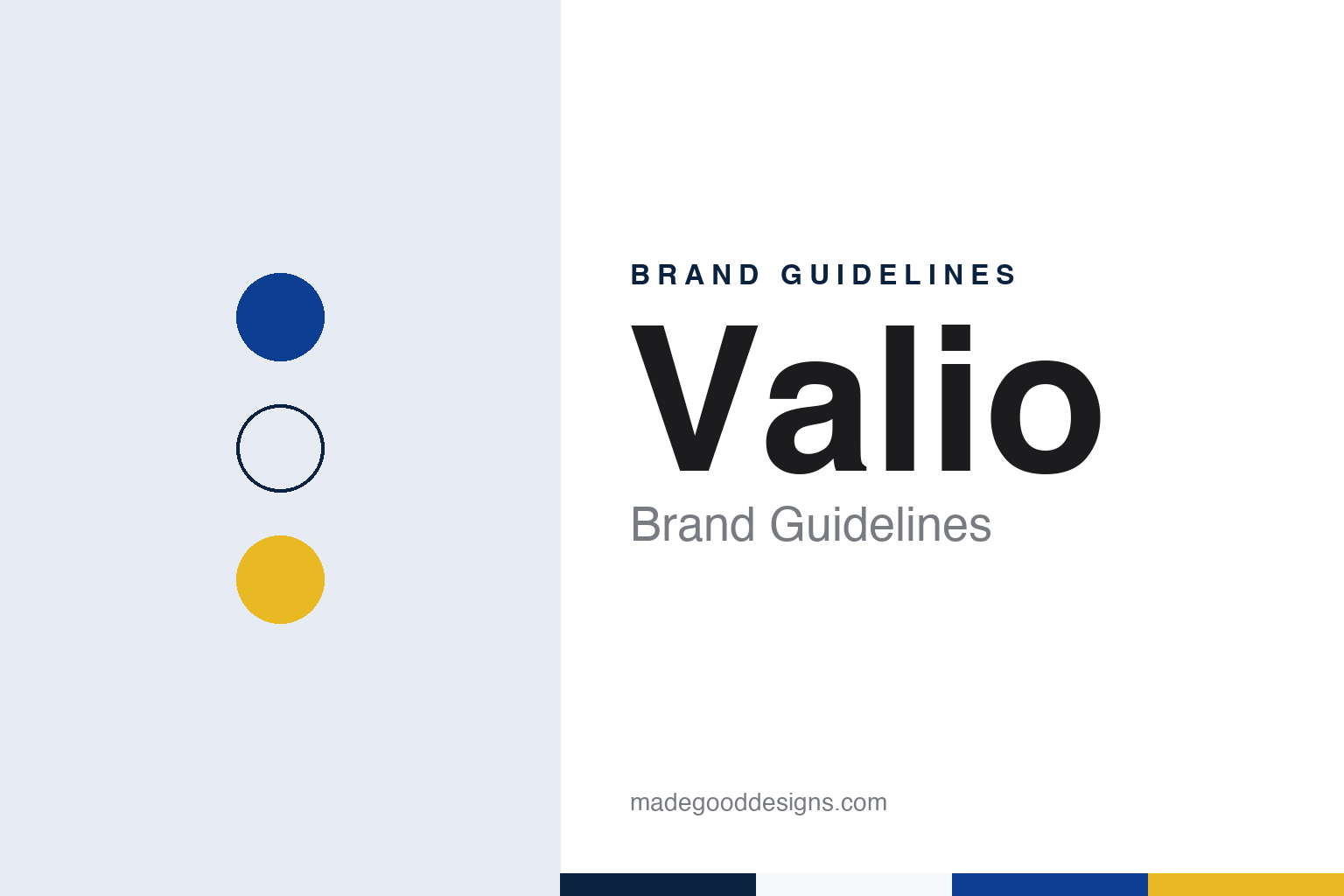
Valio Brand Guidelines
Finland’s butter export cooperative that became a dairy giant.
Aa
Two constants: a dairy blue, milk white and butter gold palette and a clean Nordic sans register. Abstract homage — not a Valio product or mark; no pack, logo or carton is reproduced.
The Butter Export Cooperative
Seventeen dairies, one word for quality and a port at Hanko.
Valio began in 1905 as Voinvienti-osuusliike Valio, the Butter Export Cooperative Valio. English Wikipedia says it was set up by 17 cooperative dairies, and Finnish Wikipedia says its purpose was to promote and supervise the quality of Finland’s export butter. Its operations began in the port town of Hanko, and its most important market was England.
The name was chosen with that purpose in mind. Finnish Wikipedia says it was proposed by Philip Suuronen, secretary of the Pellervo Society, the Finnish cooperative movement’s organisation, because the word refers to choice, top-grade quality. It suited a cooperative whose rule was to admit only dairies that produced good butter; seventeen qualified at the founding meeting. Valio says the cooperative grew quickly, to more than 150 members by 1910.
In the 1910s the business widened from butter into other dairy products, and Valio set up a laboratory: Finnish Wikipedia dates its chemical and bacteriological laboratory to 1916, while the company gives 1917. The laboratory made Valio’s name in science. Artturi Ilmari Virtanen joined it in 1919, aged 24, became its director two years later and stayed for about half a century. Finnish Wikipedia credits him with the AIV butter salt, patented in 1926, which helped Finnish butter regain its footing in England, and with the AIV fodder method of 1928. Virtanen received the Nobel Prize in Chemistry in 1945, and the company says the AIV silage method was licensed in the 1930s to countries including Sweden, the United Kingdom and the United States.
Colour
Cheese, Hyla and the lactose-free milk drink.
Cheese gave Valio many of its lasting names. English Wikipedia says Valio started making Koskenlaskija processed cheese in Helsinki in 1933; Finnish Wikipedia dates the Viola cheese spread to 1934 and says Aura blue cheese was first made in Turku in 1935 before production moved to Äänekoski in 1968. Haapavesi, a plant opened in 1965, makes mainly Oltermanni. Abroad, the company says it launched its Midnight Sun butter in Northern England and Scotland in 1962.
In 1955 the cooperative became Valio Meijerien Keskusosuusliike, and from 1956 trade with the Soviet Union dominated its exports until 1991, Finnish Wikipedia says. In the 1970s the company began the work it is now best known for abroad. Finnish Wikipedia says a 1975 project to find a use for whey led to a way of removing its lactose, and the method was then tried on milk. The result, the low-lactose Hyla milk powder, was test-marketed in 1978; a pasteurised Hyla milk followed in 1982. The name comes from “hydrolysed lactose.”
The next step was the lactose-free milk drink of 2001, which Finnish Wikipedia calls Valio’s first lactose-free product. It was barely advertised because demand was doubted, yet the first million litres sold within two months. Under EU rules it is labelled a lactose-free milk drink rather than milk. English Wikipedia describes the product as patented, and Valio licenses its lactose-free technology to dairies around the world.
In the United States Valio is known by another name. English Wikipedia says the Finlandia brand was developed in the late 1970s for the north-eastern US market, and that in 1992 Valio acquired the brand and took its cheese and butter nationwide.
Typography
Design and documentation.
The seven brands in this group are all Nordic food and dairy names: Kalles Kaviar, Felix, Estrella, Valio, Arla, Stabburet and Nidar. Nordic food brands in general sit at many different points in the trade, from names that still carry a founder’s story to brands that now belong to much larger food groups or farmer-owned co-operatives, and a single brand can be sold everywhere from a corner shop to a supermarket shelf.
A food brand’s identity is usually carried less by a single product than by a pack, a name and the meal or snack it promises, because the company behind the name may have changed hands, moved its factory or grown far beyond the town where it started. That makes the questions behind each name worth asking plainly: who started it, who owns it now, and where its food is actually made and packed.
Each guide separates what independent sources record from what the company says about itself — its founding story, its owners over time, where its products are made and how its packaging has changed — and marks plainly what rests only on the company’s own word.
Aa
A clean Nordic sans for a cooperative named after quality. (Specimen set in Libre Franklin, a sans STAND-IN; NOT the Valio logo.)
Valio
A company owned by farmers, a new logo and plant-based cartons.
In 1992 the nationwide cooperative turned into a limited company, Valio Oy, but it stayed in farmers’ hands. Finnish Wikipedia says that in 2022 Valio Oy was owned by 13 cooperatives, and that the five Valio Group procurement cooperatives, whose dairy farms supply its milk, form the core of its ownership; the farmers sit on its supervisory board and board of directors. The company is headquartered in Pitäjänmäki, Helsinki, and Finnish Wikipedia lists production in twelve Finnish localities in 2022, plus two plants in Estonia. A planned merger with Sweden’s Arla was called off around the turn of the millennium.
The portfolio has been reshaped since. Finnish and English Wikipedia say Valio sold its ice cream business to Nestlé in 2004, with Nestlé keeping long-term use of the Valio ice cream name; Valio returned to ice cream in 2018, the same year it launched the plant-based Oddlygood brand. In 2021 it bought the wholesaler Heinon Tukku, renamed Valio Aimo in 2022; in 2022 it bought the Gold&Green brand from Paulig and left Russia; and English Wikipedia says it bought Raisio’s plant-protein business, with the Härkis and Beanit brands, in 2025.
Two design changes are documented. Finnish Wikipedia says the current Valio logo was introduced in spring 2009, appearing first on basic milk cartons and spreading to the rest of the range between 2009 and 2011. Packaging changed too: Finnish Wikipedia says Valio introduced what it describes as the world’s first fully renewable milk carton in 2015, its board made from wood fibre and its plastic parts from sugar-cane-based ethanol, and that since 2018 all of Valio’s gable-top milk, buttermilk, yoghurt and cream cartons have been made entirely from plant-based materials. The company also says that in 1973 it became the first to pack infant food in aseptic Tetra Brik cartons.
For a design guide, Valio shows how a name chosen to mean “the best” in 1905 can carry a cooperative from export butter to lactose-free milk and plant-based cartons. Compare Fazer, another Helsinki food company with a long-lived identity, and Arla, the Nordic dairy cooperative it once planned to merge with. For this guide we use dairy blue, milk white and butter gold with a clean sans, an unofficial interpretation; no product or logo is reproduced.
Explore & save
Keep Valio’s identity on hand — save it to a board in the Made Good inspiration library.
Valio identity set
Pin the Valio dairy blue, milk white and butter gold palette and the clean Nordic sans register to your own board.