Podravka Brand Guidelines
The Koprivnica food company with a heart in its sign.
Aa
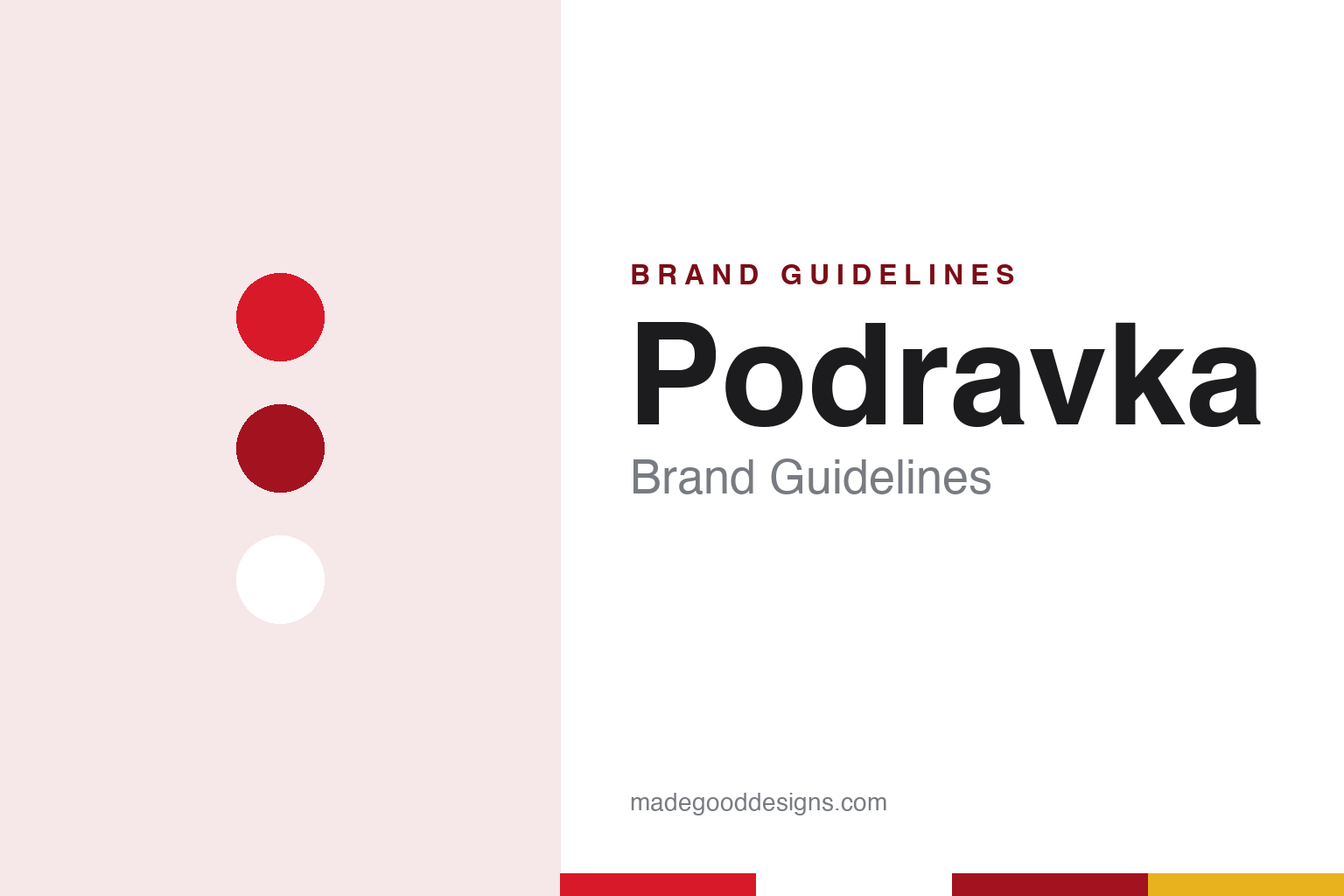
Two constants: a Podravka red on white palette and a warm grotesque register. Abstract homage — not a Podravka product or mark; no pack, logo or heart symbol is reproduced.
The Wolf workshop
A fruit business in Podravina becomes a state food company.
Podravka’s roots are in Koprivnica, a town in the Podravina region of northern Croatia, close to the Hungarian border. English Wikipedia says the brothers Marijan and Matija Wolf founded a fruit business there on 14 June 1934. The Croatian technical encyclopedia, published by the Miroslav Krleža Institute of Lexicography, describes fruit-processing workshops run for the Wolf brothers’ trading company between 1934 and 1945, alongside other Koprivnica food firms of the interwar years, including an oil company and a processed-meat factory.
The company that carries the name dates from 1947. After the Second World War the Wolf business was nationalised, and the encyclopedia says “Podravka, industrija za preradu voća i povrća” — a fruit and vegetable processing industry — was formed by merging the Wolf brothers’ canned-food business with other Koprivnica enterprises under state management. Podravka’s own history page starts its story in that year, describing how the Wolf brothers’ fruit-processing workshop and jam factory passed into social ownership and became Podravka. The company says the name comes from the word for a woman from the Podravina region.
The early work was fruit: jams, marmalades and compotes, with a quality-control laboratory opened in 1948, the encyclopedia says. English Wikipedia lists jam from 1949, and from 1952 sweets, mustard, ketchup, fruit brandy and canned meat. In 1957 came packet soups. The company names the first four as pea, two mushroom soups and a vegetable soup with semolina, followed in 1958 by chicken and beef soups with pasta, then sold as Zlatka and Simental.
The soups brought Podravka its first lasting image. The company says the rooster on its chicken soup became a symbol of a homely soup ready in five minutes; English Wikipedia calls the rooster a symbol in Yugoslavia. The soups were also where a chemical technician named Zlata Bartl, who had joined in 1955, first made her mark, before leading the team behind the product that would make Podravka known abroad.
Colour
Vegeta, a bear called Lino and a heart.
That product was Vegeta, a seasoning of salt, dried vegetables and spices, developed in Podravka’s laboratory in 1958 and on sale from 1959. It has its own guide on this site, Vegeta, because its story — the name, the packet, the television cookery — runs alongside the company’s rather than inside it. For Podravka it opened the door to exports: the company says its first agreements with foreign partners, in 1967, were for Vegeta, sent first to Hungary and to what Podravka calls Russia and English Wikipedia the Soviet Union.
Other brands followed. In 1970 Podravka began making Čokolino, a cereal for children, and the company says a teddy bear called Lino, used on its later baby-food flavours, is still the recognisable face of that range. In 1972 it founded Belupo, a pharmaceutical company, at Ludbreg near Koprivnica; a meat complex in the Danica industrial zone followed in 1973 and a Belupo factory there in 1981. English Wikipedia says Podravka founded a food museum in 1982, citing the Croatian museum documentation centre. In 2003 the company launched Coolinarika, which it describes as the first regional cookery website.
The company has written about its own identity. Its history page says the Podravka logo has changed over the years, and that its dominant colour, especially over the past thirty years, has been bright red on a white background. A heart sits in the company’s sign, it says, and its longest-running slogans have been “Od srca srcu” (“From heart to heart”) and “Kompanija sa srcem” (“The company with a heart”); a soup campaign used the rhyme “Kad se sa srcem kuha, kuha se Podravka juha” — roughly, when you cook with heart, you cook Podravka soup. English Wikipedia records that the company replaced its previous logo in January 2024.
Typography
Food brands of Central and Eastern Europe.
The seven brands in this group all make food or drink, and all of them come from Central Europe — from Poland, Hungary, Croatia and the Czech Republic: Prince Polo, Tymbark, Hortex, Pick, Podravka, Vegeta and Kofola. Food and drink brands from the region in general sit at many different points in the trade, from names that began in state enterprises to names that now belong to much larger food groups, and a single brand can be sold everywhere from a village shop to a supermarket shelf.
A food or drink brand’s identity is usually carried less by a single product than by a pack, a name and the meal or snack it promises, because the company behind the name may have changed hands, moved its factory or grown far beyond the town where it started. That makes the questions behind each name worth asking plainly: who started it, who owns it now, and where its products are actually made and packed.
Each guide separates what independent sources record from what the company says about itself — its founding story, its owners over time, where its products are made and how its packaging has changed — and marks plainly what rests only on the company’s own word.
Aa
A warm grotesque in the company’s red. (Specimen set in Archivo, a sans STAND-IN; NOT the Podravka logo.)
Podravka
From a state enterprise to a listed group.
After Croatia’s independence Podravka was privatised in 1993 and registered as a joint-stock company, and its shares have been quoted on the Zagreb Stock Exchange since 1998, the company says. English Wikipedia says money raised from the listing paid for three new factories, and in 2000 new Vegeta production opened in Koprivnica and in Poland; the company dates a new Vegeta factory in the Danica zone to that year.
Growth since then has come largely through acquisitions. Podravka bought the Czech company Lagris in 2002 and the fish brand Eva in 2006, English Wikipedia and the company say; in 2007 it bought Warzywko and Perfekt in Poland and Lero in Croatia, and in 2008 the cereal brands Čokolešnik and Čoko from Droga Kolinska, which announced the sale in October that year. It took over the fish processor Mirna in 2014, and in 2015 agreed to buy a majority of the Slovenian food group Žito, Reuters reported in April of that year; the company lists Žito, Zlato polje, Gorenjka, 1001 Cvet, Šumi and Maestro among the brands that came with it. In July 2024 Podravka signed a contract to take over the agricultural businesses of Fortenova Group, including Belje, PIK Vinkovci and Vupik, the Croatian news site Dnevnik.hr reported; the company lists the deal under 2025 and says it now runs them through a new company, Podravka Agri.
Today Podravka describes itself as a Croatian multinational with headquarters in Koprivnica, working in three segments — food, agriculture and pharmaceuticals — with more than 1,900 products and exports to more than 60 countries; its management board is chaired by Martina Dalić. Its main plants are in Koprivnica, where the company names a soups and Vegeta factory and the Danica site among its certified sites. Abroad, English Wikipedia says Podravka first produced in the United States in 2010, and Croatia Week reported in February 2017 that a Vegeta Podravka factory had opened at Bagamoyo in Tanzania. In April 2025 the Croatian portal tportal reported the end of the company’s largest investment cycle, including a new logistics centre in Koprivnica and new production and packing lines.
For a design guide, Podravka shows how a state-era food company built a brand on a heart, a red and a set of slogans while growing through a long run of acquisitions. Compare Vegeta, its best-known product, and Knorr, another soup and seasoning name. For this guide we use a bright red, a deeper red and white with a sans, an unofficial interpretation; no product or logo is reproduced.
Explore & save
Keep Podravka’s identity on hand — save it to a board in the Made Good inspiration library.
Podravka identity set
Pin the Podravka red on white palette and the warm grotesque register to your own board.