Fleury Michon Brand Guidelines
The Vendée charcutier behind surimi and Robuchon ready meals.
Aa
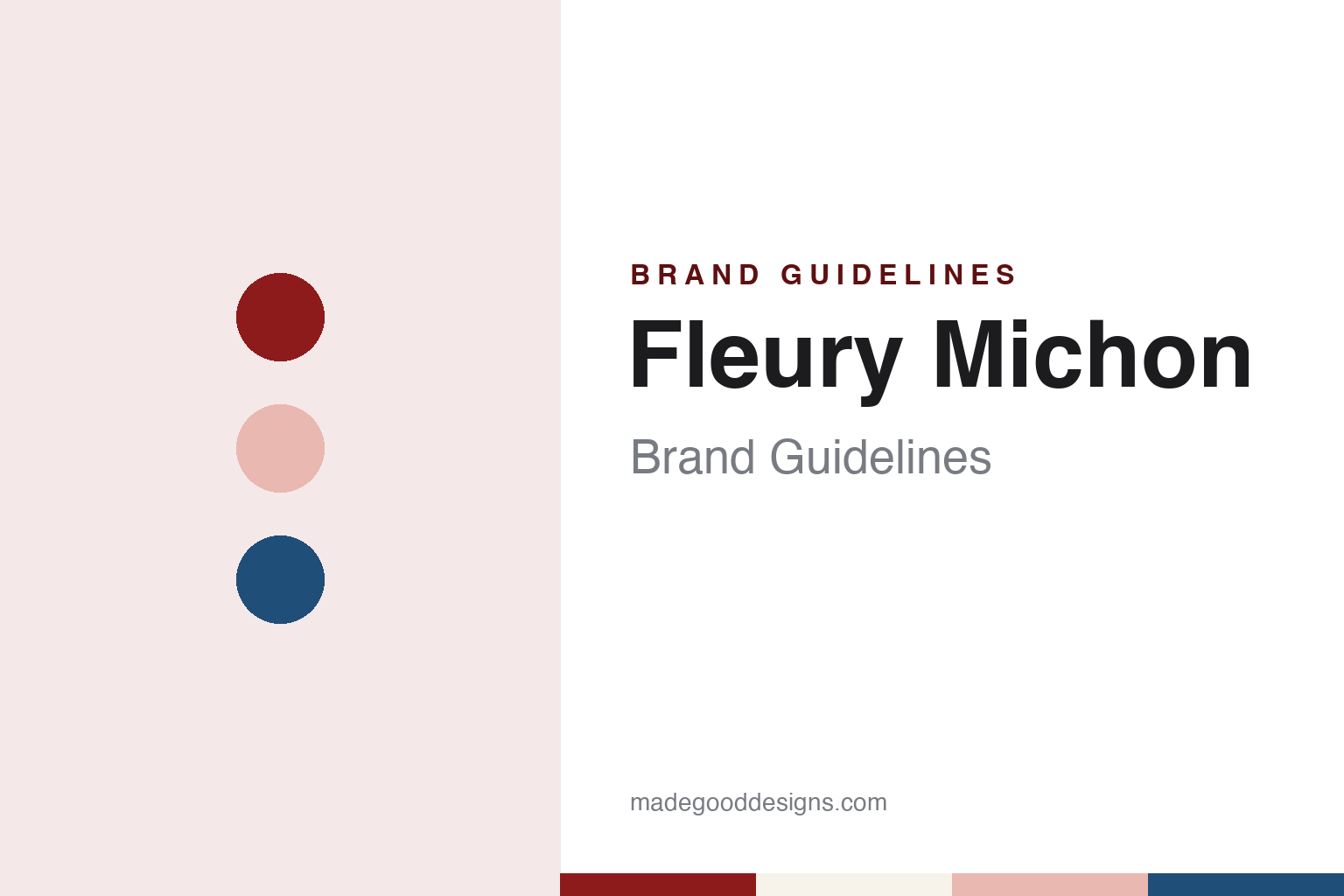
Two constants: a charcutier red, ham rose and Atlantic blue palette and a traditional display serif register. Abstract homage — not a Fleury Michon product or mark; no pack, logo or product is reproduced.
Two brothers-in-law
A Vendée charcutier, a meat trader and a Paris shop.
Fleury Michon traces its roots to Félix Fleury, a charcutier who, the company says, opened a shop in La Roche-sur-Yon, in the Vendée, in 1885, with the motto “Il faut faire les choses comme il faut” (“Things must be done properly”). The journalist Jean Watin-Augouard, in a history of the brand published by La Revue des marques in January 2015, says that in December 1904 Fleury went into partnership with his brother-in-law Lucien Michon, a meat trader. From a base in the Les Halles market district of Paris they set up a pork-trading business, named Établissements Fleury & Michon in January 1905.
The second generation took the firm towards charcuterie. La Revue des marques says that in 1934 Pierre Fleury bought the Société des abattoirs de Vendée in Pouzauges, which made some cured meats, canned meat and dry sausage; the company says it moved to Pouzauges that year, and its head office is still there. The magazine says the Fleury Michon brand itself was not registered until April 1966.
Technique set the company apart. La Revue des marques dates to 1947 the introduction of slow-cooking ham under vacuum in a plastic pouch, using technology from the American company Cryovac, which gave the product six weeks of shelf life; the company places this invention in the 1950s. The third generation, Jacques Chartier, Pierre Fleury’s son-in-law, expanded industrial charcuterie in the early 1950s, and in 1957, the magazine says, Fleury Michon was among the first charcutiers to sell pre-packed ham and sausage in self-service, in the first pre-packed sachets. A factory at Chantonnay opened in 1969.
Colour
Ready meals, a three-star chef and surimi.
The fourth generation changed what Fleury Michon made. La Revue des marques says Yves Gonnord, a vet who married Jacques Chartier’s daughter in 1961, joined in 1964, set up the company’s first in-house laboratory and ran the business from 1979. Having seen the growth of fresh take-away dishes in the United States, he applied the company’s low-temperature vacuum cooking to fresh ready meals, made in a new plant at Mouilleron-en-Pareds. The first fresh ready meal was launched for restaurants in 1975, and the first for supermarket shelves in 1979, the magazine says; in 1984 the company sold its last slaughterhouse and cannery to concentrate on charcuterie and ready meals.
Two partnerships shaped the brand. In 1987 the chef Joël Robuchon became the brand’s culinary adviser, and La Revue des marques says his portrait appeared on some products from 1991. Fleury Michon ham carried the Label Rouge quality mark at the counter from 1973 and in self-service from 1987, according to La Revue des marques. From 1982 to 1994 the company equipped thirteen racing yachts for the navigator Philippe Poupon, several of them named Fleury Michon.
Then came fish. The company dates its first surimi to 1990; La Revue des marques says Yves Gonnord brought the idea back from Japan in 1986 and that one of Europe’s first surimi-stick lines opened at Chantonnay in 1987. In 2014, to answer doubts about what surimi contains, the brand launched “Venez vérifier” (“Come and check”), a campaign in which, the magazine says, Alaska pollock fishermen invited sceptics to sea and consumers were asked to visit the factory; French Wikipedia says the visits were to the Chantonnay seafood plant.
The brand’s voice has changed with each era. La Revue des marques lists its slogans as “L’exquis” (1930), “Fleury Michon, irrésistiblement bon” (1969), “Fleury Michon, c’est bon” (1975), “Fleury-Michon, on sait pourquoi c’est si bon” (1999) and “L’obsession du bon” (2011). It also says that, after a 1997 study found consumers split over a brand that was both industrial and culinary, Fleury Michon adopted a new logo designed by the agency Dragon Rouge.
Typography
Design and documentation.
The seven brands in this group all make food, and all of them come from France: Herta, Fleury Michon, Banania, Tipiak, Cassegrain, Saupiquet and Bjorg. French food brands in general sit at many different points in the trade, from family firms that still carry a founder’s surname to names that now belong to much larger food groups, and a single brand can be sold everywhere from a village grocer to a hypermarket shelf.
A food brand’s identity is usually carried less by a single product than by a pack, a name and the meal or snack it promises, because the company behind the name may have changed hands, moved its factory or grown far beyond the town where it started. That makes the questions behind each name worth asking plainly: who started it, who owns it now, and where its food is actually made and packed.
Each guide separates what independent sources record from what the company says about itself — its founding story, its owners over time, where its food is made and how its packaging has changed — and marks plainly what rests only on the company’s own word.
Aa
A traditional display serif for a charcutier’s house founded in 1905. (Specimen set in Playfair Display, a serif STAND-IN; NOT the Fleury Michon logo.)
Fleury Michon
A listed company still run by the founding family.
Fleury Michon has remained in the hands of the founders’ descendants through five generations. In 2008 Grégoire Gonnord succeeded his father, Yves Gonnord, at the head of the group, French Wikipedia says; La Revue des marques describes him as Félix Fleury’s great-great-grandson. The company floated on the Second Marché of the Paris Bourse on 10 February 2000, the magazine says, reserving part of its capital for employees, and French Wikipedia says its shares now trade on Euronext Growth. The company says its capital is still mostly family-owned.
The group grew through acquisitions. It bought its rival Olida in February 1992, La Revue des marques says, and abroad it acquired Delta Dailyfood in Canada in 2006 and the Italian company Fresco in 2011. In July 2019 it took a 90% stake in Marfo Food Group, an airline caterer, the trade magazine LSA reported.
Production remains mostly in the west of France. French Wikipedia names sites at Pouzauges, Mouilleron-en-Pareds and Chantonnay in the Vendée, and the company says a new ham plant opened at Cambrai, in the north, in 2012; Ouest-France reported in February 2023 the closure of its site in Brittany. The company dates its poultry slices to 1994 and a “zero nitrite” range and wooden trays for its ready meals to 2019.
For a design guide, Fleury Michon shows how a family charcutier’s name, a chef’s portrait and a campaign that invited people to “come and check” can carry one brand from ham to surimi. Compare Herta, its long-time rival in pre-packed charcuterie, and Bonduelle, another French family-controlled food group. For this guide we use a charcutier red, a ham rose and an Atlantic blue with a serif, an unofficial interpretation; no product or logo is reproduced.
Explore & save
Keep Fleury Michon’s identity on hand — save it to a board in the Made Good inspiration library.
Fleury Michon identity set
Pin the Fleury Michon charcutier red, ham rose and Atlantic blue palette and the traditional display serif register to your own board.