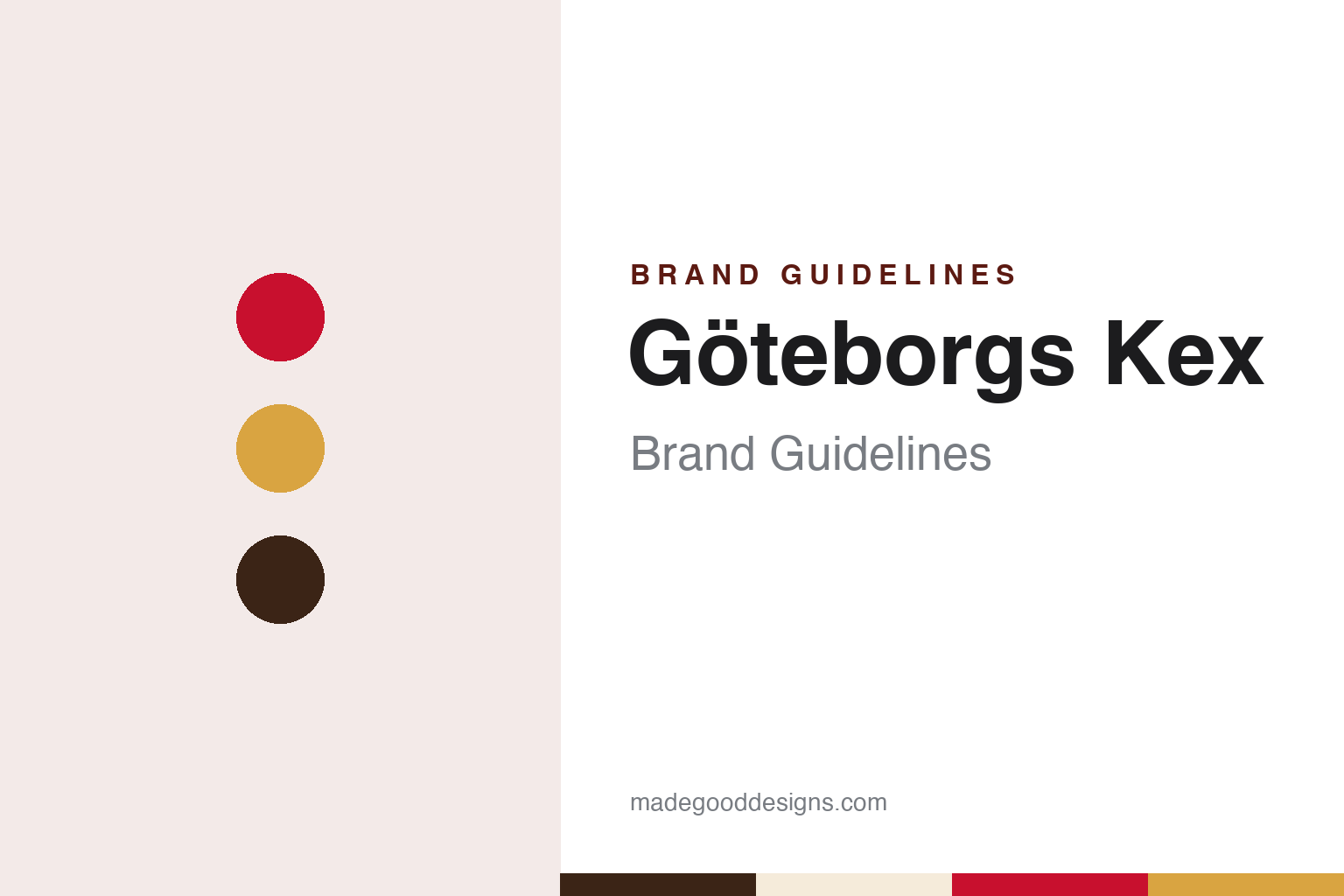
Göteborgs Kex Brand Guidelines
The Kungälv biscuit maker of 1888, now baked in Riga.
Aa
Two constants: a biscuit red, golden bake and cocoa palette and a classic biscuit-tin serif register. Abstract homage — not a Göteborgs Kex product or mark; no pack, logo or biscuit is reproduced.
British biscuits by the river
A Gothenburg merchant, a Glasgow baker and a tariff.
Despite its name, Göteborgs Kex was never baked in Gothenburg. Its factory stood in Kungälv, about 20 kilometres north of the city on the Nordre Älv river, and the name came from its founder’s base. Carl Leopold Berggren was a Gothenburg wholesaler and shipowner, the Royal Swedish Academy of Engineering Sciences (IVA) wrote in a 2022 profile; he exported Swedish iron and timber, imported flour and colonial goods, and in 1875 had founded a glassworks on land he owned in Kungälv. In 1874 he married an Englishwoman, Ellen Birch, and the company says she wanted proper biscuits for her afternoon tea, a taste shared by the many British merchant families then living in Gothenburg.
Berggren imported British biscuits until Sweden raised its import duties in the late 1880s. Swedish Wikipedia links the decision to the tariff disputes of 1887; the company dates the duty rise to 1888. Either way, Berggren decided to bake British-style biscuits at home. Through his British contacts he found a partner in Robert Cruickshank of Glasgow, who came to Sweden in June 1888 with his family and five bakery workers, according to Per T. Ohlsson’s 2007 book Konservkungen, as cited by Swedish Wikipedia. The company’s articles were adopted on 13 July 1888, the first trial bake took place on Lucia Day, 13 December 1888, and full production began in 1889. Cruickshank was a part-owner and ran production until 1896. The company says Kungälv was chosen for its river: steamboats and flour barges could tie up at the factory.
Success came quickly. In 1897 the firm was appointed a purveyor to the Swedish royal court, and the company says its biscuits went with polar expeditions, among them S. A. Andrée’s balloon flight towards the North Pole that year and Otto Nordenskjöld’s Antarctic expedition of 1901. By 1910, the company says, it sold 140 products, packed in decorated tins and mostly sold loose by weight. The Marie biscuit became its biggest seller.
Colour
Wafers, sandwich biscuits and one name on every pack.
The founding family kept control for 90 years. Berggren’s nephew Edward Berggren ran the company from 1901, and control later passed to his son-in-law Ernst Colliander; from 1947 the family held the business through a company called AB Bisco, Swedish Wikipedia says. Thin sandwich wafers, the smörgåsrån, arrived in 1935, and the ovens were switched to electric heating under the motto “Elektriskt bak ger bästa smak” — electric baking gives the best taste. In the early 1950s two 55-metre band ovens replaced loose baking trays, according to the company’s 1988 centenary history by Ingrid Arensberg and Stefan Hallberg.
The best-known names followed. Swedish Wikipedia, citing a 2014 article in the business-history magazine Företagshistoria, dates Brago to 1958, Ballerina to 1963 and Singoalla to 1964; Remi came in 1968. In the 1960s, the company says, it began advertising in four colours in leading women’s and family magazines, and its biggest products were Guld Marie, Snackers and Kungälvs Pepparkakor. In 1967 it bought the rival Örebro Kexfabrik outright and later closed its bakery there; Brago had begun as an Örebro product.
The pack design was brought together in the 1970s. The company says the graphic look of its packs had been pulling in different directions, so from 1974 Göteborgs Kex became the single brand on all its products and the Örebro Kex name was dropped. Swedish Wikipedia, citing the centenary history, says a new logo was launched that year together with uniform packaging. The company says packs were updated again in the 1980s, when exports to the Netherlands and the United States grew and the filled range spread to flavours from raspberry to liquorice. In 2010 the company turned Ballerina into a kladdkaka, a sticky chocolate cake, which it calls a big success.
Typography
Design and documentation.
The seven brands in this group all make food, and all of them come from Denmark, Sweden or the Netherlands: Toms, Kelsen, Göteborgs Kex, Polarbröd, HAK, De Ruijter and Venz. Food brands from these countries sit at many different points in the trade, from family firms that still carry a founder’s surname to names that now belong to much larger food groups, and a single brand can be sold everywhere from a corner shop to a supermarket shelf.
A food brand’s identity is usually carried less by a single product than by a pack, a name and the meal or treat it promises, because the company behind the name may have changed hands, moved its factory or grown far beyond the town where it started. That makes the questions behind each name worth asking plainly: who started it, who owns it now, and where its food is actually made and packed.
Each guide separates what independent sources record from what the company says about itself — its founding story, its owners over time, where its food is made and how its packaging has changed — and marks plainly what rests only on the company’s own word.
Aa
A classic serif for a biscuit house that began with decorated tins. (Specimen set in Libre Baskerville, a serif STAND-IN; NOT the Göteborgs Kex logo.)
Göteborgs Kex
Marabou, Orkla and a move to Latvia.
The family era ended in 1979, when the Colliander family sold the company to the Swedish chocolate maker Marabou; the company says new, larger investments needed a bigger owner. Before that it had looked abroad: in 1971 it bought the Danish biscuit maker Jul. A. Jørgensen in Aarhus, a response to worries about being outside the European Community, and kept Danish operations until 1981, Swedish Wikipedia says, citing the centenary history.
In 1994 the Norwegian branded-goods group Orkla bought Göteborgs Kex. Inside Orkla it sat alongside two other biscuit companies, Sætre in Norway and Kantolan Keksi in Finland, and since 2014 it has been part of Orkla Confectionery & Snacks Sverige, formed when Orkla merged Göteborgs Kex with the snack maker OLW, Swedish Wikipedia says. The Göteborgs Kex website, run by Orkla, today presents Ballerina and Singoalla as brands in their own right.
The biggest change came in production. In January 2018 SVT reported that Orkla was investigating a move, and on 11 June 2018 it confirmed the decision: biscuit production would continue in Kungälv until 2022 and then move to a new, modern factory to be built outside Riga, Latvia. The food workers’ union Livs called the decision irresponsible and risky, SVT reported. Orkla said product development would stay in Sweden, and in 2021 the local paper Kungälvs-Posten reported the opening of a test bakery in nearby Liljedal. The factory shop, the Bräckboden, closed in August 2022, and on 20 December 2022 the last pack of Ballerina came off the Kungälv line after 134 years, Dagens Nyheter reported; the news service Omni put the loss at 300 jobs in Kungälv. The old factory site is being redeveloped as a new district called Kexstaden.
For a design guide, Göteborgs Kex shows how a Kungälv biscuit house, its royal warrant and one name gathered onto every pack in 1974 can outlast its own factory. Compare Marabou, the Swedish chocolate maker that owned it from 1979, and Leksands, a family-run Swedish crispbread bakery. For this guide we use a biscuit red, a golden bake and cocoa brown with a classic serif, an unofficial interpretation; no product or logo is reproduced.
Explore & save
Keep Göteborgs Kex’s identity on hand — save it to a board in the Made Good inspiration library.
Göteborgs Kex identity set
Pin the Göteborgs Kex biscuit red, golden bake and cocoa palette and the classic biscuit-tin serif register to your own board.