Polarbröd Brand Guidelines
The Älvsbyn soft-bread bakery rebuilt after the 2020 fire.
Aa
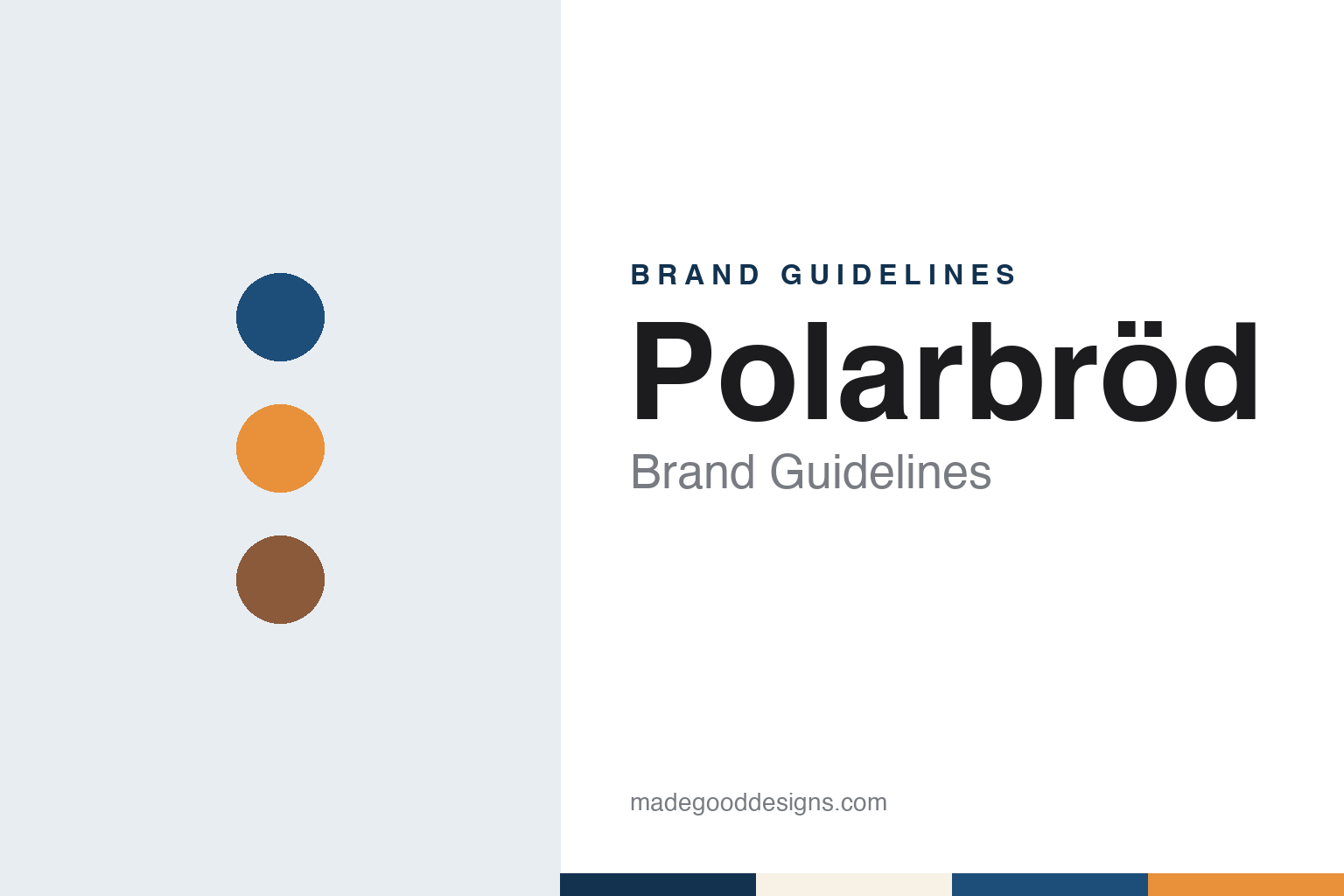
Two constants: an arctic blue, midnight-sun orange and rye crust palette and a soft northern sans register. Abstract homage — not a Polarbröd product or mark; no pack, logo or bread is reproduced.
Five generations in Älvsbyn
A baker from Gothenburg, navvies and a ten-öre cake.
Polarbröd is still based where its family began baking: Älvsbyn, a small town in Norrbotten, Sweden’s northernmost county. The story starts with Johan Nilsson, a newly qualified baker from Gothenburg who had earned his master’s certificate in Piteå. A history of the bakery published by the Norrbottens museum in 2020, written by Marcus Bodin, author of the company history Utstickare, dates his arrival in Älvsbyn to 1878; the business-history magazine Företagshistoria gave the year as 1879 in 2023. With his wife Hilda Nordström he baked for the village’s 850 inhabitants and for the navvies working on the rivers, and later for the railway workers laying the main northern line. He rented the bakery at first and bought it in 1885.
Trade dropped when the railway was finished in 1893 and the navvies moved on. In 1912 his son Frans Gustav Nilsson took over a bakery in debt. In 1926 he built a new bakery, and in its wood-fired oven he baked his own version of the local thin soft bread, made from a rye-and-wheat flour, water, salt and yeast. He called it the Tioöreskaka, the ten-öre cake, after its price. The cakes had a hole in the middle and were hung on poles to dry, the museum history says. That bakery closed in 1959.
His son Gösta Nilsson and Gösta’s wife Greta ran a café in Älvsbyn. After some years Gösta began baking his father’s cake again, from memory, adding margarine, syrup and sugar so it would freeze well, and called it the Älvsbykaka. Greta spread it with butter and smoked reindeer, folded it and froze it so that she could thaw sandwiches quickly for busy days. She called it a Rågstrut, or rye cone; it later became known across Sweden as the Renklämma.
Colour
Polarkaka, a reindeer and a sunset.
Demand grew until, by 1972, Gösta and his staff were baking 1,800 cakes a day in an oven that held six at a time, the museum history says. That year he and Greta set up a separate bakery for the soft rye cake, Polarbageriet AB, and renamed the bread Polarkaka. It was baked in a basement, frozen straight after baking and could therefore be sold all over Sweden. Swedish Wikipedia gives the founding as 1971 in its opening line and 1972 in its fact box; both the museum history and Företagshistoria date the company to 1972.
The name was a deliberate choice. Företagshistoria reported in 2023 that Greta wanted the bread linked with Norrland, the whole of northern Sweden, rather than Norrbotten in particular, which had an uneasy reputation after the large miners’ strike of 1969–70. So the bread became Polarkaka and the company Polarbageriet, later renamed Polarbröd AB, with a reindeer in front of a setting sun as its symbol. Greta sold the bread in nearby towns by bus and through delivery boys; their daughter Margareta Jonsson told the magazine that her mother saw the main market in the Mälaren valley, around Stockholm.
In 1977 a new bakery opened on Älvsbyn’s industrial estate, and through the 1980s and 1990s Polarkaka, wheat cakes and soft thin bread were baked around the clock. The company bought bakeries in Kramfors and in Bredbyn, near Örnsköldsvik, and began exporting to Norway and France, Företagshistoria reported; the Kramfors bakery at Omne was sold in 2018, the newspaper Allehanda reported that April. In 1991 Gösta Nilsson led the restoration of his father’s 1926 bakery, which reopened as a bakery museum run by the company. Two family-pack breads introduced in the 1990s, Vetekaka and Rågkaka, were replaced in April 2026 by PolarVete and PolarRåg, with new recipes and a new pack design meant, the company said, to stand out from look-alike products with similar names on the bread shelf.
Typography
Design and documentation.
The seven brands in this group all make food, and all of them come from Denmark, Sweden or the Netherlands: Toms, Kelsen, Göteborgs Kex, Polarbröd, HAK, De Ruijter and Venz. Food brands from these countries sit at many different points in the trade, from family firms that still carry a founder’s surname to names that now belong to much larger food groups, and a single brand can be sold everywhere from a corner shop to a supermarket shelf.
A food brand’s identity is usually carried less by a single product than by a pack, a name and the meal or treat it promises, because the company behind the name may have changed hands, moved its factory or grown far beyond the town where it started. That makes the questions behind each name worth asking plainly: who started it, who owns it now, and where its food is actually made and packed.
Each guide separates what independent sources record from what the company says about itself — its founding story, its owners over time, where its food is made and how its packaging has changed — and marks plainly what rests only on the company’s own word.
Aa
A soft, rounded sans for a soft northern bread. (Specimen set in Nunito Sans, a sans STAND-IN; NOT the Polarbröd logo.)
Polarbröd
A family company, a fire and a new bakery.
Polarbröd has stayed in the family. The founders’ daughters and their husbands took over the business, Företagshistoria reported; Margareta Jonsson became the company’s accountant and later head of its sales company, and her husband Kjell developed machinery to slice and fold the bread. The magazine said the family borrowed heavily when ownership changed, with help from the regional fund Norrlandsfonden, the state lender Almi and Handelsbanken. Today the group is led by the founders’ granddaughter Karin Bodin, its largest single owner, and also includes a distribution company and its own wind-power company, Polarkraft, which the company says has generated electricity for the group since autumn 2014. The company calls itself Sweden’s third-largest producer of bread, and its slogan is “Gör världen lite godare” — roughly, make the world a little better.
On the evening of 23 August 2020 a large fire broke out at the bakery in Älvsbyn, Aftonbladet reported that night, and the main factory could not be saved. In a press release two days later the company said 245 employees were without a workplace, that it was running its second bakery in Bredbyn at full capacity and had already begun baking products there that had previously been made only in Älvsbyn, and that it was looking for partners in the industry for both bread and sandwiches. The rebuilt bakery in Älvsbyn was inaugurated in May 2022, as part of the company’s 50th anniversary; Företagshistoria published a photograph of Crown Princess Victoria unveiling the Polarbröd sign on 10 May 2022, one of the few things to have survived the fire.
For a design guide, Polarbröd shows how a café recipe, a reindeer under a setting sun and a name chosen to say “the north” can carry a family bakery from a basement to supermarkets across Sweden. Compare Wasa, the crispbread first baked in Skellefteå, and Leksands, another Swedish family bread bakery. For this guide we use arctic blue, a midnight-sun orange and rye-crust brown with a rounded sans, an unofficial interpretation; no product or logo is reproduced.
Explore & save
Keep Polarbröd’s identity on hand — save it to a board in the Made Good inspiration library.
Polarbröd identity set
Pin the Polarbröd arctic blue, midnight-sun orange and rye crust palette and the soft northern sans register to your own board.