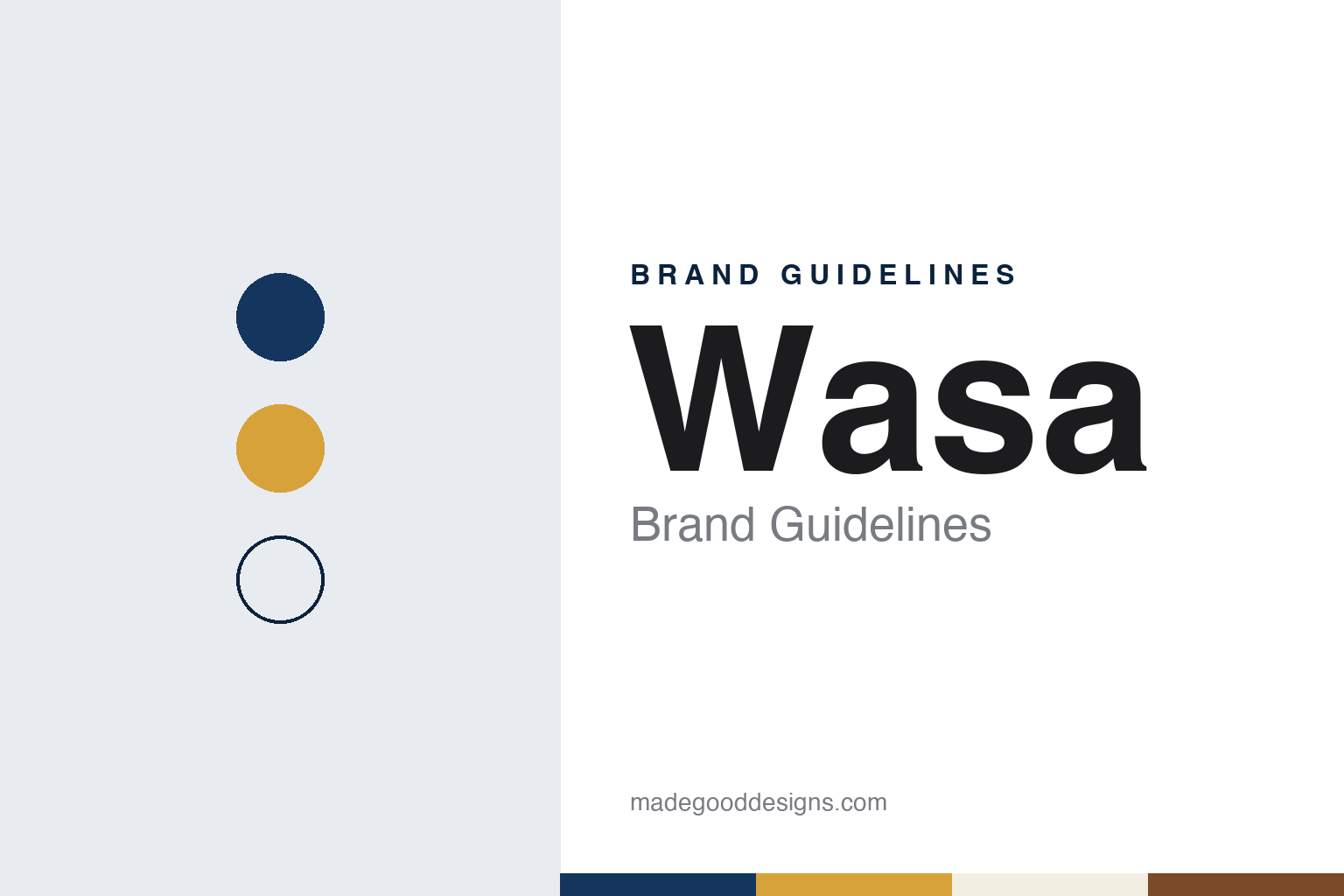
Wasa Brand Guidelines
The Skellefteå crispbread named after a Swedish king.
Aa
Two constants: a Wasa royal blue and crown gold palette and a Royal serif register. Abstract homage — not a Wasa product or mark; no pack, logo or coat of arms is reproduced.
Skellefteå
A baker in the north of Sweden.
Wasa began far from where it is baked today. The company says it was founded in 1919 in Skellefteå, a town on the Gulf of Bothnia in northern Sweden, by the baker Karl Edvard Lundström, and that it was then called the Skellefteå Spisbröd Factory — in Swedish, AB Skellefteå Spisbrödsfabrik; spisbröd is an older Swedish word for crispbread. English and Swedish Wikipedia give the same founder, town and year, and English Wikipedia adds that Lundström had run his own bakery in Skellefteå since 1915.
In 1931 the business moved south. “In 1931 we moved to Filipstad after K.E Lundström acquired Filipstads Bageri AB. And is still where we remain today,” the company says. English Wikipedia describes the Filipstad plant, in the province of Värmland, as a completely mechanised bakery that became the company’s main seat. Swedish Wikipedia says that in 1933 Lundström succeeded in baking crispbread on a conveyor belt and developed Wasa Husman, which became a best-seller across Sweden.
The company’s names changed with the brand. According to English Wikipedia, the Filipstad business took the name AB Wasa spisbrödsfabrik in 1934, shortened to AB Wasabröd in 1964. Swedish Wikipedia also says Lundström bought other bakeries, among them firms baking light wheat crispbread in Linköping and delicacy breads in Kristianstad, and ran the company until 1959, when his son Ulf took over.
Wasa was built for export. English Wikipedia says the company began exporting in the 1940s, set up its first foreign subsidiary in Denmark in 1965 and built its first foreign bakery in Celle, in Germany, in 1967.
Colour
Named after a king.
The name is a royal one. In a question-and-answer page archived in 2019, Barilla’s Swedish company explained that Wasabröd combines “Wasa” and bröd, bread, with Wasa taken “after Sweden’s king Gustav Vasa”; it said the name was chosen to create a brand every Swede would recognise. Gustav Vasa reigned in the sixteenth century and founded the Vasa dynasty. Swedish Wikipedia says his image once decorated the bread packets.
English Wikipedia adds that “Wasa” was at first the name of one product, Vasaknäcke, which carried a picture of the king, and that the company has used both a royal crown and the garb — the sheaf of grain, vase in Swedish, that gave the Vasa dynasty its name — in its marketing. It notes that spelling the name with a W rather than a V is an archaism common in Swedish marketing and does not change the pronunciation. That passage is marked as needing citations, so we give it as English Wikipedia’s account.
A second royal link is documented. Wasa is a purveyor to the Royal Court of Sweden, English Wikipedia records, and the company says it became a royal warrant holder in the 1950s, which, it says, allows it to use the Greater Coat of Arms as an emblem on its packaging; Swedish Wikipedia dates the warrant to the 1930s, so the two accounts differ.
Ownership left Sweden in the 1980s. Wasa was sold to the Swiss pharmaceutical group Sandoz — in 1982 according to Swedish Wikipedia, in 1983 according to English Wikipedia — and Sandoz later merged with Ciba-Geigy to form Novartis. In 1999 the business passed to the Italian pasta maker Barilla, the parent of brands including Mulino Bianco, and the company’s website footer says: “Wasa is a part of the Barilla Group.”
Typography
Crispbread and the cracker shelf.
The seven brands in this group all make crispbreads, crackers or oatcakes — the dry, savoury side of the biscuit aisle — and they come from four countries: Ryvita, Peter’s Yard and Carr’s from England, Nairn’s from Scotland, Wasa and Leksands from Sweden, and Finn Crisp from Finland. Brands of this kind sit at many different points in the trade, from long-established supermarket staples to younger names sold through delicatessens, and a single maker can bake under its own name and for other people’s labels at the same time.
A cracker brand’s identity is usually carried less by the product itself, which can look much the same from one maker to the next, than by a grain, a pack and the story told about where it began. That makes the questions behind each name worth asking plainly: who started it, who owns it now, and where its crispbreads, crackers or oatcakes are actually baked today.
Each guide separates what independent sources record from what the company says about itself — its founding story, its owners over time and where it bakes — and marks plainly what rests only on the company’s own word.
Aa
A royal serif — a name taken from Gustav Vasa. (Specimen set in Fraunces, a serif STAND-IN; NOT the Wasa logo.)
Wasa
Filipstad and Celle.
Wasa’s crispbread is made in two documented places: Filipstad in Sweden and Celle in Germany. In a press release of 5 May 2021, Barilla said it would invest more than a billion kronor — 1.2 billion in the headline — in the Wasa bakeries in both towns over five years, including more than 700 million kronor in Filipstad, where a new production line would be added to the newer part of the bakery and lines in the older part phased out. An earlier programme, announced by Wasabröd, put 150 million kronor into the Filipstad bakery between 2009 and 2014. A 2005 study of the plant, cited by English Wikipedia, put its output at 33,000 tonnes of crispbread a year.
The company calls itself the world’s largest producer of crispbread, and its 2019 question page said Wasa was sold in more than 40 countries; we give both as its own claims. Its history page also records a 1991 competition in which consumers were asked which side of a crispbread they butter — the smooth back won, with 3,427 of 5,229 votes, it says — and a 2007 mention on Oprah Winfrey’s television show. For its centenary in 2019 it launched Wasa 100, which it describes as wholegrain and “climate compensated.” We found no published brand guidelines and no documented typeface or colour codes.
For a design guide, Wasa shows how a royal name and heraldry can carry a plain product from a small northern town to an international owner. Compare Mulino Bianco, its stablemate at Barilla, and Marabou, another Swedish food brand now under foreign ownership. For this guide we use a royal blue, a crown gold and a rye brown with a serif, an unofficial interpretation; no product or logo is reproduced.
Explore & save
Keep Wasa’s identity on hand — save it to a board in the Made Good inspiration library.
Wasa identity set
Pin the Wasa royal blue and crown gold palette and the Royal serif register to your own board.