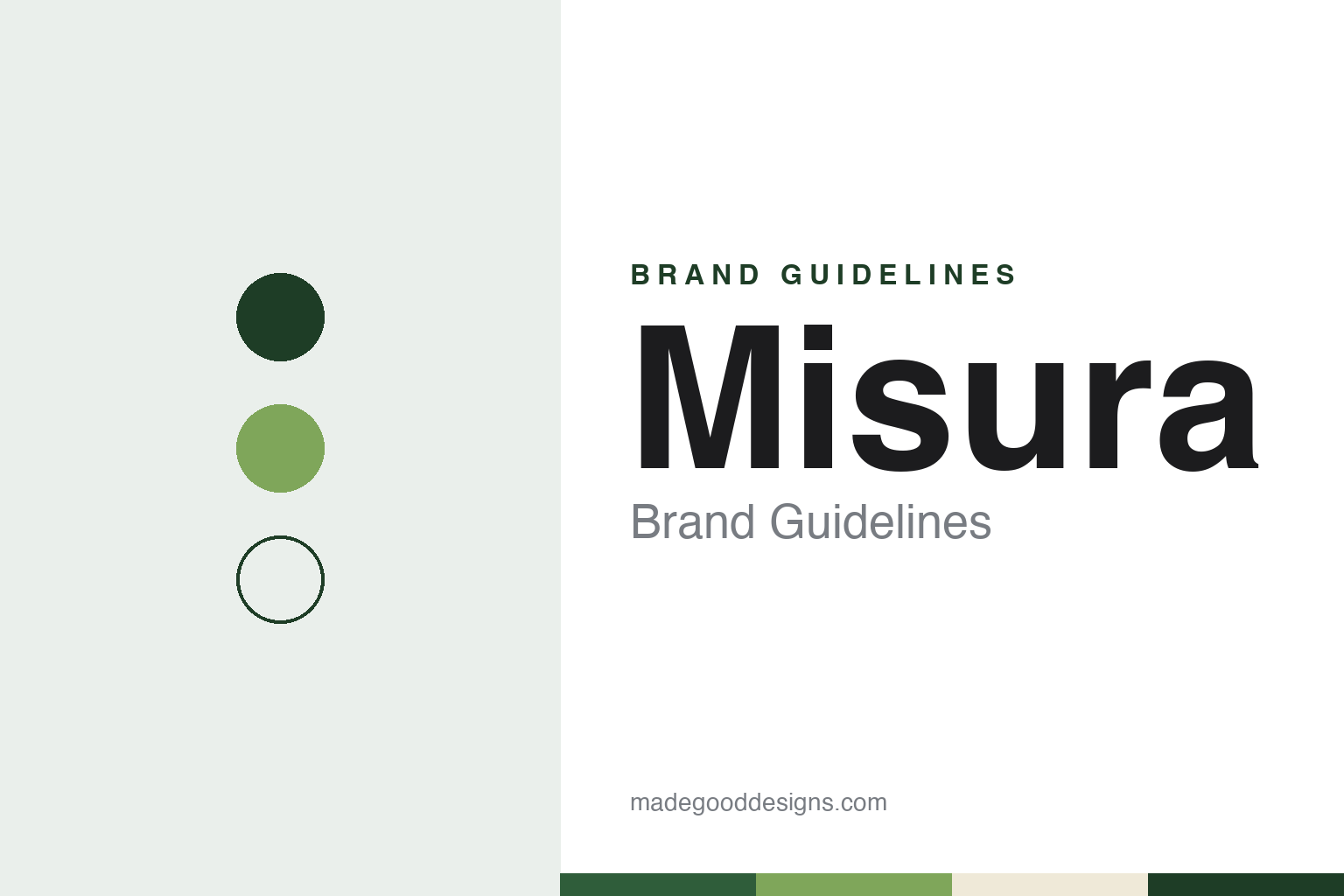
Misura Brand Guidelines
The Heinz-born wellness brand that Colussi bought in 1996.
Aa
Two constants: a Misura green and oat palette and a rounded sans register. Abstract homage — not a Misura product or mark; no pack, logo or biscuit is reproduced.
A Heinz brand
Born inside the Plasmon business.
Misura did not begin as a Colussi brand. It was created inside the Italian food business of the American company H. J. Heinz, according to Italian Wikipedia’s history of Plasmon, the Milan maker of infant foods and biscuits whose Italian company was founded in 1902 by the doctor Cesare Scotti.
Heinz bought the Società del Plasmon in 1963, the same account says, and in 1976 renamed it Plada – Plasmon Dietetici Alimentari. From the end of the 1970s Plada began to diversify beyond infant food, launching new ranges including a line for older children and the line of foods sold as Misura, which Italian Wikipedia describes as dietetic. No exact launch year appears in the sources checked, so we give it as the late 1970s.
Through the 1980s and early 1990s Heinz’s Italian arm bought and sold a series of sweet and food brands — the confectioner Sperlari in 1981, Nipiol in 1983, and later Galatine — and changed its own company name several times between Plada and Heinz Italia. In 1995, Italian Wikipedia says, it sold Fitgar, a range of isotonic sports drinks that had begun as part of the Misura line, to the Schiapparelli group.
The business Misura came from had deep roots of its own. Italian Wikipedia says the Società del Plasmon built its first factory in Milan in 1932, rebuilt it after wartime bombing, and that after the Heinz takeover a new plant was built at Latina, south of Rome, in 1967, where production was later concentrated. In 1993 Heinz’s Italian arm sold its confectionery division, with Sperlari and its other sweet brands, to the American company Hershey Foods. Misura was one of the brands that Heinz’s Italian business later sold, three years after the confectionery sale.
Colour
Sold to a biscuit maker.
The decisive change came in 1996. That year, Italian Wikipedia says, Plada-Heinz sold the Misura brand, with all of its products then on the market, to Colussi, the biscuit maker based at Petrignano d’Assisi, near Perugia. Colussi’s own timeline gives the same date and seller, describing the purchase as its entry into the wellness food category. It is the first acquisition in the company’s timeline, which places it after it had already added fette biscottate and crackers to its own biscuits in the 1980s.
The sale moved Misura from a company built on infant foods to one built on biscuits, and it has stayed there for three decades. Colussi, a family-run group, has since bought the Agnesi pasta business, the Tuscan confectioner Sapori and the chocolate maker La Suissa, among others, the company says; Misura sits in its list beside the Colussi and GranTurchese biscuit brands.
Today the Misura website names Colussi S.p.A. as its operator, with a registered office in Milan and administrative offices at Petrignano d’Assisi. The range it shows is far wider than biscuits: crackers and crunchy snacks, sweet snacks, fette, an oat bread it calls PanAvena, cereals, pancakes, drinks and pasta. The site groups products under line names including Fibrextra, Dolcesenza, Privolat and Naturicca; we give those as names only and make no claim about what the products do.
Typography
Biscuits as a national habit.
The seven brands in this group all make biscuits, and all of them come from Italy: Pavesi, Doria, Galbusera, Gentilini, Colussi, Misura and Saiwa. Italian biscuit brands in general sit at many different points in the trade, from family firms that still carry a founder’s surname to names that now belong to much larger food groups, and a single brand can be sold everywhere from a corner bar to a supermarket shelf.
A biscuit brand’s identity is usually carried less by a single product than by a pack, a name and the breakfast or snack it promises, because the company behind the name may have changed hands, moved its factory or grown far beyond the town where it started. That makes the questions behind each name worth asking plainly: who started it, who owns it now, and where its biscuits are actually baked and packed.
Each guide separates what independent sources record from what the company says about itself — its founding story, its owners over time, where its biscuits are made and how its packaging has changed — and marks plainly what rests only on the company’s own word.
Aa
A rounded sans for a wellness range. (Specimen set in Nunito Sans, a sans STAND-IN; NOT the Misura logo.)
Misura
A brand inside a group.
Because Misura has belonged to Colussi since 1996, its corporate facts are the group’s. Colussi traces its baking to Venice — it dates the family trade to 1791 and its first factory to 1911 — and moved to Perugia after the Second World War, before settling at Petrignano d’Assisi. The group is still chaired by a member of the Colussi family, Italian Wikipedia says.
Where Misura products are made is less clear. Italian Wikipedia lists six Colussi plants in Italy, and the group’s website says it has five in Italy and ten in all, but neither source checked says which of them make Misura biscuits or crackers, so we do not name one. Nor do the sources checked document a logo designer, a typeface or a colour code for the brand, or give the dates of its pack redesigns.
The brand’s history is also a reminder of how Italian food brands change hands. Misura was created inside a multinational, saw one of its own lines sold separately, and was then sold to a family-run Italian company that still lists it as a brand of its own. Colussi’s website lists it as one of seven brands in Italy, alongside Colussi, GranTurchese, Sapori 1832, La Suissa, Agnesi and the distributed Del Monte.
For a design guide, Misura shows how a brand can carry its own identity through a change of owner and a widening range. Compare Mulino Bianco, a biscuit brand created inside Barilla, and Matilde Vicenzi, a Verona biscuit maker. For this guide we use a field green, a leaf green and an oat cream with a sans, an unofficial interpretation; no product or logo is reproduced.
Explore & save
Keep Misura’s identity on hand — save it to a board in the Made Good inspiration library.
Misura identity set
Pin the Misura green and oat palette and the rounded sans register to your own board.