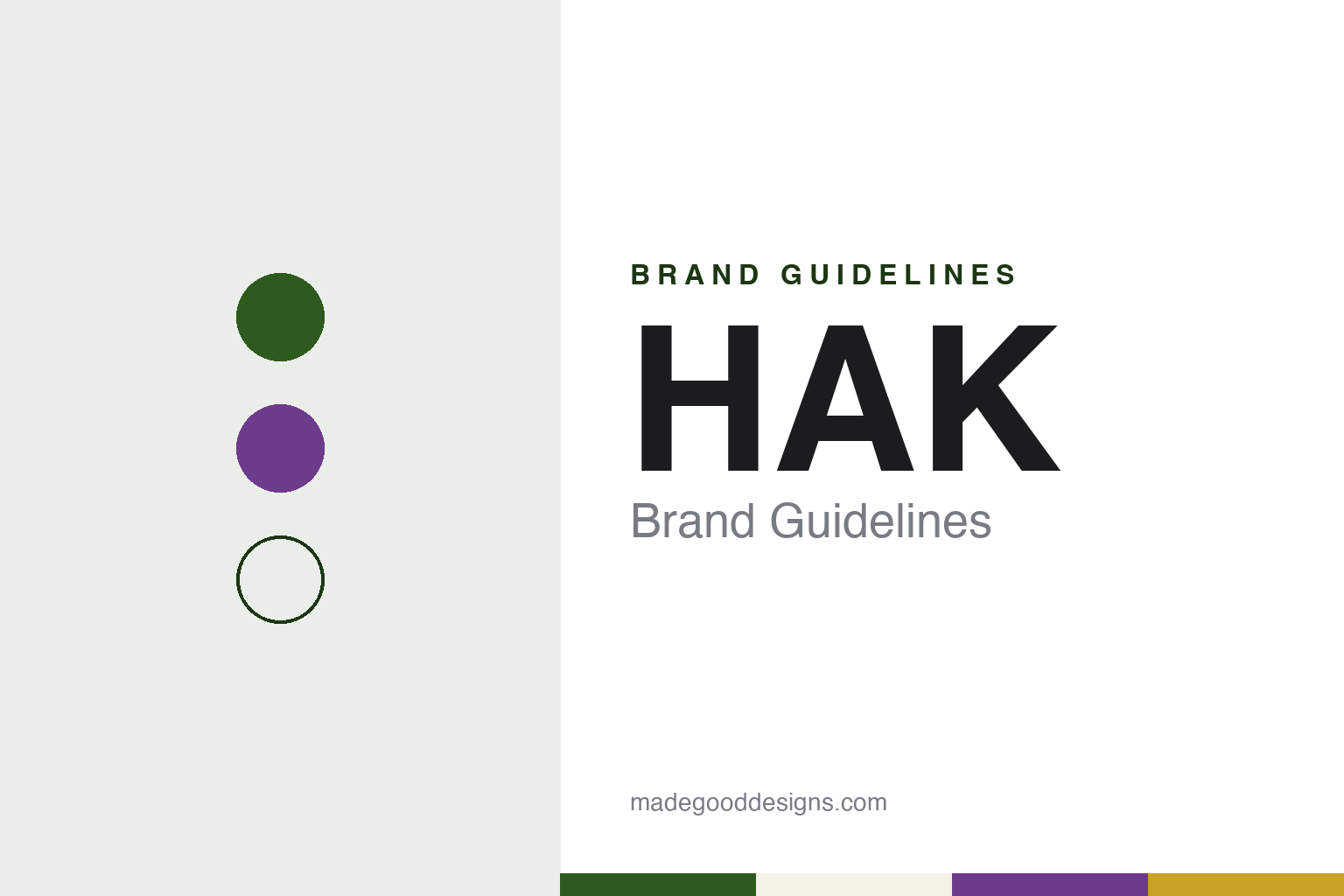
HAK Brand Guidelines
The Giessen vegetable brand built on the glass jar.
Aa
Two constants: a pea green, lid purple and jar cream palette and a sturdy grotesque sans register. Abstract homage — not a HAK product or mark; no jar, label or logo is reproduced.
A greengrocer’s family
Shops in Altena, then a cannery in Giessen.
HAK grew out of a family business, not a factory. Dutch Wikipedia says the Hak family began trading in vegetables and potatoes in the 1920s in the Land van Heusden en Altena, the river country in the north of Noord-Brabant; the company itself dates that trade to 1925. The first shop, belonging to Hendrik Hak, was in Giessen, followed by shops in Dussen and Werkendam. According to the company’s own history, the shops already sold preserved goods such as liqueurs, cherries in syrup and apple sauce.
In 1952 the family opened a cannery in Giessen, a village the company describes as having about 900 inhabitants, and preserved vegetables and fruit by heat in glass jars. Dutch Wikipedia, citing the company, says apple sauce came first and other vegetable conserves followed quickly. The factory was enlarged in 1958, to a capacity of 2,000 jars an hour, and in 1962 a new factory complex doubled that to 4,000 jars an hour; in the same year the three shops closed and the cannery became the whole business. The company says that in 1962, with Aart Hak as director, it employed 140 people and packed 38 kinds of vegetables and fruit.
Growth was not smooth. Dutch Wikipedia records branch factories in Doetinchem, after the purchase of the Blom company in 1970, and in Oud Gastel, after the purchase of Lama in 1973, both closed again in the 1980s. In 1984 Hak took over the bankrupt Conservenfabriek Geldermalsen, known for the Veluco brand, which ran into trouble again and went bankrupt as a separate unit in 1988, the Volkskrant reported in 1986 and Dutch Wikipedia notes. A history of the firm’s first fifty years, written by Josee Koning, was published by the Hak family in 2002.
Colour
You see what you buy.
Glass is the thread that runs through the HAK story. The company says that in 1964 it moved entirely to glass jars and developed its own jar with the Van Tuyn glassworks, under the slogan “HAK. Je ziet wat je koopt” — “HAK. You see what you buy.”
Television made the brand a household name. In the 1980s HAK ran commercials starring the actress and entertainer Martine Bijl, with the slogan “U moet de groenten van Hak hebben” — “You must have the vegetables from Hak.” The company dates the campaign to 1986; the advertising trade magazine Adformatie, writing in 2019, called the commercials an iconic success. The company says Bijl returned to its advertising in 2006, the same year its logo and labels were redesigned.
Later campaigns used other familiar faces. After the brand strategy was reset at the end of 2012, the slogan became “Lekker Hollands, met de groenten van Hak,” and campaigns featured the footballer Ronald de Boer and the singer Ilse de Lange, Dutch Wikipedia says. In 2015 the chef Herman den Blijker fronted a campaign called “Bonen Erbij,” urging people to add beans to everyday meals, and in September 2021 HAK began a multi-year collaboration with the actress Elise Schaap around locally grown vegetables.
The pack itself has kept changing around the jar. The company lists a “1-2 Open” lid with a distinctive purple rim in 2011, a stand-up pouch (the stazak) in 2015, and a further redesign of logo and labels in 2018 intended to show more of the vegetables and make nutritional information clearer. HAK says at least 85% of its vegetables and pulses are grown within 125 kilometres of Giessen, and Dutch Wikipedia reports that since 2021 they have been certified under the On the way to PlanetProof scheme.
Typography
Design and documentation.
The seven brands in this group all make food, and all of them come from Denmark, Sweden or the Netherlands: Toms, Kelsen, Göteborgs Kex, Polarbröd, HAK, De Ruijter and Venz. Food brands from these countries sit at many different points in the trade, from family firms that still carry a founder’s surname to names that now belong to much larger food groups, and a single brand can be sold everywhere from a corner shop to a supermarket shelf.
A food brand’s identity is usually carried less by a single product than by a pack, a name and the meal or treat it promises, because the company behind the name may have changed hands, moved its factory or grown far beyond the town where it started. That makes the questions behind each name worth asking plainly: who started it, who owns it now, and where its food is actually made and packed.
Each guide separates what independent sources record from what the company says about itself — its founding story, its owners over time, where its food is made and how its packaging has changed — and marks plainly what rests only on the company’s own word.
Aa
A sturdy grotesque sans for a brand that let the jar do the talking. (Specimen set in Archivo, a sans STAND-IN; NOT the HAK logo.)
HAK
From family firm to a chain of owners.
HAK left family hands in 1992, when the Dutch food and ingredients group CSM became its owner, Dutch Wikipedia says. In December 2000 the American H.J. Heinz Company acquired CSM’s food division, and HAK came with it, the Volkskrant reported. Five years later, in 2005, the investment company NPM Capital bought HAK and placed it, together with the pickles and sauces maker Jonker Fris, bought from Premier Foods, in a new holding company called Neerlands Glorie. In 2006 Neerlands Glorie took over the brand name of the bankrupt pickle and apple-sauce maker Koeleman of Ter Aar, and the company says Jonker Fris’s operations were moved to Giessen in 2008.
The holding then narrowed its focus. By 2009 Neerlands Glorie was concentrating on the HAK brand, Distrifood reported, and at the end of 2012 it stopped making supermarket own-label products, LevensmiddelenKrant reported. In June 2017 it bought the chilled-vegetable specialist Peter van Halder, later renamed HAK Fresh, and in November 2017 it took a 51% stake in the German company Foodeko, through which it had sold in Germany since 2013, forming a joint venture called HAK-Foodeko.
Ownership moved again in the 2020s. In July 2021 the Russian food producer KDV Group agreed to buy NPM Capital’s stake in HAK, without disclosing terms, Nieuwe Oogst reported. In November 2022, as a precaution against possible sanctions after Russia’s invasion of Ukraine, Neerlands Glorie Groente & Fruit, the company that owns HAK, was moved out of KDV into Flexway, a company based in the United Arab Emirates; Nieuwe Oogst reported that the Russian businessman Denis Shtengelov is a major shareholder of both. HAK’s chief executive, Timo Hoogeboom, told the paper that HAK would remain HAK and operate fully independently from the Netherlands. Trouw reported in December 2025 that an ambition, announced in 2023, to make all of HAK’s Dutch cultivation organic by 2027 had been dropped.
For a design guide, HAK shows how a single packaging decision — the clear glass jar — can carry a brand for seventy years, with slogans, lids and labels built around letting the product be seen. Compare it with the French vegetable group in our Bonduelle guide and the German jar brand in our Kühne guide. For this guide we use pea green, lid purple and jar cream with a sturdy grotesque sans, an unofficial interpretation; no product or logo is reproduced.
Explore & save
Keep HAK’s identity on hand — save it to a board in the Made Good inspiration library.
HAK identity set
Pin the HAK pea green, lid purple and jar cream palette and the sturdy grotesque sans register to your own board.