Fage Brand Guidelines
The Athens dairy whose name means “eat!”
Aa
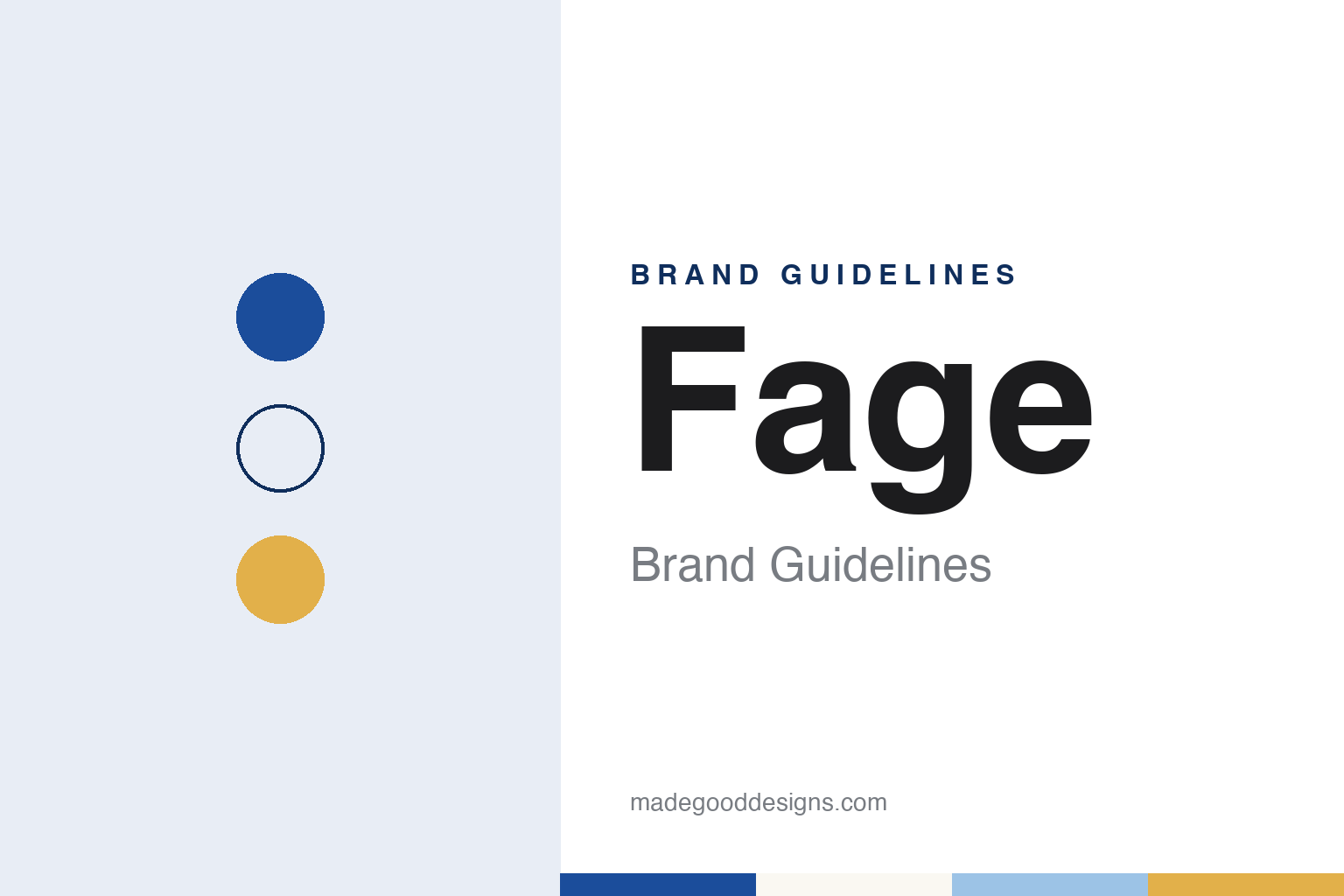
Two constants: an Aegean blue, strained white and honey palette and a soft modern serif register. Abstract homage — not a Fage product or mark; no tub, logo or label is reproduced.
A dairy shop in Athens
A family name, an order to eat and a strained yoghurt.
Fage — written ΦΑΓΕ in Greek, and FAGE in capitals by the company — began as a small dairy shop in Athens. The company says the Filippou family opened it in 1926; its Greek website credits the family of Athanasios Filippou. Greek Wikipedia, in an uncited passage, gives the date as 1 September 1926 and places the shop in Patissia, a district in the north of the city. In a 2014 judgment, England’s Court of Appeal recorded that Fage began producing yoghurt in Greece in the late 1920s.
The name works twice. English Wikipedia explains that ΦΑΓΕ is the Greek imperative “eat!” and also the initials of Filippou Adelfoi Galaktokomikes Epicheiriseis — the Filippou Brothers’ dairy business. The company’s American website simply translates the name as “to eat,” and says that by the 1950s Greece had fallen for its thick, creamy strained yoghurt.
The shop became an industrial dairy over the next half-century. Greek Wikipedia says Fage set up the first network for mass-producing yoghurt in Attica in 1954 and opened its first yoghurt factory in Galatsi, an Athens suburb, in 1964; English and Greek Wikipedia both say its present factory was built in 1974. The Greek company, ΦΑΓΕ Ελλάδας, has its head office at Metamorfosi, north of Athens, according to Greek Wikipedia. The court judgments describe the family business as two companies working together in Britain: FAGE Dairy Industry S.A., the Greek manufacturer, and FAGE UK, its British distributor.
Colour
Total, a smaller tub and the meaning of “Greek”.
The product that made the name travel was Total. English Wikipedia, citing Daphne Zepos on the Greek food site Kerasma, says Fage began straining cow’s-milk yoghurt for industrial production in Greece in 1975, when it launched the Total brand. The company itself says that in the 1970s it introduced “attractively designed packaging”: a smaller, sealed tub carrying the FAGE name, which its Greek site describes as a new, smaller pack bearing the ΦΑΓΕ logo. In Greece, the Court of Appeal noted, the yoghurt is sold as “strained” — the word Greeks use — and not as “Greek yoghurt.”
Abroad, Greek became the selling point. The Court of Appeal found that Fage first brought its yoghurt to the United Kingdom in 1983, always under the Total brand and always made in Greece. The High Court judgment of March 2013 adds that FAGE UK began as Gordon Conrad Limited, founded by a Mr Conrad, whom the judge described as the originator of Fage’s British market in the 1980s. English Wikipedia, citing the Oxford English Dictionary, says strained yoghurt became widely known in English only in the 1980s, when Fage imported it into Britain as Total. By 2012, the High Court found, Fage’s yoghurt made up more than 95% by value of all yoghurt sold in Britain as Greek yoghurt.
That position led to court. In September 2012 the American company Chobani began selling its US-made yoghurt in Britain as “Greek yoghurt,” and Fage sued for passing off. In March 2013 Mr Justice Briggs ruled that British shoppers understood “Greek yoghurt” to mean yoghurt made in Greece, and granted an injunction; the Court of Appeal upheld it on 28 January 2014. At home, English Wikipedia says, Fage moved into cheese in 1991, with traditional Greek cheeses such as feta and Trikalino, and into fresh milk in 1993; Greek Wikipedia says it has since stopped selling milk.
Typography
Design and documentation.
The seven brands in this group all make food or drink, and all of them come from Portugal or Greece: Compal, Delta Cafés, Pavlides, Misko, Loux, Fage and Kyknos. Food and drink brands in general sit at many different points in the trade, from family firms that still carry a founder’s surname to names that now belong to much larger food groups, and a single brand can be sold everywhere from a corner shop to a supermarket shelf.
A food or drink brand’s identity is usually carried less by a single product than by a pack, a name and the meal or moment it promises, because the company behind the name may have changed hands, moved its factory or grown far beyond the town where it started. That makes the questions behind each name worth asking plainly: who started it, who owns it now, and where its products are actually made and packed.
Each guide separates what independent sources record from what the company says about itself — its founding story, its owners over time, where its products are made and how its packaging has changed — and marks plainly what rests only on the company’s own word.
Aa
A soft modern serif for a dairy whose name is an order to eat. (Specimen set in Fraunces, a serif STAND-IN; NOT the Fage logo.)
Fage
From New York state to Luxembourg.
America followed Britain. The company says its yoghurt was exported to the United States in the 1990s, and English Wikipedia dates its entry into the American market to 2001. The yoghurt was first made in Greece and shipped over, the High Court recorded in 2013; after competitors began selling yoghurt not made in Greece as Greek yoghurt in the United States, Fage started producing its own yoghurt there in about 2008. The company says it was the third generation of the family that began making FAGE in upstate New York, and English Wikipedia names Johnstown, New York, as its American base. Its US arm trades as FAGE USA Dairy Industry, which uses the trademarks under licence from FAGE International S.A., according to its website.
Its American advertising drew attention of its own. In 2007, English Wikipedia says, citing the advertising archive Advertolog, Fage put up a billboard on the route of the Macy’s Thanksgiving Day Parade designed to look as if a Tweety balloon had become stuck in a tub of its yoghurt. In 2011 it began airing what Adweek described as its first television advertisements in North America, under the line “Plain Extraordinary,” with a voiceover by the actor Willem Dafoe.
The head office has also moved. In October 2012, at the height of the Greek financial crisis, Fage announced that it would move its headquarters from Greece to Luxembourg, English Wikipedia says, citing Greek Reporter; the reasons given were lower taxes, easier access to bank funding and less exposure to the crisis. English Wikipedia, citing a 2016 company investor release, places FAGE International S.A. in Strassen, Luxembourg. The company says Fage is still family-owned and has been made by the same Greek family for nearly a century; its international website lists more than twenty countries where Total is sold, from Ireland and Spain to the Gulf states.
For a design guide, Fage shows how a family name that doubles as an order to eat can carry one plain white yoghurt around the world. Compare Yeo Valley, the family-owned Somerset yoghurt maker, and Gaea, the Greek olive-oil brand. For this guide we use an Aegean blue, a strained white and a honey gold with a serif, an unofficial interpretation; no product or logo is reproduced.
Explore & save
Keep Fage’s identity on hand — save it to a board in the Made Good inspiration library.
Fage identity set
Pin the Fage Aegean blue, strained white and honey palette and the soft modern serif register to your own board.