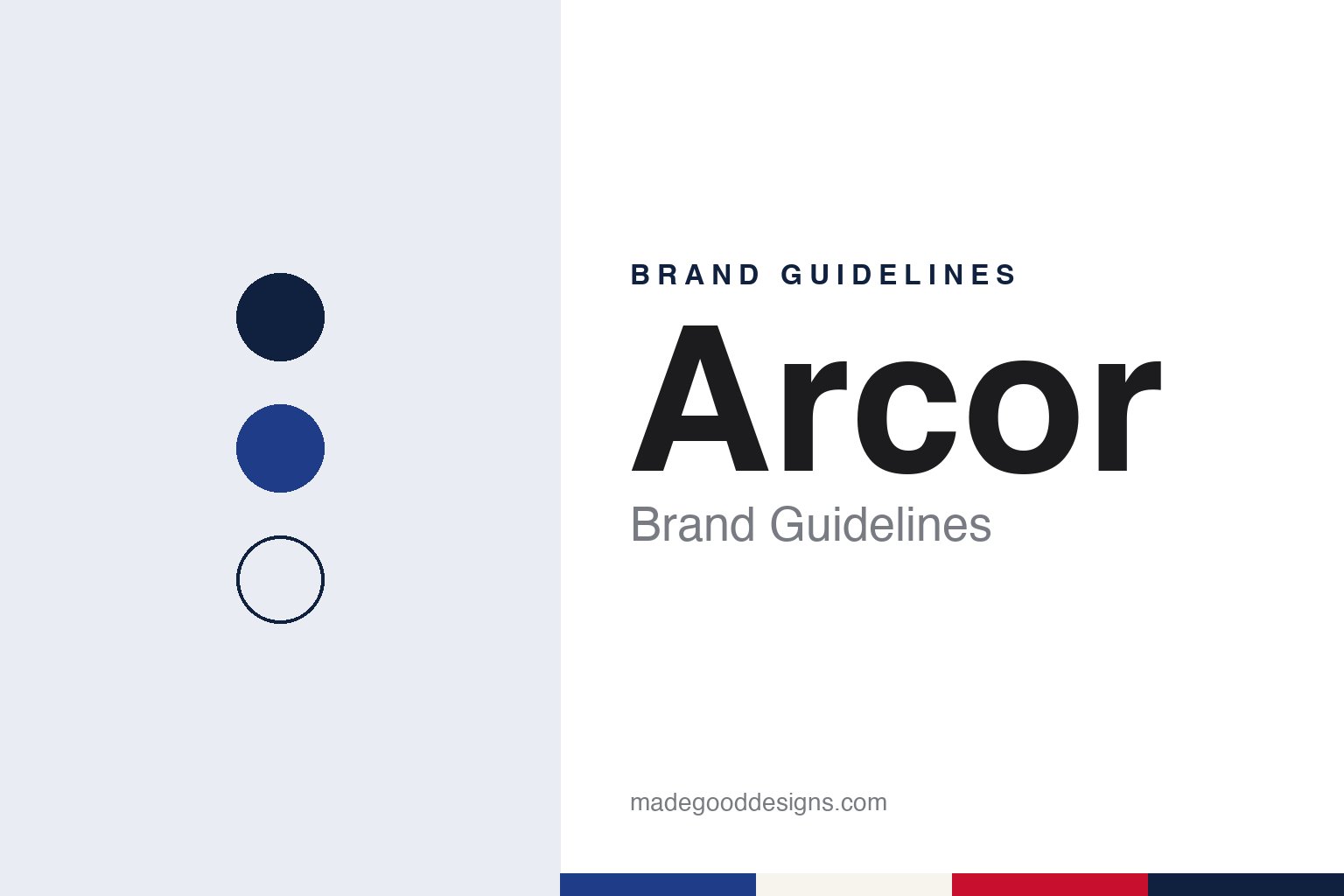
Arcor Brand Guidelines
The Arroyito candy maker that became a Latin American food group.
Aa
Two constants: an Arcor blue, toffee and red palette and a rounded geometric sans register. Abstract homage — not an Arcor product or mark; no wrapper, logo or pack is reproduced.
Arroyito and Córdoba
A bakery family, a town in Córdoba and a name made of two places.
Arcor was founded on 5 July 1951 in Arroyito, a town in the Argentine province of Córdoba, and its name is made from the first letters of Arroyito and Córdoba, Spanish Wikipedia says. Spanish Wikipedia names the founders as Fulvio Salvador Pagani, with Enrique Brizio and the brothers Modesto, Pablo and Vicente Maranzana; English Wikipedia describes the founders as members of the Pagani family — Amos, Renzo, Fulvio and Elio — together with eighteen other shareholders. Both agree on the town and the date. The first site, according to Spanish Wikipedia, was a plot of about 10,000 square metres, bought with help from relatives, friends and neighbours.
The family business is older than the company. Spanish Wikipedia says Amos Pagani emigrated to Argentina in 1924, worked as a baker and then opened his own bakery in La Para, Córdoba, adding milk sweets around 1936. In 1946 the Paganis joined investors in a sweets and crackers factory at Sastre, in Santa Fe province, a business Spanish Wikipedia calls Sasort, and in 1948 they went into partnership with Brizio and the Maranzana brothers, the step that led to Arcor three years later.
Growth was quick. By 1958, Spanish Wikipedia says, the Arroyito plant was producing 60,000 kilos of sweets a day. The company first exported in 1964, and English Wikipedia dates its first shipment to the United States, of milk candy, to 1968. Arcor then built a presence across South America: Spanish Wikipedia lists Paraguay in 1976, Uruguay in 1979, Brazil in 1981 and Chile in 1989, and English Wikipedia adds a manufacturing plant in Peru in 1995 and European offices in Barcelona in 2002.
Colour
Chocolates, biscuits and a partnership with Danone.
From the 1990s Arcor grew by buying established names. It acquired the chocolate maker Águila Saint in 1993; English Wikipedia says the Águila chocolate business dates from 1880. English Wikipedia adds Noel, a jams and chocolate maker founded in 1847 by Carlos Noel, in 1994. The Argentine biscuit maker LIA followed — Spanish Wikipedia gives 1997, English Wikipedia 1998 — and the Chilean sweets and chocolate company Dos en Uno, dated 1998 by Spanish Wikipedia and 1999 by English Wikipedia. In 2001, Spanish Wikipedia says, Arcor bought Nestlé brands in Brazil including Kid’s, Poosh and 7Belo.
The biggest change came with Danone. Spanish Wikipedia says that in 2005 a strategic partnership with the French group put the biscuit, alfajor and cereal-bar businesses of both companies in Argentina, Brazil and Chile under Arcor’s management; English Wikipedia dates the joint venture to 2004 and gives the split as 51% Arcor and 49% Danone. Spanish Wikipedia’s article on Melville Sewell Bagley, citing El Cronista in 2004, also dates the agreement to 2004. The venture is called Bagley Latinoamérica, after the Buenos Aires biscuit house founded in 1864.
In 2005, according to both Wikipedias, Arcor also bought Benvenuto, owner of the La Campagnola canned-food brand. From 2007 it took a stake in Mastellone, the dairy company behind La Serenísima, Spanish Wikipedia says, and in 2017 it bought the packaging maker Zucamor outright.
Arcor’s best-known products are sweets and chocolates. Spanish Wikipedia lists Bon o Bon, Cofler, Tofi, Águila and Rocklets among its chocolates and Butter Toffees, Mogul, Topline and Menthoplus among its sweets, and English Wikipedia describes the group as the world’s top producer of hard candies.
Typography
Latin American food brands and their records.
The seven brands in this group all make food or drink, and they come from four South American countries — Argentina, Chile, Peru and Colombia: Arcor, Bagley, Havanna, Carozzi, Costa, Inca Kola and Colombina. South American food and drink brands in general sit at many different points in the trade, from family firms that still carry a founder’s surname to names that now belong to much larger food groups, and a single brand can be sold everywhere from a corner shop to a supermarket shelf.
A food or drink brand’s identity is usually carried less by a single product than by a pack, a name and the treat or staple it promises, because the company behind the name may have changed hands, moved its factory or grown far beyond the town where it started. That makes the questions behind each name worth asking plainly: who started it, who owns it now, and where its products are actually made and packed.
Each guide separates what independent sources record from what the company says about itself — its founding story, its owners over time, where its products are made and how its packaging has changed — and marks plainly what rests only on the company’s own word.
Aa
A rounded geometric sans for a confectionery name. (Specimen set in Poppins, a sans STAND-IN; NOT the Arcor logo.)
Arcor
Still family-led, still in Arroyito.
Arcor has remained under the control of the founding family. In 1993, at the age of 35, the accountant Luis Alejandro Pagani became president of the group, Spanish Wikipedia says, and in 2000 he became the first Latin American businessman to enter the Candy Hall of Fame. Spanish Wikipedia says that since 2023 the company has been led by Alfredo Gustavo Pagani. The group’s headquarters remain in Arroyito, Spanish Wikipedia says.
Spanish Wikipedia gives more than 45 plants in Latin America and one in Angola, about 21,000 employees and exports to more than 100 countries; English Wikipedia, using 2019 figures, gives 39 industrial plants across Latin America and 19,700 employees, with exports to more than 120 countries. Spanish Wikipedia also records the Fundación Arcor, set up in 1991 with a focus on education, and a sustainability strategy launched in 2021, and says the company protects more than 14,000 hectares of forest in the provinces of Misiones and Tucumán.
For a design guide, Arcor shows how a company named after its home town can carry a portfolio of separate brands — Bon o Bon, Butter Toffees, Águila, La Campagnola — while the group name sits in the background, and how a partnership can borrow an older name, Bagley, for a shared biscuit business. Compare Bagley, the Buenos Aires biscuit house at the centre of its venture with Danone, and Garoto, a Brazilian chocolate maker with its own long history. For this guide we use a deep blue, a toffee brown and a candy red with a rounded sans, an unofficial interpretation; no product or logo is reproduced.
Explore & save
Keep Arcor’s identity on hand — save it to a board in the Made Good inspiration library.
Arcor identity set
Pin the Arcor blue, toffee and red palette and the rounded geometric sans register to your own board.