Majani Brand Guidelines
Bologna’s 1796 chocolate house and its four-layer Cremino Fiat.
Aa
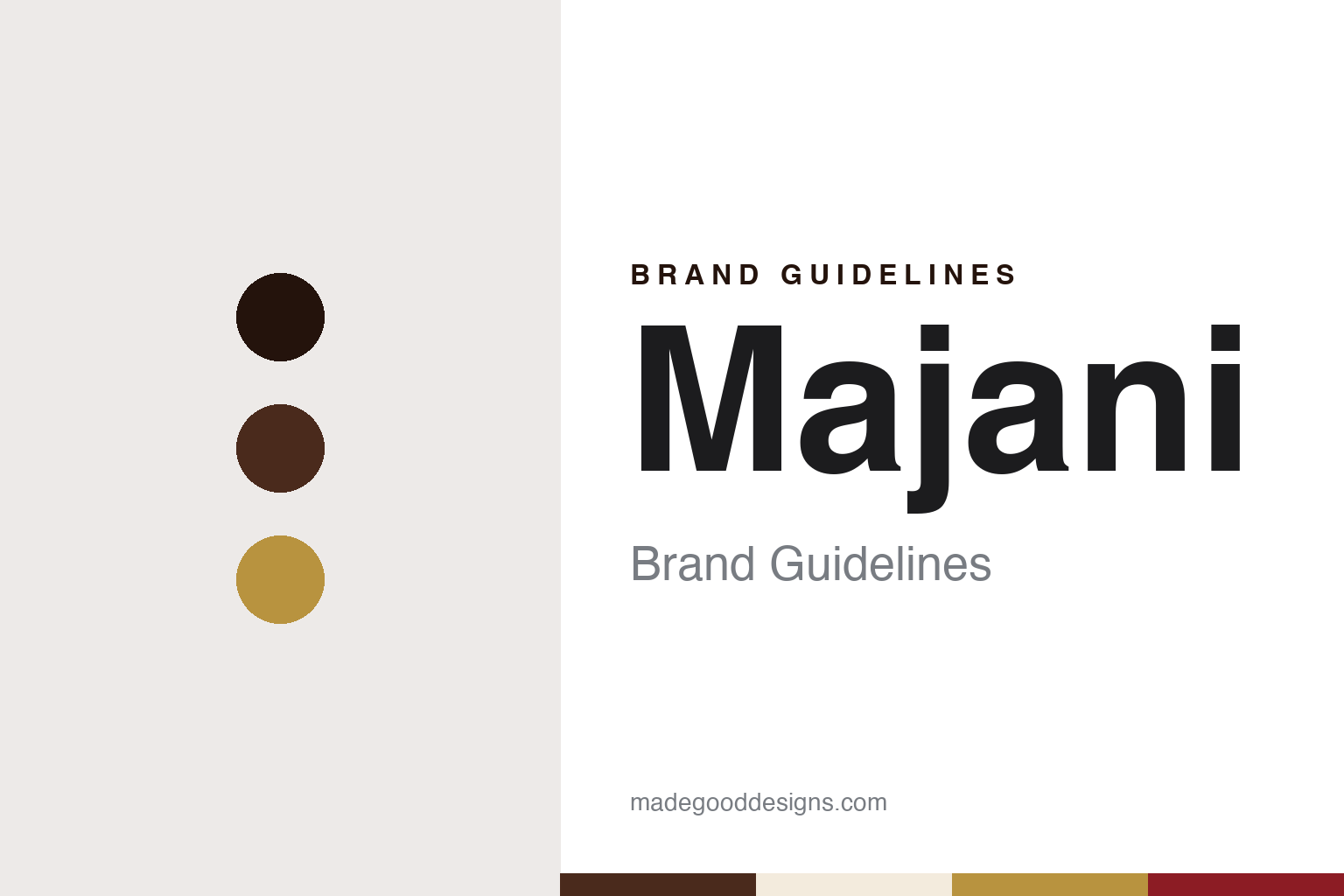
Two constants: a Majani cocoa, gold and crimson palette and a Heraldic serif register. Abstract homage — not a Majani product or mark; no wrapper, logo or coat of arms is reproduced.
Laboratorio di Cose Dolci
A sweetshop beside Piazza Maggiore.
Majani dates itself to 1796 in Bologna, and calls itself the oldest chocolate factory in Italy still in business. Its own history begins in a small “Laboratorio di Cose Dolci” — a workshop of sweet things — near Piazza Maggiore, where, the company says, the brothers Francesco and Romualdo Majani were taken on by the owner and soon became the sole owners. Italian Wikipedia’s article on the company calls the brothers sons of Teresa Majani; its articles on the Palazzina Majani and on Anna Majani instead name Teresa (Teresina) Majani as the founder, so we give both versions.
The company’s timeline has Francesco buying a palazzo on Via de’ Carbonesi around 1830, to live, make chocolate and sell it there; the building still holds its historic shop. In 1856, it says, Giuseppe Majani obtained a passport to cross the divided Italian states and buy modern machinery, after which the sign read “Stabilimento a Vapore di Confetture e Cioccolata” — a steam-powered factory of confectionery and chocolate.
Recognition followed at the world’s fairs in Paris (1867 and 1878), Vienna (1873) and Milan (1881), according to Italian Wikipedia. In 1878 King Umberto I allowed the firm to raise the royal arms over its shop, and two Spanish infantes, the Duke of Montpensier in 1885 and Antonio de Orléans in 1893, followed. The company says all three coats of arms remain in the Majani logo.
In 1908 the family opened the Palazzina Majani on Via Indipendenza, an Art Nouveau building by the architect Augusto Sezanne with a café, a tea room and a ballroom. Critics mocked it as a Viennese chair set down among Bologna’s porticoes, Wikipedia records. The café closed in 1953; the building later became a bank and, from 2004, a clothing shop.
Colour
The Scorza and the Cremino Fiat.
Two products carry the brand. The Scorza, which Majani dates to 1832 and calls the first solid chocolate made in Italy, is a rough, bark-like stick made by rolling a thin veil of chocolate on itself; the company says the recipe has not changed. We give the “first” as Majani’s claim.
Better documented is the Cremino Fiat of 1911. English Wikipedia says Fiat held a contest among Italian chocolate makers to publicise its new Tipo 4 car, and that Majani won with a cremino of four layers instead of the usual three — two of gianduja and two of almond paste. Italian Wikipedia attributes the initiative to Giovanni Agnelli. Majani says the four layers echo the car’s name, and that the recipe, rich in hazelnuts and almonds and made without milk, has been handed down unchanged. Italian Wikipedia adds that Anna Majani later won a legal dispute with Fiat, which had sought to stop the use of its name on the sweet; it gives no date, so we report it as that article’s account.
A newer line plays on Bologna’s cooking: a chocolate Tortellino, a chocolate shell filled with cream, which the company calls a tribute to its city.
Majani says it is one of the few companies that still make chocolate from raw cocoa beans, handling every stage in-house — cleaning, roasting, winnowing, grinding, refining to 20 microns and conching for up to 72 hours. It says 85 per cent of its cocoa is “fino de aroma” from Central and South America, with beans from Asia and Africa making up to 20 varieties in all, from origins including Peru, Venezuela, Ecuador, Ghana and Madagascar. These are the company’s statements.
Typography
Design and documentation.
The seven brands in this group all make chocolate, and they come from three countries: Cacao Barry from France, Callebaut from Belgium, and Venchi, Caffarel, Majani, Guido Gobino and Slitti from Italy. They stand on either side of one of the oldest divides in the chocolate trade: between the chocolate that other people work with and the chocolate that is sold finished.
On one side is industrial couverture, chocolate made with enough cocoa butter to melt, temper and coat well, and sold in blocks, callets and pistoles to pastry chefs, chocolatiers, bakers and food manufacturers. A couverture brand often reaches the public second-hand, through a dessert, a bonbon or a filled biscuit, and its identity has to work on a sack in a professional kitchen as much as on a shelf. On the other side are confectionery houses, the Italian ones especially, whose names are on the box itself: pralines, gianduja, hazelnut spreads and filled bars, sold in their own shops and in fine-food stores, where the wrapper, the shop and the family name carry the brand.
Each guide separates what independent sources record from what the company says about itself — who founded it, who owns it now, where its beans come from and where its chocolate is made — and marks plainly what rests only on the company’s own word.
Aa
A heraldic serif — a logo that keeps three royal coats of arms. (Specimen set in Cormorant Garamond, a serif STAND-IN; NOT the Majani logo.)
Majani
Three coats of arms on one logo.
Ownership is the most tangled part of the story. Majani says the firm has been in family hands for nine generations since its founding. Italian Wikipedia records a break: after the Second World War the family restarted production at Via de’ Carbonesi, and by 1976 it was in the minority among the shareholders. In 1978 the company built its present factory at Crespellano, now part of Valsamoggia, outside Bologna — two buildings totalling 7,500 square metres, Italian Wikipedia says.
The company credits Francesco Majani with saving it from failure in 1985 by buying back every share sold outside the family. Wikipedia’s biographies of his daughter, Anna Majani, credit her: she took full control in 1985 by mortgaging family property, with her son Francesco Mezzadri Majani handling the finances. English Wikipedia says she designed dozens of new shapes, textures and packages and “turned her family’s chocolates into design objects”; Italian Wikipedia says she turned down offers to buy the company, including one from Nestlé. Today the business trades as Majani 1796 S.p.A., with its factory and head office at Crespellano; we found no parent group in the sources we checked. In 2011 it received a Palme d’Or at the first Italian Salon du Chocolat and a plaque as one of the businesses “that made Italian history,” Italian Wikipedia says.
For a design guide, Majani shows how heraldry and a founding date can carry a brand: a logo that still holds three royal coats of arms, and a year, 1796, written into the company’s name. Compare Caffarel, the Turin house credited with the first gianduiotto, and Amedei, a Tuscan maker that also works from the bean. For this guide we use a cocoa brown, a heraldic gold and a royal crimson with a serif, an unofficial interpretation; no product or logo is reproduced.
Explore & save
Keep Majani’s identity on hand — save it to a board in the Made Good inspiration library.
Majani identity set
Pin the Majani cocoa, gold and crimson palette and the Heraldic serif register to your own board.