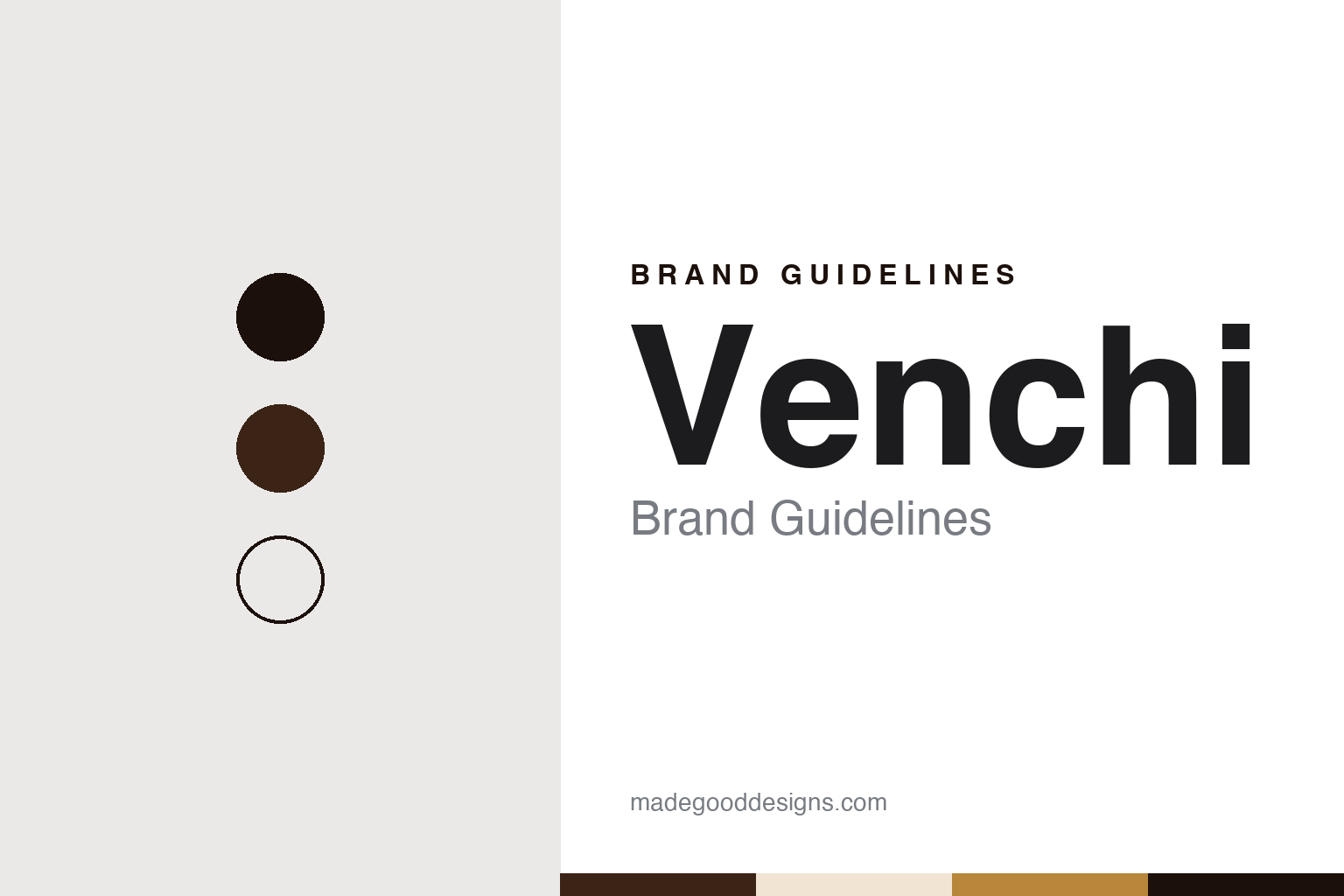
Venchi Brand Guidelines
A nineteenth-century Turin name, revived as a chocolate-and-gelato shop chain.
Aa
Two constants: a Venchi cocoa and hazelnut palette and a Display serif register. Abstract homage — not a Venchi product or mark; no wrapper, logo or shop design is reproduced.
From Turin to Cuneo
A name that outlived its company.
Venchi dates itself to 1878, when, the company says, Silviano Venchi began making chocolate “in a small Turin workshop.” The food writers Clara and Gigi Padovani, who traced the firm’s papers in Turin’s archives, give his name as Silvano and describe a farmer’s son from Robbio, in the rice country of Lomellina, who came to Turin as a boy to learn the confectioner’s trade and opened a workshop on Via degli Artisti; their research was summarised by la Repubblica and reprinted by the trade site Comunicaffè in December 2020.
According to that account, the workshop had become a joint-stock company by 1886; in 1890 the German illustrator Roberto Ochsner drew a poster for its Cacao Due Vecchi; and in 1904 its “Chocolat de Luxe” took a gold medal at Turin’s general exhibition. The Nougatine — caramelised hazelnut pieces in dark chocolate — is the company’s oldest recipe still on sale; Venchi dates it to 1922, the year the Padovanis say the name was registered as a trademark.
In 1930, under the partner Riccardo Gualino, Venchi was gathered with other makers into UNICA, the Unione Nazionale Industrie Cioccolato e Affini. By the 1970s the business had more than 300 shops — an early Italian franchise network, in the Padovanis’ telling — until a financial crisis in 1978 ended in bankruptcy and the closure of its factories. The brand passed to Pietro Cussino, a Cuneo chocolatier who had supplied the shops.
Colour
One factory, many shops.
The modern company began in 1998, when three entrepreneurs — Daniele Ferrero, Niccolò Cangioli and Giovanni Battista Mantelli — took over the brand, according to Italian Wikipedia and the company. Il Sole 24 Ore reported in May 2018 that the business they bought employed 30 people; by 2017 it had 950 staff and consolidated revenue of €80 million. The same report described a deliberate choice of channels: no supermarket distribution, about 90 agents selling to pastry and sweet shops, and production planned against advance orders, with seasonal catalogues issued months ahead “as in fashion,” in Mantelli’s phrase. Ferrero has been chairman and chief executive, with Mantelli as the creative lead and Cangioli in charge of developing the shops, the paper said.
Production moved to a new factory at Castelletto Stura, in the province of Cuneo. In a March 2024 interview with Comunicaffè, Ferrero said that all production takes place there, that two-thirds is exported, that Italy accounts for about 35% of turnover and that capacity was being doubled to 4,000 tonnes a year. The company’s cocoa commitments — Rainforest Alliance-certified cocoa, Piemonte IGP hazelnuts and Bronte pistachios — appear in its own sustainability material, and we give them as its statements.
The shops changed the brand. In the mid-2000s Venchi began making and selling gelato alongside chocolate in what it calls the “Chocogelateria”; Italian Wikipedia dates the change to 2006, Il Sole 24 Ore to 2007. The company lists London and Hong Kong (2012), Broadway (2018), Tokyo’s Ginza (2019), Paris (2022), Sydney (2023) and the Dubai Mall (2024) among its key openings, and says it runs more than 200 shops of its own in over 70 countries. Comunicaffè reported 2024 revenue of about €250 million.
Outside money arrived late. In October 2021 Hong Kong’s Nuo Capital and Jakyval, a holding of Hermès heirs, bought 3.5% between them, BeBeez reported; in August 2024 the De Agostini group bought 10.27%, with Ferrero remaining the largest shareholder at about 30%.
Typography
Piedmont and its chocolate.
The seven brands in this group all make chocolate, and they come from three countries: Cacao Barry from France, Callebaut from Belgium, and Venchi, Caffarel, Majani, Guido Gobino and Slitti from Italy. They stand on either side of one of the oldest divides in the chocolate trade: between the chocolate that other people work with and the chocolate that is sold finished.
On one side is industrial couverture, chocolate made with enough cocoa butter to melt, temper and coat well, and sold in blocks, callets and pistoles to pastry chefs, chocolatiers, bakers and food manufacturers. A couverture brand often reaches the public second-hand, through a dessert, a bonbon or a filled biscuit, and its identity has to work on a sack in a professional kitchen as much as on a shelf. On the other side are confectionery houses, the Italian ones especially, whose names are on the box itself: pralines, gianduja, hazelnut spreads and filled bars, sold in their own shops and in fine-food stores, where the wrapper, the shop and the family name carry the brand.
Each guide separates what independent sources record from what the company says about itself — who founded it, who owns it now, where its beans come from and where its chocolate is made — and marks plainly what rests only on the company’s own word.
Aa
A display serif — the register of an old Turin name. (Specimen set in Cormorant Garamond, a serif STAND-IN; NOT the Venchi logo.)
Venchi
A heritage brand run as a retailer.
Venchi’s best-known recent product is Chocoviar, dark chocolate grains the company calls “chocolate caviar”; it says it launched them in 2004, and Italian Wikipedia records that they won the Vassoio d’Oro at Eurochocolate in Perugia that year. The Cremino, a layered chocolate, and the Nougatine sit alongside it. We found no published brand guidelines; the company says its shops are designed by Tuscan architects, but we found no named designer for its logo or packaging.
Two cautions for readers. The founder’s name appears as both Silviano and Silvano, and dates for the gelato shops and the Nougatine differ between sources; we have given both where they conflict. And Venchi’s 1998 owners were not the founding family: the continuity is in the name, the recipes and the Piedmont setting, not in the people. The Padovanis’ account has the brand passing from Cussino to Mantelli and a group of private investors, and returning to “the Venchi of 1878” in 2001.
The shop is now the main stage for the identity. Each Chocogelateria sells chocolate by weight and gelato over the counter, and the company’s list of openings reads like an airport and shopping-street map; Ferrero told Comunicaffè in April 2025 that large airports were a particular focus. That makes the brand’s design problem a retail one: the same name has to read on a bar wrapper, a gift box and a shopfront.
For a design guide, Venchi shows how a dormant nineteenth-century name can be rebuilt as a shop-led brand, with one factory feeding a retail chain. Compare Caffarel, the older Turin maker now owned by Lindt & Sprüngli, and Domori, a Piedmont-based maker built on single-origin cocoa. For this guide we use a cocoa brown and a hazelnut gold with a serif, an unofficial interpretation; no product or logo is reproduced.
Explore & save
Keep Venchi’s identity on hand — save it to a board in the Made Good inspiration library.
Venchi identity set
Pin the Venchi cocoa and hazelnut palette and the Display serif register to your own board.


