Pirate Life Brand Guidelines
The Adelaide can brewery started by a father, a son and a mate.
Aa
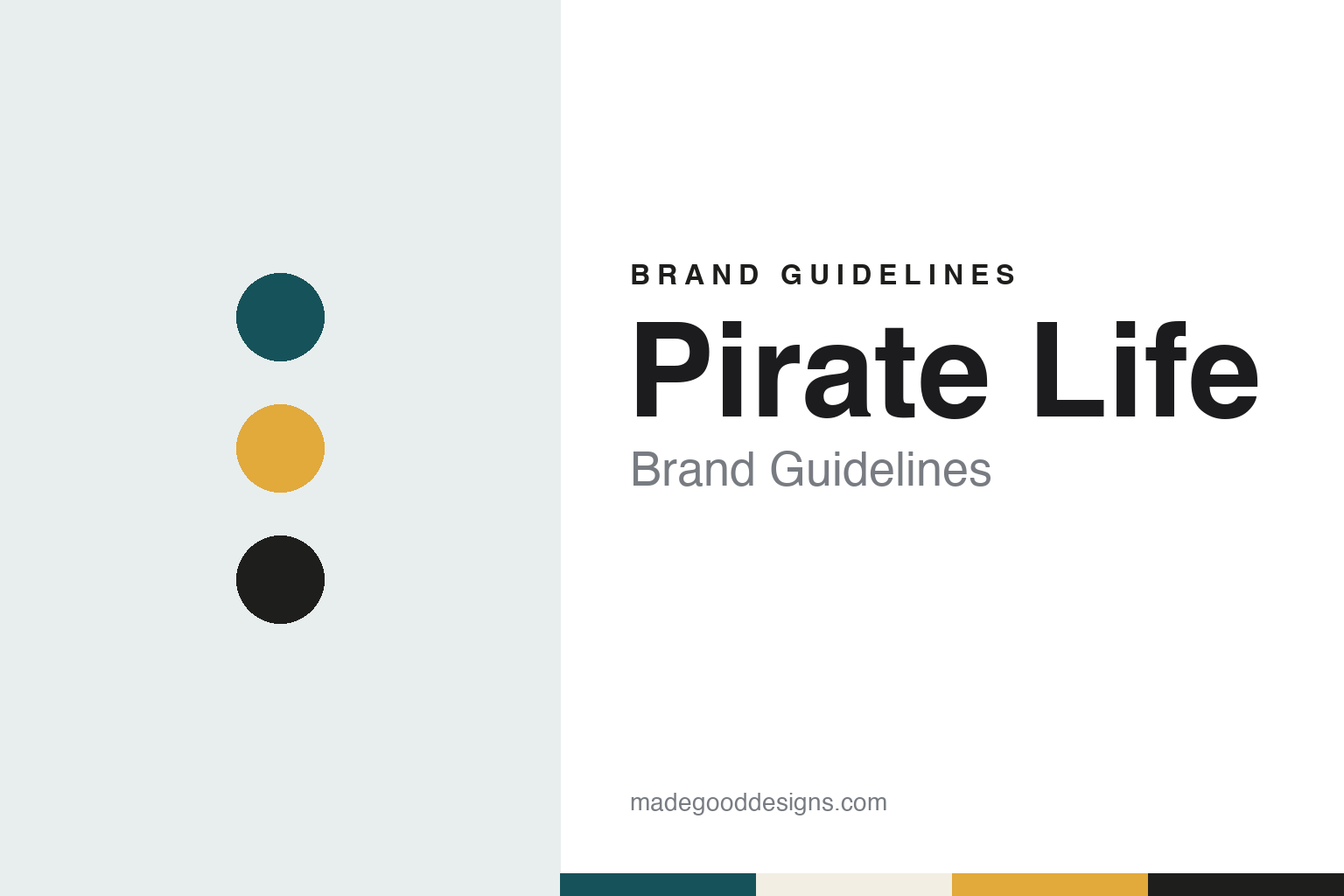
Two constants: a port teal, hop gold and can black palette and a heavy grotesque register. Abstract homage — not a Pirate Life product or mark; no can, label or logo is reproduced.
Three West Australians in an Adelaide warehouse
A father, a son, a best mate and a lease in Hindmarsh.
Pirate Life was started by three people who moved east to do it. The German trade journal Brauwelt International reported in December 2017 that the brewery was founded in 2014 by the West Australian father-and-son team Michael and Jack Cameron and Jack’s best mate Jared “Red” Proudfoot. English Wikipedia says the three relocated from Western Australia and that the brand officially launched in 2015.
The two dates fit together. Beer & Brewer reported in August 2017 that the team signed the lease on its Hindmarsh brewery, in Adelaide’s inner west, in November 2014, and the Munich trade site inside.beer dated the start of brewing to March 2015. Broadsheet later described the first home as a modest Hindmarsh warehouse. Michael Cameron, then chief executive, told the Australian Craft Brewers Conference in 2017, as Beer & Brewer reported, that the business had grown from three people to 41 staff, ran its own distribution company in Australia and the United Kingdom, and exported to New Zealand, Singapore and Hong Kong. English Wikipedia says the distribution business, Pirate Cartel, was set up in 2016.
From the start the beer went into cans. inside.beer quoted Michael Cameron, in a June 2016 interview, saying that with hoppy beers cans are the best way to get the beer to market in good condition, with no way for light or oxygen to get in. On its own website the company describes its IIPA as Pirate Life’s first beer, and says its Mosaic IPA was first served at the brewery’s second birthday. At the 2017 conference, Beer & Brewer reported, Cameron credited part of the brand’s success to its name, saying the word “pirate” seemed to resonate with people emotionally, and to more than 270 tastings held around the country in the early days.
Colour
A sale to CUB, a woolstore brewery and a peacock on the wall.
The sale came quickly. On 30 November 2017, inside.beer reported, Carlton & United Breweries — at the time a wholly owned subsidiary of AB InBev — announced that it had bought Pirate Life. The price was not disclosed, Brauwelt International noted, and CUB said it would build a new brewery and hospitality venue at Port Adelaide. The deal came two months after AB InBev’s ZX Ventures arm bought Sydney’s 4 Pines. Jared Proudfoot said Hindmarsh had run out of capacity and would be kept for new styles such as sours, seasonal and barrel-aged beers, and the founders and staff were expected to stay on.
The Port Adelaide brewery opened officially on 9 March 2019, timed to the brand’s fourth birthday, Beer & Brewer reported. It occupies the 1938 Dalgety woolstores on the corner of Baker and Barlow Streets. Its taphouse has a 22-yard bar — the length of a cricket pitch — with 24 taps, a detail CityMag also noted on its tour of the site, along with an enormous peacock mural painted by the artist Mike Maka. Jack Cameron told CityMag there was no real relevance to the peacock; the artist simply wanted to paint one. The building also became the office of CUB’s South Australian team.
Hindmarsh did not last as a second site. Broadsheet reported in July 2020 that Pirate Life had left the Hindmarsh premises to focus on Port Adelaide and on a new microbrewery inside the SkyCity casino in Adelaide. In March 2024 the brand opened Pirate Life South Melbourne, its first venue in Victoria, in a former mechanic’s garage on Market Street; Beer & Brewer reported that the fit-out was by the South Australian architecture firm Studio Gram.
Typography
Design and documentation.
The seven brands in this group are all Australian craft breweries: Little Creatures, Stone & Wood, 4 Pines, Balter, Pirate Life, Young Henrys and Mountain Goat. All seven began as independent breweries, and six of them have since been bought into one of two large brewing groups: Lion, a subsidiary of Japan’s Kirin, and Carlton & United Breweries, which Asahi bought from AB InBev in a purchase completed on 1 June 2020, BeverageDaily reported.
The sales came over more than a decade. Lion bought Little World Beverages, the Fremantle company behind Little Creatures, in 2012, according to English Wikipedia. Asahi bought Melbourne’s Mountain Goat in September 2015, The Shout reported. AB InBev bought Manly’s 4 Pines in 2017 through its venture arm ZX Ventures, and Adelaide’s Pirate Life the same year, English Wikipedia says; Carlton & United bought Balter of Currumbin in late 2019, Good Beer Hunting reported, and all three passed to Asahi with CUB in 2020. Lion announced on 9 September 2021 that it was buying Fermentum Group, the owner of Byron Bay’s Stone & Wood, Brauwelt reported. Newtown’s Young Henrys took a different route: when it announced a brewing partnership with Tribe in Goulburn in September 2019, Hospitality magazine reported that there would be no change of ownership and that the brewery remained independently owned by its founders, Oscar McMahon and Richard Adamson.
A craft brewery’s identity is usually carried by a name, a label, a can and a tap decal rather than by the building where the beer is made, and after a sale the beer may be brewed somewhere else entirely. Each guide separates what independent sources record from what the company says about itself — its founders, its owners over time, where its beer is brewed and how its packaging has changed — and marks plainly what rests only on the company’s own word.
Aa
A heavy grotesque for a brewery that put its beer in cans from day one. (Specimen set in Archivo Black, a sans-serif STAND-IN; NOT the Pirate Life logo.)
Pirate Life
From AB InBev to Asahi, and a can that changes artists.
Pirate Life changed owners again without being sold itself. AB InBev had become CUB’s owner in 2016 through its takeover of SABMiller, Brauwelt International explained, and in 2020 AB InBev sold its Australian business to the Japanese brewer Asahi. English Wikipedia, citing an Asahi Group Holdings announcement of 1 June 2020, says Pirate Life has been owned by Asahi Beverages since that purchase. Asahi has therefore owned the brand since 2020, and the company’s website lists venues at Port Adelaide and South Melbourne.
The visual side of the brand leans on artists as much as on a single mark. The company’s online shop sells merchandise named after several versions of its logo, and its Artist Series of limited cans had reached number sixteen by February 2026, when the company said the artist Mitch Walder had designed both the can and a matching mural on the brewery’s CO2 tank. Alongside the core IPAs, the company now sells a South Coast line that includes a pale ale, a crisp lager it introduced in 2025 and an ultra-low-alcohol pale.
For a design guide, Pirate Life shows how a young brewery can make its package — the can — part of its story from the first batch, and how a brand bought by a global group can keep a local face through murals, venues and artist editions. Compare 4 Pines, bought by AB InBev in the same year, and Balter, another Australian craft brand that went to CUB. For this guide we use port teal, hop gold and can black with a heavy sans, an unofficial interpretation; no product or logo is reproduced.
Explore & save
Keep Pirate Life’s identity on hand — save it to a board in the Made Good inspiration library.
Pirate Life identity set
Pin the Pirate Life port teal, hop gold and can black palette and the heavy grotesque register to your own board.