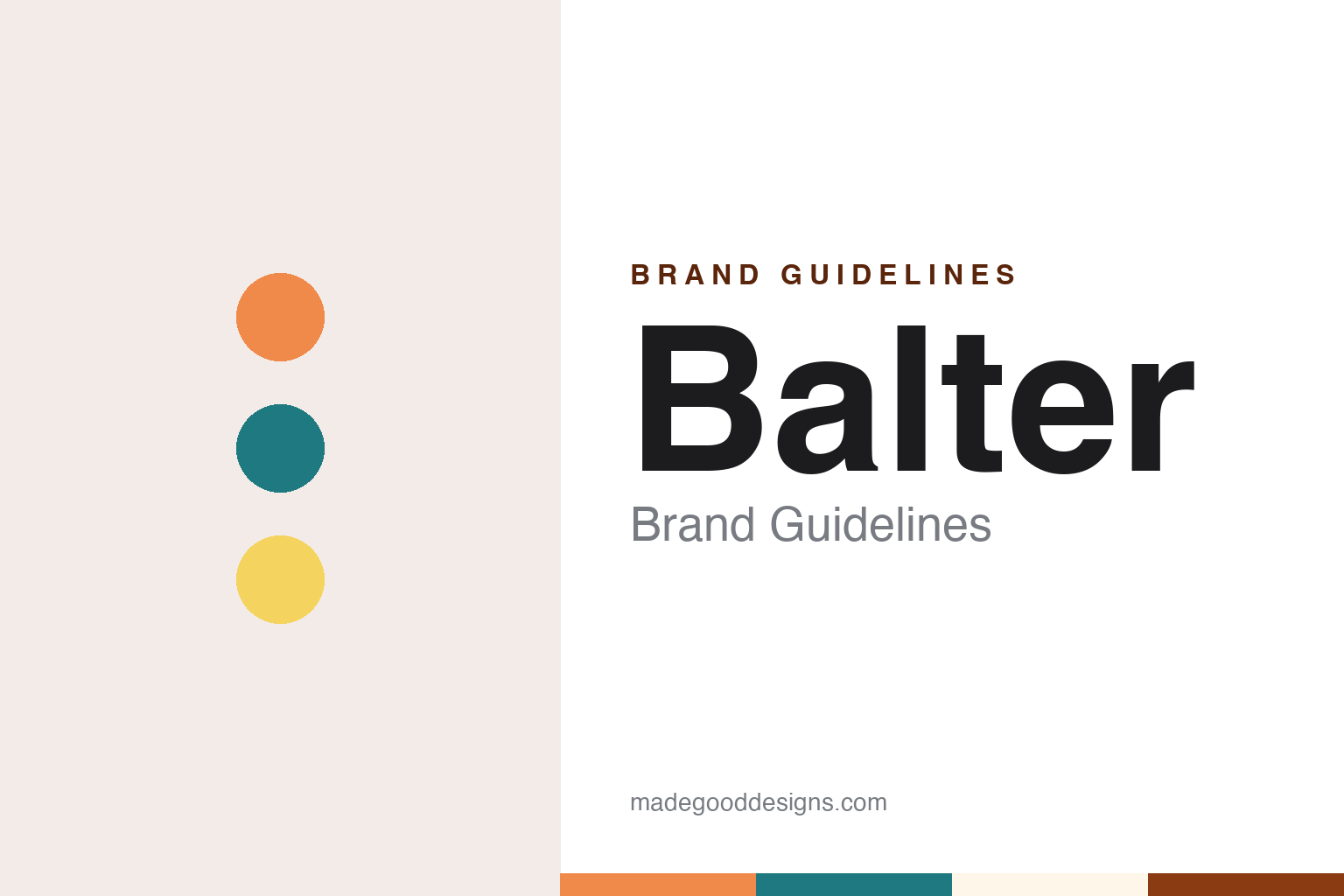
Balter Brand Guidelines
The Gold Coast brewery founded by surfers, launched 2016.
Aa
Two constants: a sunset coral, teal and sand palette and a heavy condensed sans register. Abstract homage — not a Balter product or mark; no label, logo or can is reproduced.
Surfers, a brand director and a brewer
A Gold Coast brewery built by friends, with a brewer from Byron Bay.
Balter Brewing Company launched on the Gold Coast in March 2016. Its best-known founders are four professional surfers — Mick Fanning, Joel Parkinson, Bede Durbidge and Josh Kerr — whose involvement The Weekend Australian reported in April 2016, English Wikipedia notes. The company’s own list of founders is longer: alongside the four surfers it names Sean Ronan, Stirling Howland as founder and brand director, Ant Macdonald as founder and general manager, and the head brewer Scott Hargrave.
Hargrave brought the brewing pedigree. The Crafty Pint, in an early-2017 profile that Balter republished on its own site, reported that he had worked at Stone & Wood in its early years and then become head brewer at the Byron Bay Brewing brewpub before the Balter team approached him. He was not an easy sell. “Part of me saying yes was having other guys like Stirling saying it wasn’t about the boys, it was about the beer,” he told the magazine, adding that he had needed to be sure the project was not “some cynical play.”
The brewery and its venue are at Currumbin Waters, at the southern end of the Gold Coast, The Crafty Pint reported, and within ten months the brewery had added six tanks to keep up. The first beer was an XPA, followed by an ALT Brown and a Pilsner. Brews News reported in December 2019 that Balter had been launched with the backing of 46 friends and family investors. The company’s current core range includes the XPA, an IPA, a Cerveza and Eazy Hazy, and it marked ten years of brewing in 2026.
Colour
A word for joyful dancing, and cans meant to be noticed.
The name is an English verb. The company defines balter as “to dance artlessly without particular skill or grace, but usually with enjoyment,” and says that for the brewery it stands for the pleasure of doing something just for the thrill of it. Its stated philosophy is that “good beer is for everyone,” and its site describes the beer as approachable, likening good beer to a good host.
The brand side of the business had a professional behind it from the start. Brews News reported in July 2017, introducing a podcast interview, that Stirling Howland had begun at the surf company Billabong at 14 and moved into branding, marketing and online work, and that Mick Fanning had asked him to work on the brewery because of that experience; the publication described Balter’s packaging as iconic. The Crafty Pint wrote in early 2017 that the XPA could already be found on tap and in its “simple, eye-catching cans” in venues across Australia.
The brand’s advertising has continued under its new owner. B&T reported in May 2025 that the independent agency ATime&Place had made a campaign for Balter with the brewery’s in-house creative team, running across television, digital, outdoor and Balter’s own channels. “You know what I love? That rich people don’t have better beer,” the agency’s chief creative officer, Matt Lawson, said, and Balter’s head of marketing, Genna Nibaldi, said the brewery set out to make good beer accessible to as many people as possible.
Typography
Design and documentation.
The seven brands in this group are all Australian craft breweries: Little Creatures, Stone & Wood, 4 Pines, Balter, Pirate Life, Young Henrys and Mountain Goat. All seven began as independent breweries, and six of them have since been bought into one of two large brewing groups: Lion, a subsidiary of Japan’s Kirin, and Carlton & United Breweries, which Asahi bought from AB InBev in a purchase completed on 1 June 2020, BeverageDaily reported.
The sales came over more than a decade. Lion bought Little World Beverages, the Fremantle company behind Little Creatures, in 2012, according to English Wikipedia. Asahi bought Melbourne’s Mountain Goat in September 2015, The Shout reported. AB InBev bought Manly’s 4 Pines in 2017 through its venture arm ZX Ventures, and Adelaide’s Pirate Life the same year, English Wikipedia says; Carlton & United bought Balter of Currumbin in late 2019, Good Beer Hunting reported, and all three passed to Asahi with CUB in 2020. Lion announced on 9 September 2021 that it was buying Fermentum Group, the owner of Byron Bay’s Stone & Wood, Brauwelt reported. Newtown’s Young Henrys took a different route: when it announced a brewing partnership with Tribe in Goulburn in September 2019, Hospitality magazine reported that there would be no change of ownership and that the brewery remained independently owned by its founders, Oscar McMahon and Richard Adamson.
A craft brewery’s identity is usually carried by a name, a label, a can and a tap decal rather than by the building where the beer is made, and after a sale the beer may be brewed somewhere else entirely. Each guide separates what independent sources record from what the company says about itself — its founders, its owners over time, where its beer is brewed and how its packaging has changed — and marks plainly what rests only on the company’s own word.
Aa
A heavy condensed sans for a short, loud name. (Specimen set in Anton, a sans-serif STAND-IN; NOT the Balter logo.)
Balter
Nearly four years independent, then CUB and Asahi.
Balter sold within four years of launching. Brews News reported on 5 December 2019 that Carlton & United Breweries had bought the brewery for an undisclosed sum, that talks had begun after CUB approached the team that January, and that the brewery’s rapid growth had needed more capital. Founders and management would stay, more than 60 staff would keep their jobs and brewing would stay at the Gold Coast brewery; Hargrave said there were no plans to change ingredients and that brewing independence had been a key condition of the sale. Balter joined 4 Pines and Pirate Life in CUB’s portfolio.
CUB itself was changing hands at the time, from AB InBev to Asahi. Brews News reported on 2 June 2020 that Asahi had completed its takeover of CUB, after the competition regulator required it to sell several cider and beer brands, and English Wikipedia lists Asahi as Balter’s owner. Asahi has owned Balter, through CUB, since 2020. The brewery has since looked beyond Australia: in September 2025 the company announced the arrival of its XPA and Eazy Hazy in New Zealand, and it has brewed collaboration beers with the New Zealand brewery Garage Project and with Mountain Culture.
The name needs a little care online. “Balter” is also an English word and a surname, and the brewery’s own site is balter.com.au.
For a design guide, Balter shows how a borrowed old word, a cast of well-known founders and a brand director with a surf-industry background can carry a beer brand from a single Gold Coast brewery to national shelves, while keeping its message that good beer is for everyone. Compare 4 Pines, the Manly brewery in the same CUB portfolio, and Stone & Wood, the Byron Bay brewery where Balter’s head brewer started out. For this guide we use sunset coral, teal and sand with a heavy condensed sans, an unofficial interpretation; no product or logo is reproduced.
Explore & save
Keep Balter’s identity on hand — save it to a board in the Made Good inspiration library.
Balter identity set
Pin the Balter sunset coral, teal and sand palette and the heavy condensed sans register to your own board.


