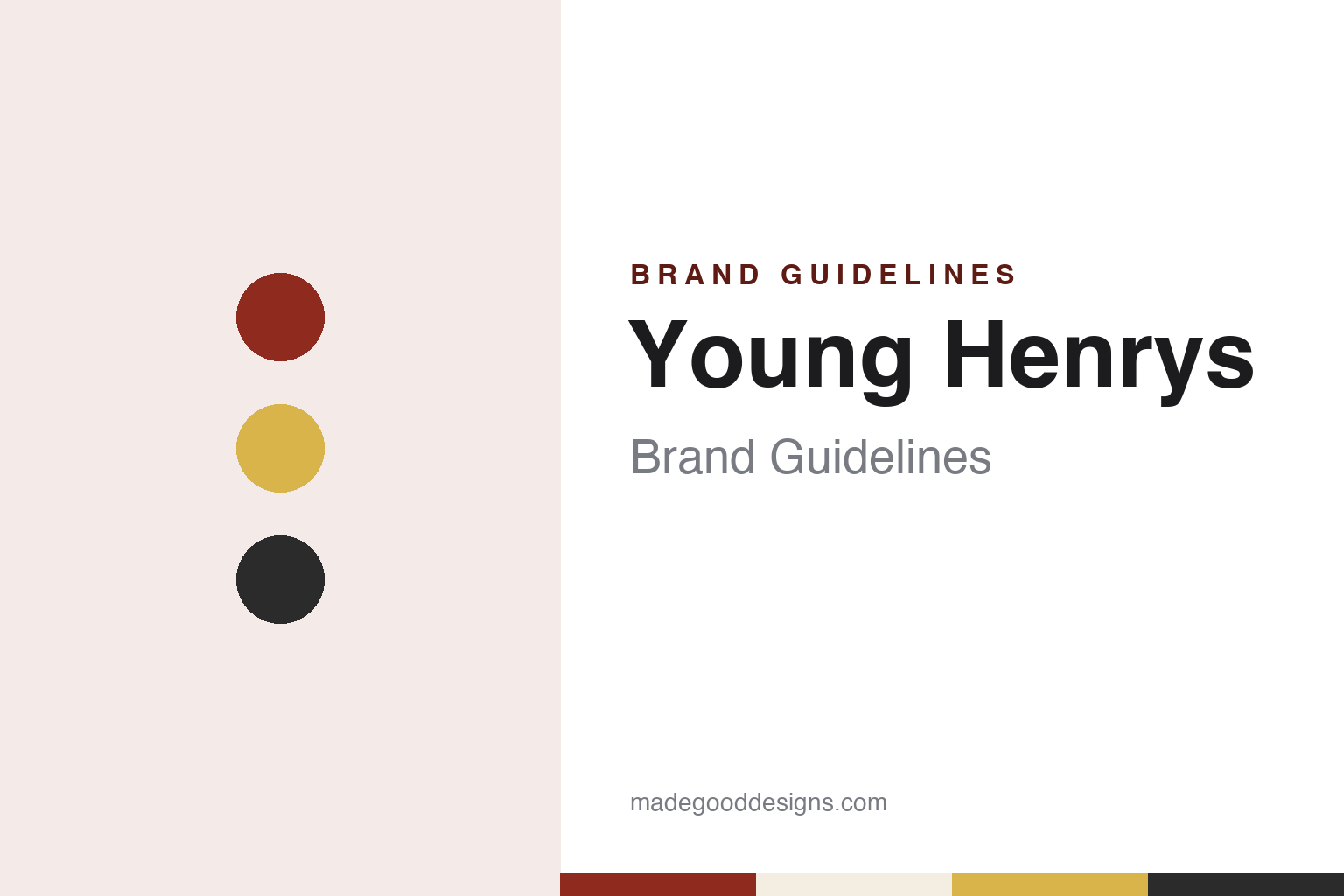
Young Henrys Brand Guidelines
The independent Newtown brewery behind Newtowner.
Aa
Two constants: a Wilford red, pale ale gold and warehouse black palette and a fat slab serif register. Abstract homage — not a Young Henrys product or mark; no can, label or logo is reproduced.
A beer club, a working title and a Newtown warehouse
Two Sydney beer people, one rejected application and a name that stuck.
Young Henrys was founded in 2012 by Oscar McMahon and Richard Adamson, English Wikipedia says. Adamson had been head brewer at the Sydney brewer Barons Brewing from 2005 and left in 2010, the year that company went into voluntary administration. In 2011 the two began running a monthly Beer Club at the Roxbury Hotel in Glebe, where Australian and international breweries each showed two beers, and it was at those evenings that the idea of their own brewery took shape.
The name began as a joke. English Wikipedia quotes the company’s sales director, Dan Hampton, explaining that Adamson was minding his young son at the time, and that before one planning meeting McMahon asked whether “Young Henrys” was coming along; they wrote it down as a working title. McMahon has said the traditional-sounding name is appropriate for a brewery that recreates traditional beer styles.
The first site did not go to plan. English Wikipedia says the founders first applied to open in a warehouse on Devonshire Street in Surry Hills in 2012, and that the application drew 57 objections among 74 public submissions and was rejected by the council. They moved the project to a warehouse at 76 Wilford Street, Newtown, where a brewpub for 90 people was approved the same year. Broadsheet reported in 2025 that the brewery has occupied the rented Wilford Street space since 2012, and Oscar McMahon described it to that magazine as a late-1970s industrial warehouse in what he believed was the last small industrial park in Newtown. A second brewery, The Beer Farm at Metricup in Western Australia, opened in 2014 in an old dairy, English Wikipedia says, and in July 2015 it was restructured as a separate business making its own beer.
Colour
A pale ale for a suburb’s birthday, and a brewery that likes a band.
The beer most tied to the brand is Newtowner. English Wikipedia says it was launched on 12 December 2012 to mark 150 years of Newtown, was meant to be a limited release, and became the brewery’s flagship. The original limited-release label, it says, featured native flora and fauna and the suburb’s postcode, 2042 — a number McMahon returned to in 2025, when he told Broadsheet that if the brewery had to move it was committed to staying in the 2042 postcode. Natural Lager and Cloudy Cider were among the first products in 2012, and the company also makes gin. In January 2026 the company launched Newtowner 3.5, a lighter version of the pale ale, and its website now promotes Newtowner with the line “same legend, new look.”
Music has been a recurring partner. English Wikipedia records a 2013 beer, Brew Am I, made with the Australian band You Am I for its 20th-anniversary tour; FooTown Lager, made with Foo Fighters for their 2018 Australian tour; and a lager with the garage-rock band Dune Rats. City Hub reported in June 2025 that the brand works under the ethos “Serve the People,” supports local arts, music and queer culture, and had re-released a special-edition lager for the Mardi Gras season. Sport has a place too: in March 2026 the company released a draught, AJ213, to honour the South Sydney Rabbitohs’ Alex Johnston, whom the company calls rugby league’s all-time greatest try scorer.
The brewery has also used its site for environmental projects. English Wikipedia says Young Henrys worked with the Pingala co-operative to put a 33 kW solar array on the roof in August 2016, part-funded by community investors, and in 2018 installed algae bioreactors with the University of Technology Sydney to absorb carbon dioxide from fermentation. In 2017 it was one of five breweries that founded the Inner West Brewers Association.
Typography
Design and documentation.
The seven brands in this group are all Australian craft breweries: Little Creatures, Stone & Wood, 4 Pines, Balter, Pirate Life, Young Henrys and Mountain Goat. All seven began as independent breweries, and six of them have since been bought into one of two large brewing groups: Lion, a subsidiary of Japan’s Kirin, and Carlton & United Breweries, which Asahi bought from AB InBev in a purchase completed on 1 June 2020, BeverageDaily reported.
The sales came over more than a decade. Lion bought Little World Beverages, the Fremantle company behind Little Creatures, in 2012, according to English Wikipedia. Asahi bought Melbourne’s Mountain Goat in September 2015, The Shout reported. AB InBev bought Manly’s 4 Pines in 2017 through its venture arm ZX Ventures, and Adelaide’s Pirate Life the same year, English Wikipedia says; Carlton & United bought Balter of Currumbin in late 2019, Good Beer Hunting reported, and all three passed to Asahi with CUB in 2020. Lion announced on 9 September 2021 that it was buying Fermentum Group, the owner of Byron Bay’s Stone & Wood, Brauwelt reported. Newtown’s Young Henrys took a different route: when it announced a brewing partnership with Tribe in Goulburn in September 2019, Hospitality magazine reported that there would be no change of ownership and that the brewery remained independently owned by its founders, Oscar McMahon and Richard Adamson.
A craft brewery’s identity is usually carried by a name, a label, a can and a tap decal rather than by the building where the beer is made, and after a sale the beer may be brewed somewhere else entirely. Each guide separates what independent sources record from what the company says about itself — its founders, its owners over time, where its beer is brewed and how its packaging has changed — and marks plainly what rests only on the company’s own word.
Aa
A fat slab serif for a brewery with a pub-sign name. (Specimen set in Alfa Slab One, a slab-serif STAND-IN; NOT the Young Henrys logo.)
Young Henrys
Staying independent, brewing in Goulburn, looking for a new home.
Young Henrys has not been sold. In September 2019 it announced a brewing partnership with Tribe, an independent contract brewer with a new plant in Goulburn, New South Wales; the announcement, published by Brews News and reported by Hospitality magazine, said there would be no equity or change of hands for either company, that Young Henrys would remain independently owned by its founders, and that brewing would continue in Newtown. Both companies were members of the Independent Brewers Association at the time. By June 2025, when The Shout and Beer & Brewer interviewed Oscar McMahon, he named his fellow owners as Richard Adamson and Dan Hampton. The company’s website describes it as independent and “Australian made and owned.”
The Newtown home is now in question. On 30 May 2025 Loucas Architects lodged a development application with the Inner West Council to demolish the Wilford Street site and build a six-storey block of 40 apartments, The Shout reported. McMahon said the landlord had kept the brewery informed, that the team had been looking for a new site for five or six months, and that it was committed to Newtown and Enmore, to a place where customers can visit, and to keeping production. He told Broadsheet that moving a brewery is expensive and the team was not in a rush.
For a design guide, Young Henrys shows how an independent brewery can build a brand out of a suburb — a postcode on a label, a beer named after the neighbourhood, a taproom people treat as a meeting place — and keep it while production moves elsewhere. Compare Little Creatures, the Fremantle craft brewery, and Stone & Wood, from Byron Bay. For this guide we use Wilford red, pale ale gold and warehouse black with a slab serif, an unofficial interpretation; no product or logo is reproduced.
Explore & save
Keep Young Henrys’s identity on hand — save it to a board in the Made Good inspiration library.
Young Henrys identity set
Pin the Young Henrys Wilford red, pale ale gold and warehouse black palette and the fat slab serif register to your own board.


