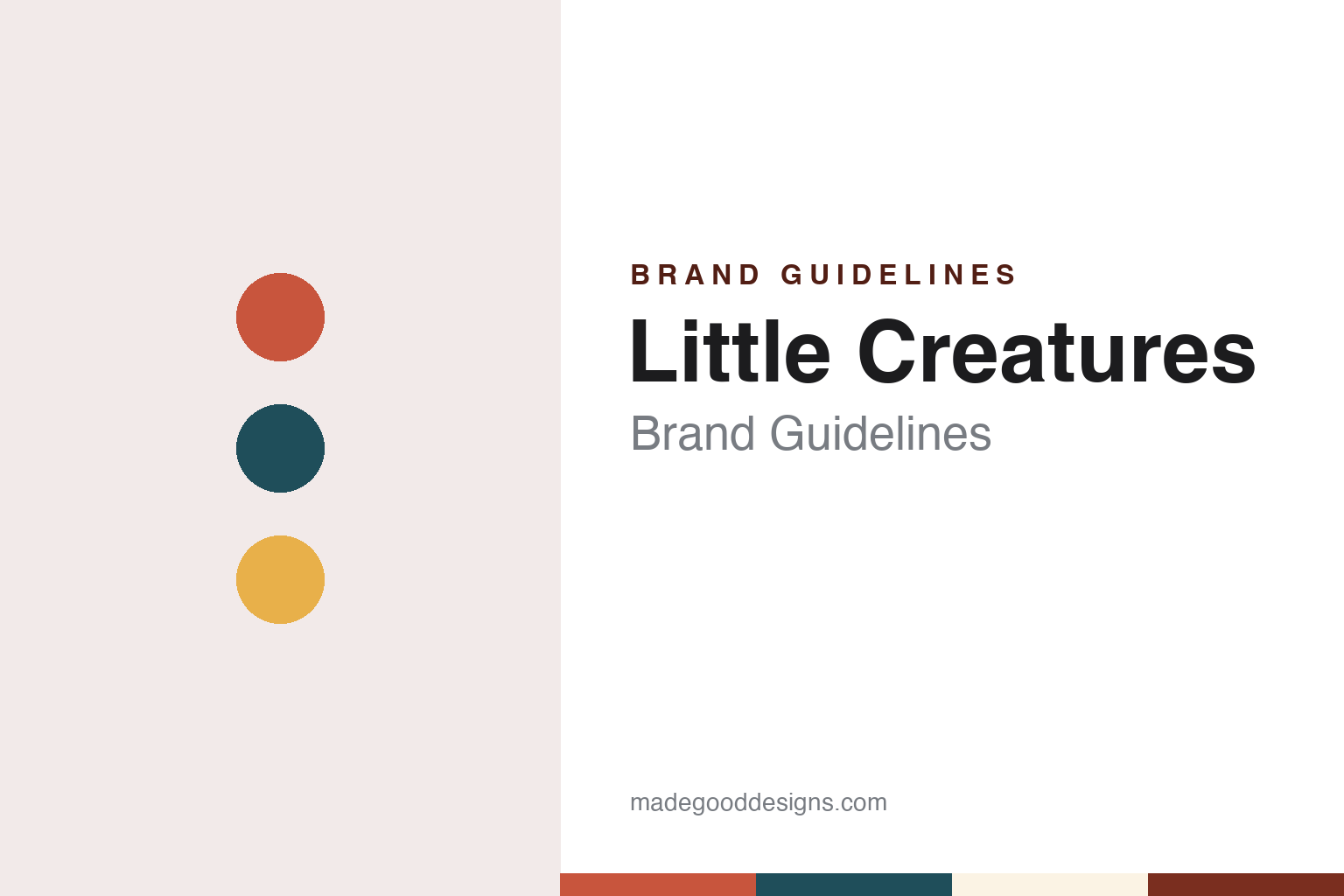
Little Creatures Brand Guidelines
Fremantle’s pale ale brewery, founded 2000.
Aa
Two constants: a harbour brick, rust and harbour teal palette and a soft display serif register. Abstract homage — not a Little Creatures product or mark; no label, logo or bottle is reproduced.
A hop-forward ale on Fremantle harbour
Three former Matilda Bay hands, a crocodile farm and an American-style pale ale.
Little Creatures began on the waterfront at Fremantle, Western Australia, in 2000. English Wikipedia, citing The West Australian (2012), names its founders as Howard Cearns, a marketing specialist, Nic Trimboli, a restaurateur, and Phil Sexton, a brewer, all of whom had earlier worked with the Matilda Bay Brewing Company. A 2008 profile in the business magazine Nett, cited by English Wikipedia, says the three began talking in 1997 about brewing a hoppy American-style ale. The company tells the same story in its own words: the aim was a hop-packed American Pale Ale, made with hops brought in from the United States.
The site came first, and the brewery was fitted into it. Little Creatures says its founders found an old crocodile farm on the edge of the Fremantle Fishing Boat Harbour. English Wikipedia, citing the Footprint Australia Handbook (2002), adds that the building had originally been put up to house the Taskforce ’87 yachts, among them Kookaburra, during the 1987 America’s Cup, and only later became a crocodile farm. The company says it opened its doors in late 2000, and English Wikipedia, citing SmartCompany (2012), says Little Creatures Pale Ale was the first beer released.
That beer still defines the brand. English Wikipedia describes it as an American pale ale brewed with whole Cascade and Chinook hop flowers and Australian malts and given a secondary fermentation in the bottle, and the company says the Pale takes nearly six weeks from brew to bottle. Little Creatures also says that soon after opening it called in two English brewers, Roger Bailey and Roger Bussell, to help build the brewery, and named its amber ale, Rogers, in their honour.
The name has two origin stories in print. English Wikipedia says it refers to the live yeast cells that turn the sugars of malt wort into alcohol, and links it to the 1985 Talking Heads album Little Creatures. The same article, citing Adrian Tierney-Jones’s book 1001 Beers You Must Try Before You Die (2011), says Cearns came up with it after reading J. R. R. Tolkien’s The Hobbit, thinking the phrase sounded like fermentation.
Colour
An open brewery, a cherub and hand-drawn labels.
The brand’s first design decision was architectural. The company says its founders felt breweries had long hidden behind brick walls and gates, and wanted an open brewery that welcomed passers-by instead. Rather than tucking the brewhouse out of sight, Little Creatures put its first hospitality space, the Great Hall, among the tanks and kegs, it says, so that drinkers sat inside a working brewery.
On the bottle, the constant is a cherub. In a release published by Brews News in January 2018, the company announced a packaging refresh across all its beers that it called its biggest transformation since the Fremantle brewery opened in 2000, rolling out from mid-November 2017. The beer was unchanged. After 17 years in a supporting role, the release said, the cherub became the centrepiece of the new designs, and it quoted Marty Ferguson of Little Creatures describing the figure as an icon of the brand’s free-thinking personality and youthful spirit. The labels gained an energetic injection of colour and hand-drawn illustrations telling the story of each beer’s creation and provenance, with what Ferguson called a few nods to Fremantle and Western Australia.
The refresh kept more than it changed. Head brewer Russ Gosling told Packaging News in January 2018 that the label shape, the bottle design and the circular Little Creatures logo on the bottle neck had been retained, and that the cherub was still embossed on the glass. Each beer’s colour was made bolder and cleaner, the label typefaces changed, and a “flavo-meter” running from “flavour” to “more flavour” was added to help drinkers choose. In the same interview the company noted that its Dog Days ale first went into a can in September 2016.
The cherub has also been dressed up. Packaging News reported in 2023 that Little Creatures had produced its first limited-edition themed packaging, for its partnership with Sydney Gay and Lesbian Mardi Gras and Sydney WorldPride 2023. The design studio Interweave carried out the brief, using pastel colours and illustrations, with two hearts drawn from the festival’s infinity-heart motif set behind the cherub.
Typography
Design and documentation.
The seven brands in this group are all Australian craft breweries: Little Creatures, Stone & Wood, 4 Pines, Balter, Pirate Life, Young Henrys and Mountain Goat. All seven began as independent breweries, and six of them have since been bought into one of two large brewing groups: Lion, a subsidiary of Japan’s Kirin, and Carlton & United Breweries, which Asahi bought from AB InBev in a purchase completed on 1 June 2020, BeverageDaily reported.
The sales came over more than a decade. Lion bought Little World Beverages, the Fremantle company behind Little Creatures, in 2012, according to English Wikipedia. Asahi bought Melbourne’s Mountain Goat in September 2015, The Shout reported. AB InBev bought Manly’s 4 Pines in 2017 through its venture arm ZX Ventures, and Adelaide’s Pirate Life the same year, English Wikipedia says; Carlton & United bought Balter of Currumbin in late 2019, Good Beer Hunting reported, and all three passed to Asahi with CUB in 2020. Lion announced on 9 September 2021 that it was buying Fermentum Group, the owner of Byron Bay’s Stone & Wood, Brauwelt reported. Newtown’s Young Henrys took a different route: when it announced a brewing partnership with Tribe in Goulburn in September 2019, Hospitality magazine reported that there would be no change of ownership and that the brewery remained independently owned by its founders, Oscar McMahon and Richard Adamson.
A craft brewery’s identity is usually carried by a name, a label, a can and a tap decal rather than by the building where the beer is made, and after a sale the beer may be brewed somewhere else entirely. Each guide separates what independent sources record from what the company says about itself — its founders, its owners over time, where its beer is brewed and how its packaging has changed — and marks plainly what rests only on the company’s own word.
Aa
A soft display serif for a harbour-side brewery with a cherub on every label. (Specimen set in Fraunces, a serif STAND-IN; NOT the Little Creatures logo.)
Little Creatures
From a listed Fremantle brewer to Lion’s craft flagship.
Growth came quickly. The company says that by 2005 demand for the Pale Ale reached the east coast and it built a new brewhouse next door in Fremantle, and English Wikipedia says the business set up a second brewery in Healesville, Victoria, in 2008. The parent company, Little World Beverages, was listed on the stock exchange, and in June 2012 news.com.au reported that Lion, the Sydney-based brewer owned by Japan’s Kirin, had agreed to buy it; Lion already held a large minority stake, the report said. English Wikipedia records the takeover as completed in 2012.
An east-coast brewery followed. The company says it bought an old wool mill in South Geelong, built in 1923, in 2011, and mashed in its first Geelong-brewed Pale Ale in October 2013; it says the beer from Fremantle and Geelong follows the same recipe, ingredients and quality checks. Lion’s other craft brands now sit close by: when Lion agreed to buy the Byron Bay brewer Stone & Wood’s parent in 2021, Stone & Wood’s own timeline described it joining the group alongside Little Creatures.
Fremantle remains the home. The Fremantle Shipping News reported in March 2026 that Little Creatures had opened a two-level venue at 42 Mews Road after a major refit, during the brewery’s 25th-birthday year, with Pale Ale and Fremantle Lager served from the brewery’s tanks. The old Great Hall became the Brewhouse, a visitors’ hub for tours; the report credited Lion’s in-house team with the interior design and architecture and said construction was managed by Dundee Rock, a 100 per cent Aboriginal-owned builder.
The name needs care online. Little Creatures is also the title of the 1985 Talking Heads album; the brewery’s own site is littlecreatures.com.au.
For a design guide, Little Creatures shows how an open-plan brewery, a single hop-forward ale and a cherub that waited 17 years for the middle of the label can carry a brand from one Fremantle shed to national shelves. Compare Stone & Wood, its Lion stablemate from Byron Bay, and Kirin, the Japanese brewer that owns Lion. For this guide we use harbour brick, rust and harbour teal with a soft serif, an unofficial interpretation; no product or logo is reproduced.
Explore & save
Keep Little Creatures’s identity on hand — save it to a board in the Made Good inspiration library.
Little Creatures identity set
Pin the Little Creatures harbour brick, rust and harbour teal palette and the soft display serif register to your own board.