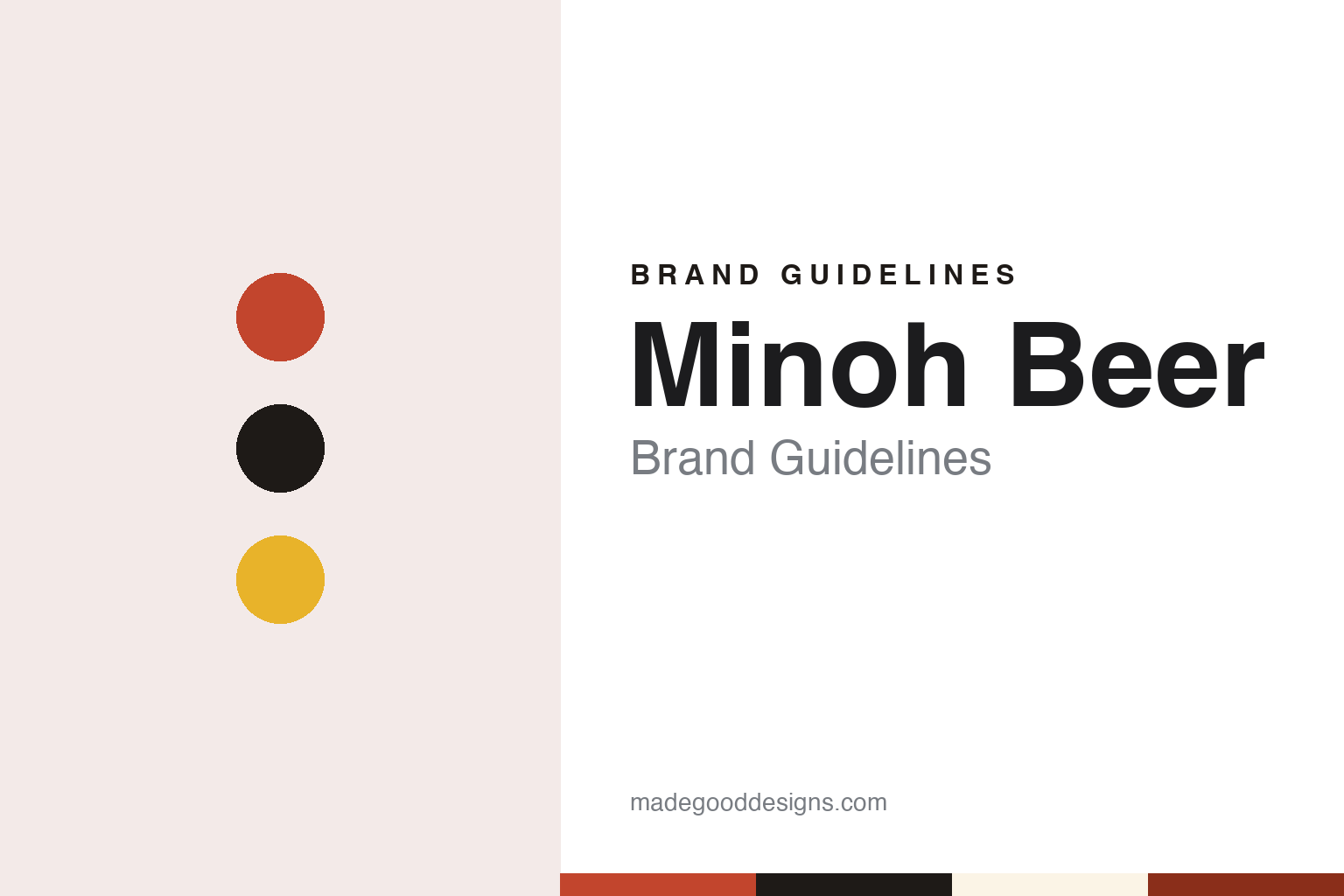
Minoh Beer Brand Guidelines
An Osaka family brewery by the waterfall, brewing since 1997.
Aa
Two constants: a maple red, stout black and yuzu gold palette and a heavy gothic sans register. Abstract homage — not a Minoh Beer product or mark; no label, logo or bottle is reproduced.
A liquor seller’s brewery in the hills of Minoh
From a father’s idea in the 1990s to a daughter-run brewery.
Minoh Beer is made by Minoh Beer Co. (Kabushiki Kaisha Minoh Beer), a small independent brewery in Minoh, a city in the hills of northern Osaka Prefecture. The company gives its founding date as 17 October 1996 and says brewing began in 1997. Its brewery operates under a separate company name, A.J.I. Beer, which Japanese Wikipedia says was also the name of the original brewing company.
The founder was Masaji Oshita, whom the company calls the “father” of Minoh Beer. Japanese Wikipedia, citing a January 2018 profile in the Nikkei, says he ran a liquor shop in neighbouring Suita when he decided to make beer. The company’s president, his daughter Kaori Oshita, writes on its site that her father chose Minoh, a town known for a national park with a waterfall, autumn leaves and wild monkeys.
The brewery grew out of the late-1990s boom in Japanese ji-bīru, or local beer. Japanese Wikipedia, citing the 2007 guidebook Nippon no Ji-Bīru (ASCII), says Minoh first worked from imported concentrated wort and began brewing from malt in 2002. Kaori Oshita helped at the brewery while still a student and was put in charge of it as brewery manager in 1998, according to Japanese Wikipedia, again citing the Nikkei profile.
The Nikkei profiled Kaori Oshita as president in January 2018, and The Japan Times ran a feature in November 2018 headlined “Minoh Beer: A father’s dream, a daughter’s reality.” Japanese Wikipedia says the present company, Minoh Beer Co., was set up in 2014 with her as president.
Colour
A waterfall town, a troop of monkeys and a beer for every season.
Minoh Beer draws its identity from its home town. The company describes itself as a local beer “born in Minoh” and made by hand, and it places the brewery beside the Meiji no Mori Minoh Quasi-National Park. It says its beer is neither filtered nor heat-treated, so the yeast stays alive in the bottle and in the keg.
The town’s monkeys appear on the label. The company says the label of Osaru IPA (osaru is Japanese for monkey) uses Minoh’s monkeys as its motif and calls the artwork a symbol of Minoh Beer; the beer joined the regular range in 2020. The rest of the year-round line-up is built on classic styles, which the company says it treats as its standard: a Stout, which it calls its flagship and representative beer, a Pilsner, a Pale Ale, a Weizen and a W-IPA.
Seasonal beers carry the local produce. The company says it brews with peaches in summer and with yuzu, a local speciality, in winter, working with the farmers at harvest time, and that it also uses wild yeasts and sake-rice koji. In 2022 it began a new range it calls the Baton Beer series. The fruit beers change with the harvest: in 2026 the company released peach Weizens named after two peach varieties, Hakuho in August and Kawanakajima in October.
Its stated aim is ordinary rather than special: the company says it wants Minoh Beer to be a “daily beer,” the local beer people want to drink every day. Its motto, as Kaori Oshita puts it on the site, is to “brew beer, and brew people,” a line about training a team that the company says mostly arrived without any brewing experience.
Typography
Design and documentation.
The seven brands in this group are all Japanese craft beers: Hitachino Nest, Yo-Ho, Coedo, Echigo, Minoh, Baird and Shiga Kogen. Most of them trace back to a single change in the law. Japanese Wikipedia records that a 1994 revision of the liquor tax law cut the minimum annual output needed for a beer licence from 2,000 kilolitres to 60, and that the small regional breweries that followed, known as “ji-bīru,” at one point numbered more than 300.
Several of the seven grew out of older drinks businesses. English Wikipedia says Kiuchi Brewery, the maker of Hitachino Nest in Naka, Ibaraki, was founded in 1823 as a sake producer and began brewing beer in 1996; Shiga Kogen Beer belongs to Tamamura Honten, a Nagano sake house that dates itself to 1805 and began brewing beer in 2004. Others sit inside larger companies: Japanese Wikipedia says Yo-Ho Brewing of Karuizawa was founded in 1996 by Yoshiharu Hoshino of Hoshino Resorts and entered a business and capital alliance with Kirin Beer in 2014, that Coedo is the beer division of Kyodo Shoji of Kawagoe, and that the confectioner Bourbon has owned all of Echigo Beer of Niigata since 2010. Minoh Beer is a family brewery in Minoh, Osaka, and Zoom Japan reported in 2020 that Baird Beer was founded in Numazu in 2000 by Bryan and Sayuri Baird and moved its headquarters to Shuzenji in 2014.
Each guide separates what independent sources record from what the company says about itself — its founding story, its owners over time, where its beer is brewed and how its labels and cans have changed — and marks plainly what rests only on the company’s own word.
Aa
A heavy gothic sans for a small brewery with a big local voice. (Specimen set in Zen Kaku Gothic New, a sans-serif STAND-IN; NOT the Minoh Beer logo.)
Minoh Beer
A stout that travels, and a brewery that stays local.
The stout has carried the name abroad. At the 2017 International Brewing & Cider Awards in Burton upon Trent, the organisers reported in April 2017, Minoh won a gold medal for its W-IPA and a bronze for its Stout. Kaori Oshita told the organisers she was proud that a British style of beer had been rated so highly by a panel that included British judges, and that Japan’s small craft-beer sector tends to collaborate more than it competes. The company’s own list of competition medals runs back to 2002.
At home the brewery keeps close to its neighbours. The company says all of its spent malt goes to local farmers as feed for cattle and chickens, that eggs from those chickens are sold in its own shop, and that its yearly founding festival is held jointly with the local residents’ association. It runs a shop and pub, WAREHOUSE, next to its Minoh head office, and Beer Belly pubs in Osaka.
Online, the brewery’s official site is minoh-beer.jp.
For a design guide, Minoh Beer shows how a small family brewery can build a recognisable identity from what is around it: a waterfall town, its monkeys, its fruit and a short list of classic styles brewed every day. Compare Hitachino Nest, the Ibaraki craft beer with the owl on its label, and Suntory, the drinks group that began in Osaka. For this guide we use maple red, stout black and yuzu gold with a heavy sans, an unofficial interpretation; no product or logo is reproduced.
Explore & save
Keep Minoh Beer’s identity on hand — save it to a board in the Made Good inspiration library.
Minoh Beer identity set
Pin the Minoh Beer maple red, stout black and yuzu gold palette and the heavy gothic sans register to your own board.


