Echigo Beer Brand Guidelines
Niigata’s goat-mark craft beer, from a sake house to Bourbon.
Aa
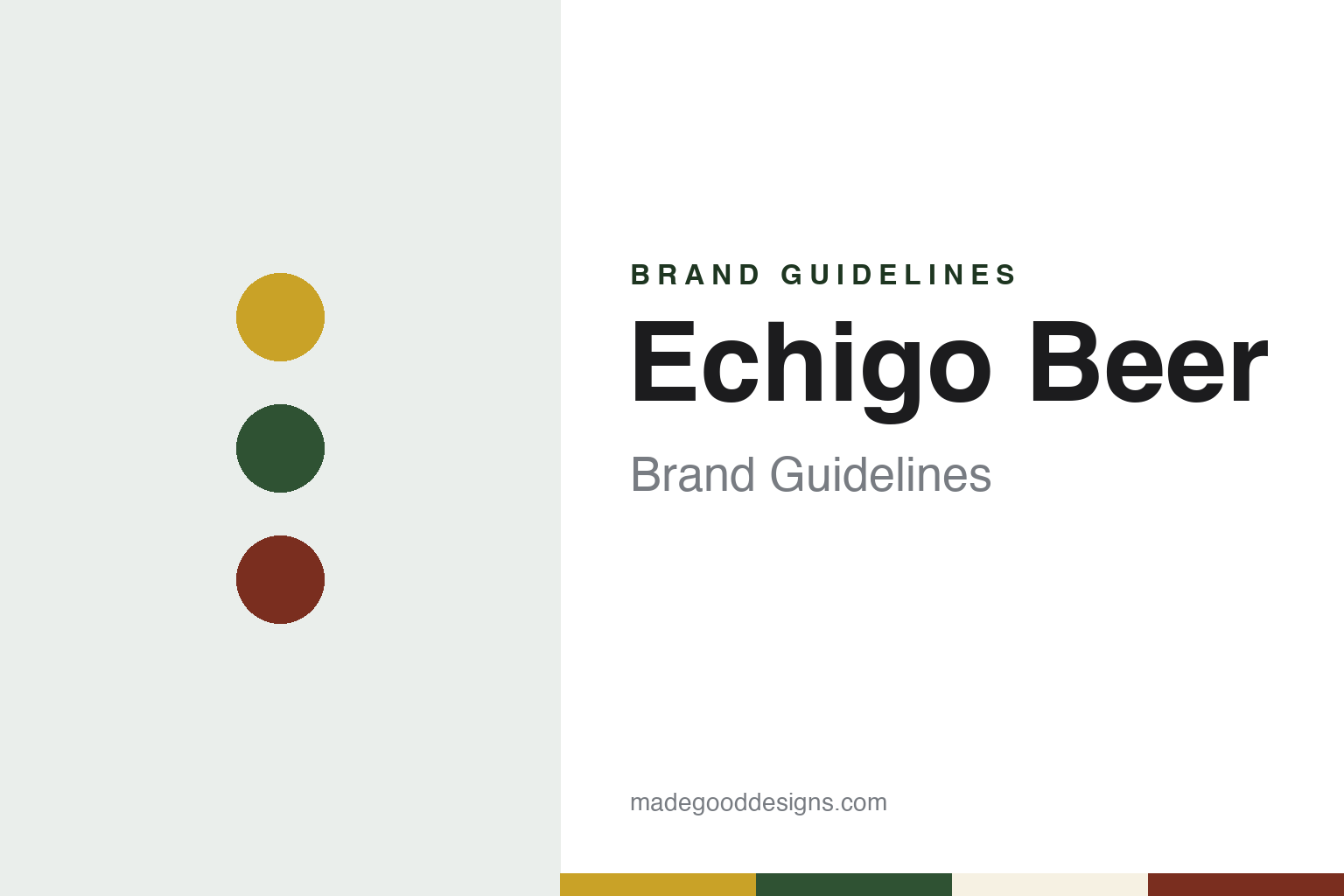
Two constants: a pine green, barley gold and red ale palette and a classic book serif register. Abstract homage — not an Echigo Beer product or mark; no label, logo or can is reproduced.
A sake brewer’s son and a beer from Europe
Born at a Niigata sake house when Japan opened beer to small brewers.
Echigo Beer takes its name from Echigo, the old name for the province that is now Niigata Prefecture, on the Sea of Japan coast. The brand began inside Uehara Shuzo, the Niigata sake brewery behind Echigo Tsurukame, Japanese Wikipedia says. Its founder was the brewery’s fifth-generation head, Seiichiro Uehara. The company says that in the late 1970s and 1980s he lived in Europe, based in Rome, working in theatre, and that holidays in Regensburg, the German home town of his partner, introduced him to German beer culture, which he wanted to bring back to his own region.
The opening came from Tokyo. A revision of Japan’s liquor tax law in 1994 sharply cut the minimum annual production needed for a beer licence, which made small breweries possible for the first time. The company says it received a trial licence and began test brewing in July 1994 and was granted a full beer-brewing licence in December 1994.
Echigo was not alone. Writing in Outdoor Japan in 2009, the beer writer Bryan Harrell said Echigo and Okhotsk Beer in Hokkaido were the first to receive brewing licences under the new rules in late 1994, but that “Echigo opened first.” He described a brewpub set on a hill framed by pine forest, with a menu of sausage and salami from small Japanese producers. Japanese Wikipedia likewise notes that Okhotsk obtained its licence first while Echigo opened first, so both are described as Japan’s first craft brewers. Echigo Beer itself calls its beer Japan’s first domestically made craft beer.
Colour
A church-like brewpub, a canning brewery and a goat.
The first home was a brewpub. Harrell wrote that it was “quite a sight” when it opened in December 1994, with high ceilings and a heavy European influence in the architecture that gave it a church-like feel. The company dates the opening to 1995, and it marked the brewpub’s 30th anniversary in February 2025. The beers, Harrell wrote, were mostly American versions of European styles: pale ale, amber ale, stout and a German-style pilsner. A second, larger brewery for canned beer, at Uwaseki, began operating in 1999, the company says, and it is now the head office and brewery; Harrell wrote that it was built for a lower-cost canned product, leaving the original brewery to concentrate on small batches. The company says it began exporting to the United States in 2004, and in 2024 it opened a pub in Niigata in partnership with the pub chain HUB.
The emblem comes from the same European story. The company says its trademark, a smiling male goat holding a glass of beer, was drawn by the founder’s partner, a German picture-book artist; Japanese Wikipedia identifies her as Uehara’s wife. The company explains that the billy goat is a symbol of fertility, good harvests and thriving trade in Germany and the Czech lands, and Japanese Wikipedia adds that goats often appear on the labels of German bock beers.
The goat was formalised in 2020, when the company says it renewed the packaging of all its main products and unified the design of the goat mark. Local ingredients sit beside the European styles: Japanese Wikipedia describes a Koshihikari Echigo Beer brewed with Niigata’s Koshihikari rice and a pilsner made with Saaz hops from the Czech Republic.
Typography
Design and documentation.
The seven brands in this group are all Japanese craft beers: Hitachino Nest, Yo-Ho, Coedo, Echigo, Minoh, Baird and Shiga Kogen. Most of them trace back to a single change in the law. Japanese Wikipedia records that a 1994 revision of the liquor tax law cut the minimum annual output needed for a beer licence from 2,000 kilolitres to 60, and that the small regional breweries that followed, known as “ji-bīru,” at one point numbered more than 300.
Several of the seven grew out of older drinks businesses. English Wikipedia says Kiuchi Brewery, the maker of Hitachino Nest in Naka, Ibaraki, was founded in 1823 as a sake producer and began brewing beer in 1996; Shiga Kogen Beer belongs to Tamamura Honten, a Nagano sake house that dates itself to 1805 and began brewing beer in 2004. Others sit inside larger companies: Japanese Wikipedia says Yo-Ho Brewing of Karuizawa was founded in 1996 by Yoshiharu Hoshino of Hoshino Resorts and entered a business and capital alliance with Kirin Beer in 2014, that Coedo is the beer division of Kyodo Shoji of Kawagoe, and that the confectioner Bourbon has owned all of Echigo Beer of Niigata since 2010. Minoh Beer is a family brewery in Minoh, Osaka, and Zoom Japan reported in 2020 that Baird Beer was founded in Numazu in 2000 by Bryan and Sayuri Baird and moved its headquarters to Shuzenji in 2014.
Each guide separates what independent sources record from what the company says about itself — its founding story, its owners over time, where its beer is brewed and how its labels and cans have changed — and marks plainly what rests only on the company’s own word.
Aa
A classic book serif for a European-minded wordmark. (Specimen set in Libre Baskerville, a serif STAND-IN; NOT the Echigo Beer logo.)
Echigo Beer
From the sake house to a confectioner, and a second brewery.
The beer business left the sake brewery in stages. The company says Echigo Beer Co., Ltd. was established on 15 May 2000 and took over the beer business that October; Japanese Wikipedia says the new company was set up with support from Bourbon, the Niigata confectioner, and that in March 2010 Bourbon bought all of Echigo Beer’s shares from Uehara Shuzo, making it a wholly owned subsidiary. Bourbon has owned Echigo Beer since 2010, and the trade paper Nihon Shokuryo Shimbun described it as a Bourbon subsidiary in January 2026. The original brewpub closed after the change of ownership, Japanese Wikipedia says.
Echigo has also absorbed a brand from a national brewer. On 1 October 2007, Japanese Wikipedia says, it bought BeerStyle 21, an in-house venture of Kirin, and took over brewing its GARGERY beer. In 2025 the company acquired a second brewery at Nasu in Tochigi Prefecture; Nihon Shokuryo Shimbun reported that the plant came from Sapporo Breweries and that the first beer brewed there went on sale in February 2026.
The brewery’s official site is echigobeer.com.
For a design guide, Echigo Beer shows how one hand-drawn animal, a goat with a glass, can carry a brewery from a sake house’s brewpub through a change of owner to two breweries. Compare Bourbon, the Niigata confectioner that owns it, and COEDO, the Kawagoe craft beer named after Japanese colours. For this guide we use pine green, barley gold and red ale with a serif, an unofficial interpretation; no product or logo is reproduced.
Explore & save
Keep Echigo Beer’s identity on hand — save it to a board in the Made Good inspiration library.
Echigo Beer identity set
Pin the Echigo Beer pine green, barley gold and red ale palette and the classic book serif register to your own board.