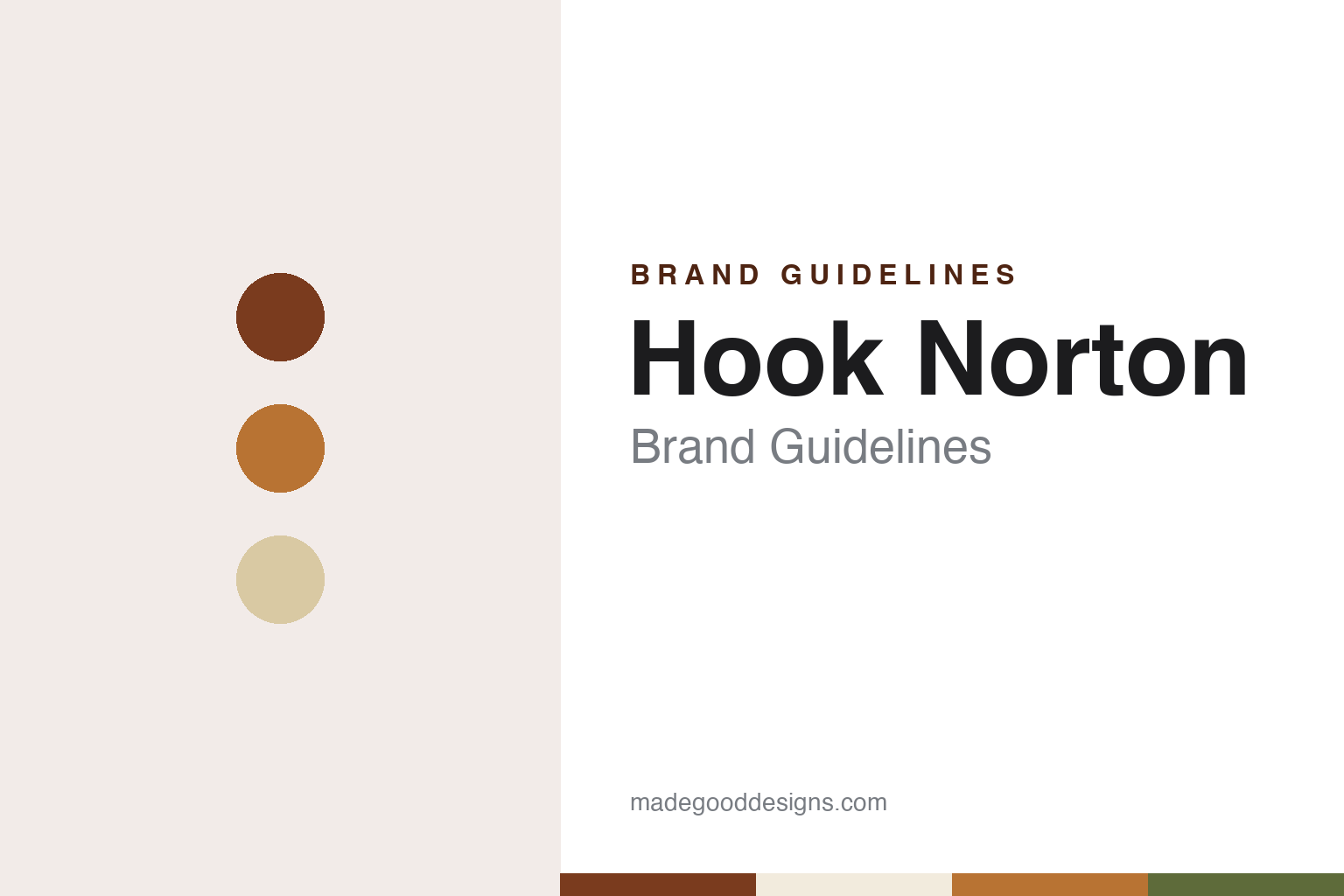
Hook Norton Brand Guidelines
A village malthouse of 1849, a Victorian tower and one family.
Aa
Two constants: a tower brick, brewhouse copper and Cotswold stone palette and a Victorian book serif register. Abstract homage — not a Hook Norton product or mark; no pump clip, label or logo is reproduced.
A maltster, a nephew and a tower
John Harris’s malthouse, the first brewing book and the Clarke family.
Hook Norton Brewery takes its name from the north Oxfordshire village where it has always stood. The brewery’s own history says that in 1849 John Harris moved to Hook Norton and bought a farm of 52 acres that came with a malthouse. He worked as a maltster and also became a dealer in hops, and from that trade the brewery grew. The Oxford Companion to Beer, in an entry by the beer writer Tim Hampson, likewise describes Harris as a farmer and maltster and dates the brewery to 1849.
The company says commercial brewing is thought to have begun a few years later: its first brewing book opens with Brew No. 1, a “Mild XXX”, on 24 November 1856. Its estate of pubs began in 1859 with a beerhouse at Down End, and about ten years later the brewery bought the Pear Tree Inn at the end of Brewery Lane, the company says. In the 1880s the railway extension from Chipping Norton reached the village, and the brewery says the line gave it a way to bring in materials and send out casks.
From 1887 the brewery was run day to day by Harris’s nephew Alban Clarke, according to the company, and it is through the Clarke line that the business has passed down. Clarke doubled the size of the site: a bottling room, store and wash shed came first, in 1890, then a stable block, new offices and finally a new six-storey brewery built on the existing site. A 25-horsepower steam engine was installed on the ground floor in 1899, at first to drive the pumps that raised water from the well, the company says. In 1904 Clarke bought a steam wagon for heavy loads to Banbury, and in 1928 the brewery bought its first motor lorry, a Morris.
Colour
A gravity-fed tower, a working steam engine and shire horses.
The building is the brand’s best-known image. The Oxford Companion to Beer says the six-storey tower was built in the late 1890s to the design of William Bradford, an architect who drew up plans for some seventy other breweries, among them Harvey’s of Lewes in Sussex, and whose signature was an ornate, Queen Anne-style roofline. In a tower brewery the stages run from floor to floor: English Wikipedia describes mashing at the top, boiling in the middle and fermentation and racking at the bottom, with ingredients raised to the top and moved down by gravity. The Companion notes that most of the original vessels have since been replaced, and quotes James Clarke’s view that his great-great-grandfather would have used stainless steel had it been available.
The steam engine is still there. The Companion identifies it as a 25-horsepower Buxton & Thornley engine. English Wikipedia says brewing at Hook Norton was steam-powered until 2006, and that the engine is now run weekly for visitors and, on certain days, still drives the mash equipment, the mill and the sack hoist.
Horses are the other living link. The company says deliveries by shire horse stopped in 1950 and were revived in 1985, and that the horses now deliver within about five miles of the brewery and appear at local events; English Wikipedia also records that beer is still delivered in the village by horse-drawn dray. In 1999 a visitor centre opened in the old malt house, the company says, officially opened by the Princess Royal, and in 2014 a small micro brewery was added for trial brews and for visitors who want to brew their own.
The beer names lean on the nickname “Hooky”. English Wikipedia, citing Tim Hampson’s The Beer Book (2008), lists a core range of Hooky Mild, Hooky, a session bitter, Lion, a golden bitter, Old Hooky, a best bitter, and Double Stout. The company says Lion, which it calls the “pride of the Cotswolds”, was launched in 2013, and that in 2018 three of its beers were first put into cans.
Typography
Design and documentation.
The seven brewers in this group are all English regional and family names: St Austell, Timothy Taylor, Marston’s, Wadworth, Hook Norton, Black Sheep and Harvey’s. Most of them are Victorian or older. John Marston set up in Burton upon Trent in 1834, English Wikipedia says; Hook Norton dates from 1849 in the Oxfordshire village of the same name; Walter Hicks founded what became St Austell Brewery in Cornwall in 1851; Timothy Taylor began brewing in Keighley in 1858 and moved to Knowle Spring in 1863, the company says; and Wadworth has brewed in Devizes since 1875. Harvey’s of Lewes dates itself to 1790. Black Sheep is the newcomer: English Wikipedia says Paul Theakston set it up in Masham in 1991, after his family’s brewery in the same town had been taken over.
Their ownership has gone in different directions. Several still describe themselves as family businesses: Timothy Taylor says the brewery remains in the Taylor family; Wadworth says it passed from Henry Wadworth to his founding partner John Smith Bartholomew and is now in the fifth generation of Bartholomew family ownership; Hook Norton’s managing director James Clarke is a fifth-generation descendant of the founder, John Harris, according to an interview with The Morning Advertiser that the brewery republishes; and Harvey’s says it has been in the custodianship of John Harvey’s descendants since 1790. St Austell says it was founded as a family-owned company, and on 1 July 2016 it bought Bath Ales, English Wikipedia says. Marston’s went the other way: in 2020 its brewing business joined Carlsberg’s UK arm in the Carlsberg Marston’s Brewing Company, Carlsberg bought out Marston’s remaining stake in July 2024, and since January 2025 the breweries have been part of Carlsberg Britvic, according to English Wikipedia. Black Sheep entered administration in May 2023 and was bought by the London investment firm Breal Capital, The Caterer reported on 31 May 2023; in January 2026 its owner, Keystone Brewing Group, was sold in a pre-pack deal to the newly formed Great British Drinks Company, The Caterer reported on 22 January 2026.
A brewer’s identity is usually carried less by a single bottle than by a pump clip, a name and the town it promises, because the company behind the name may have changed hands or changed how and where it brews. Each guide separates what independent sources record from what the brewery says about itself — its founding story, its owners over time, where its beer is brewed and how its pump clips and labels have changed — and marks plainly what rests only on the company’s own word.
Aa
A Victorian book serif for a brewery that still works in its 1890s tower. (Specimen set in Libre Caslon Text, a serif STAND-IN; NOT the Hook Norton logo.)
Hook Norton
Still in the family, five generations on.
Hook Norton has stayed with the founder’s family. The Oxford Companion to Beer says the brewery is family-owned and run by James Clarke, the great-great-grandson of John Harris. A Morning Advertiser interview, republished by the brewery in December 2024, calls him Hook Norton’s fifth-generation managing director and says he joined the production side in April 1991, became head brewer in 1998 and took charge of the business in September 2004. The company describes itself as “a proudly independent and passionate family business”, and says it is one of only 32 family-owned breweries. It marked its 175th anniversary in 2024, counting from 1849.
The visual identity has been reworked around that heritage rather than away from it. The company says that in 2012 it restructured its beer range and introduced a new corporate identity and product branding.
One practical note: Hook Norton is also the name of the village, and the brewery’s own website, hooky.co.uk, goes by the nickname rather than the place.
For a design guide, Hook Norton shows how a regional brewer can let a working Victorian building — its tower, its steam engine and its horses — carry the brand, while the family name stays in the background. Compare Harvey’s, the Lewes brewery whose tower William Bradford also planned, and Wadworth, the Devizes brewer in neighbouring Wiltshire. For this guide we use tower brick, brewhouse copper and Cotswold stone with a book serif, an unofficial interpretation; no product or logo is reproduced.
Explore & save
Keep Hook Norton’s identity on hand — save it to a board in the Made Good inspiration library.
Hook Norton identity set
Pin the Hook Norton tower brick, brewhouse copper and Cotswold stone palette and the Victorian book serif register to your own board.


