Sapporo Brand Guidelines
Japan’s 1876 Kaitakushi brewery and its north star.
Aa
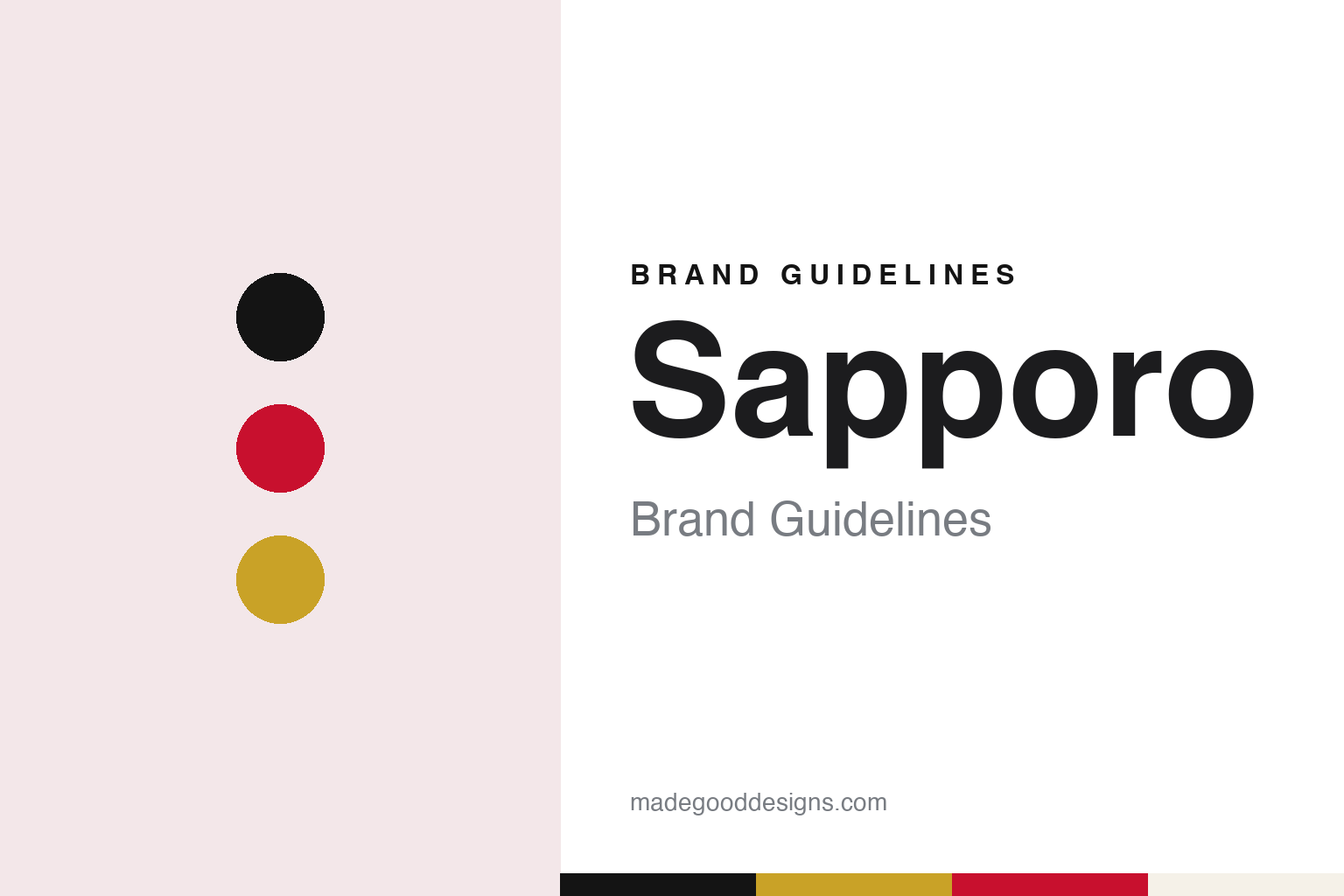
Two constants: a label black, north-star gold and red star palette and a high-contrast serif register. Abstract homage — not a Sapporo product or mark; no label, logo or can is reproduced.
The Kaitakushi brewery
A government brewery on the northern frontier.
Sapporo began as a government project. In the Meiji period the Kaitakushi, the office charged with colonising and developing Hokkaido, set up a string of businesses in the new city of Sapporo, and one of them was a brewery. Japanese Wikipedia says the Kaitakushi Bakushu Jozosho (Kaitakushi Beer Brewery) was established in September 1876 under the direction of the colonisation office’s deputy chief, Kuroda Kiyotaka, with Seibei Nakagawa and Murahashi Hisanari among those who set it up.
Nakagawa is the figure the brand puts first. Sapporo’s American site describes him as Japan’s first German-trained brewmaster, says he left Japan at seventeen, at a time when leaving the country was forbidden, and learned the craft in Germany. English Wikipedia says he became brewmaster in June 1876 and that the plant was completed that September. English Wikipedia places the first Sapporo lager in 1876; the company’s Japanese history dates the release of its “cold” Sapporo beer, a lager, to 1877. Either way, the company calls Sapporo the oldest beer brand in Japan.
The brewery did not stay in government hands for long. Japanese Wikipedia says that in 1886 it was sold to the Okura-gumi trading house of the industrialist Okura Kihachiro, and that in 1887 Okura, Shibusawa Eiichi and Asano Soichiro formed the Sapporo Beer Company to run it. That same year, English Wikipedia notes, a separate firm, the Nippon Beer Brewery Company, was set up in Tokyo; its beer, Yebisu, was first brewed in 1890.
Competition among Sapporo, Nippon Beer, Osaka Beer (the forerunner of Asahi) and Kirin led to a merger in 1906: Sapporo, Nippon and Osaka became the Dai-Nippon Beer Company, which held a near monopoly in Japan until after the Second World War. Japanese Wikipedia says beer brand names were banned in 1943, so the Sapporo name lapsed. When Dai-Nippon was broken up in 1949, its eastern half became Nippon Breweries and sold its beer as “Nippon Beer.” Drinkers asked for the old name back; Sapporo returned in Hokkaido in 1956 and nationwide in 1957, and in 1964 the company itself became Sapporo Breweries.
Colour
A star from the colonisation office, in red and in gold.
The constant on Sapporo’s labels is a five-pointed star. Japanese Wikipedia says it represents the north star, Polaris, and was the emblem of the Hokkaido Kaitakushi, the office that owned the original brewery; the company keeps it as part of its tradition. The star comes in two colours that each mark a beer.
The red star belongs to Sapporo Lager. Japanese Wikipedia says the red star derives from the Kaitakushi flag, and that bar owners and drinkers call the beer “Akaboshi” (red star), a nickname the company has since adopted on its own site. The beer sold simply as “Sapporo Beer” was renamed Sapporo Lager Beer in 1992. It is sold mainly in bottles to bars and restaurants. From 1970 to 1972, Japanese Wikipedia says, it was advertised with the actor Toshiro Mifune.
The gold star belongs to Sapporo Draft Black Label, the company’s main product in Japan, which English Wikipedia says was launched in 1977. Outside Japan the same beer is sold as Sapporo Premium; English Wikipedia says it has been the best-selling Asian beer in the United States since Sapporo U.S.A. was founded in 1984.
Yebisu is the other pillar. Brewed in Tokyo from 1890, it lay dormant after the war and was relaunched in 1971, and Sapporo positions it as its premium, all-malt label. Its Japanese name is written with an obsolete kana character, ヱ, which is why the brand is romanised with a silent Y; the Tokyo district of Ebisu, English Wikipedia notes, was named after the beer, which was originally brewed there. The old brewery site became Yebisu Garden Place in 1994, and the company opened a Yebisu museum there in 2010.
The brand also works through sponsorship. Japanese Wikipedia says Sapporo has been the special sponsor of the Hakone Ekiden, the New Year university relay race, since 1987, and produces original advertisements for its broadcast. In 2020 Sapporo Breweries won a Best of Packaging prize at the Lausanne Index Prize.
Typography
Design and documentation.
The seven brands in this group are all beer names from Asia and Europe: San Miguel, Efes, Sapporo, Orion, Cass, Hite and Staropramen. Beer brands in general sit at many different points in the trade, from breweries that still carry the name of a town or a founder to labels that now belong to much larger drinks groups, and a single brand can be sold everywhere from a corner shop to a stadium bar.
A beer brand’s identity is usually carried less by a single bottle than by a label, a name and the place it promises, because the company behind the name may have changed hands, moved its brewing or grown far beyond the place where it started. That makes the questions behind each name worth asking plainly: who started it, who owns it now, and where its beer is actually brewed and packaged.
Each guide separates what independent sources record from what the company says about itself — its founding story, its owners over time, where its beer is brewed and how its labels have changed — and marks plainly what rests only on the company’s own word.
Aa
A high-contrast serif for a brand that dates its beer to the Meiji period. (Specimen set in Libre Bodoni, a serif STAND-IN; NOT the Sapporo logo.)
Sapporo
From a frontier brewery to the name of the group.
In 2003 Sapporo Breweries reorganised into a holding company, Sapporo Holdings, with the beer business moved into a new subsidiary that kept the Sapporo Breweries name. The group, headquartered in Ebisu, Shibuya, Tokyo, is a member of the Mitsui keiretsu, according to English Wikipedia. That structure has now been reversed. In a notice of 24 December 2025 the company announced that the holding company would absorb its brewing subsidiary on 1 July 2026 and take the Sapporo Breweries name, a change Jiji Press reported the same day; the company’s English website now carries the name Sapporo Breweries Ltd. The plan went with the sale of the group’s real estate business, including Yebisu Garden Place, to a consortium led by KKR and PAG, Jiji Press reported.
Despite the name, Sapporo is not brewed only in Sapporo. English Wikipedia lists breweries in Japan including Sendai (1971), Shizuoka (1980) and Chiba (1988). Abroad, Sapporo bought the Canadian brewer Sleeman of Guelph, Ontario, in 2006, as CBC News reported, and Sleeman has brewed Sapporo for North America. English Wikipedia says Sapporo for the United States is also brewed by City Brewing in La Crosse, Wisconsin, and that the group runs a brewery in Long An province, Vietnam. In 2022 Sapporo U.S.A. acquired Stone Brewing of California, completed in August that year.
Sapporo also bought San Francisco’s Anchor Brewing in 2017; in July 2023 it announced that Anchor would close, a decision The New York Times reported amid stalled union contract talks.
The name needs care. Sapporo Ichiban, the instant ramen, is made by Sanyo Foods and has no connection with the brewer beyond the city it is named after.
For a design guide, Sapporo shows how one emblem inherited from a nineteenth-century government office can mark a whole family of beers, red for the lager and gold for the draught, for well over a century. Compare Kirin, the Yokohama brewer of the qilin label, and Suntory, the Osaka drinks group. For this guide we use label black, north-star gold and red star with a serif, an unofficial interpretation; no product or logo is reproduced.
Explore & save
Keep Sapporo’s identity on hand — save it to a board in the Made Good inspiration library.
Sapporo identity set
Pin the Sapporo label black, north-star gold and red star palette and the high-contrast serif register to your own board.