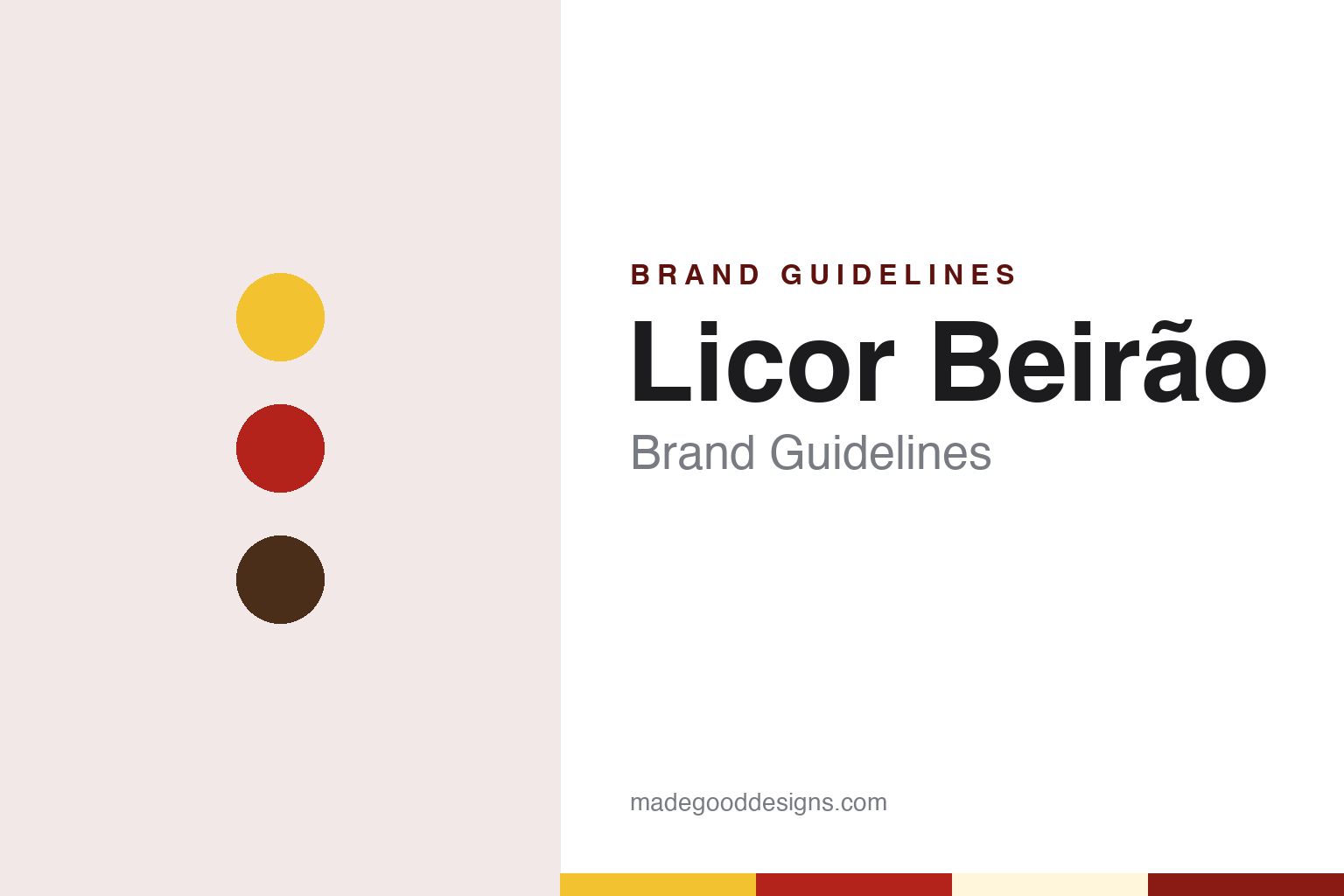
Licor Beirão Brand Guidelines
The Lousã liqueur named in 1929 and built on the roadside.
Aa
Two constants: a ribbon yellow, Beirão red and bottle brown palette and a bold old-style serif register. Abstract homage — not a Licor Beirão product or mark; no label, logo or bottle is reproduced.
From a Lousã pharmacy to a family firm
A town liqueur, a prize name and a young buyer in wartime.
Licor Beirão is a Portuguese liqueur from Lousã, a town in the Coimbra district of central Portugal, in the old province of Beira that gives the drink its name. Its roots go back to the nineteenth century. The company’s own history says that around 1890 a travelling wine salesman from Porto settled in Lousã after marrying a pharmacist’s daughter, that the pharmacy sold liqueurs made to secret formulas, and that when the law stopped alcoholic drinks being sold with medicinal claims he carried on making the liqueur in a small factory of his own.
The name came in 1929. English Wikipedia, citing the Portuguese food guide Boa Cama Boa Mesa, says the liqueur won a gold medal that year at a contest held during the second Beirão Congress in Castelo Branco, and took the name “Beirão” from it. The company also gives 1929 as the year the drink officially became Licor Beirão.
The decisive change of hands came in 1940. The company says the factory was for sale because of the hardships of the Second World War, and that it was bought by José Carranca Redondo, a young man from Lousã who had worked there, who set up the firm J. Carranca Redondo, Lda.; a Diageo press release of July 2024 likewise describes the company as started in 1940 by José Carranca Redondo. The company says his wife, Maria José, made the liqueur in the early years. In 1970, Portuguese and English Wikipedia both say, citing a report by the public broadcaster RTP, he bought the Quinta do Meiral in Lousã, an estate of more than twelve hectares that became the company’s headquarters, its factory and the family’s home. Público reported his death in June 2005.
Colour
Roadside signs, a slogan and a yellow ribbon.
Licor Beirão is remembered in Portugal as much for its advertising as for its taste. English Wikipedia, citing a 2005 article in the newspaper Público, says José Carranca Redondo launched the first Portuguese advertising campaign built on billboards, and Portuguese Wikipedia says a large campaign on the country’s roads and in its cafés through the 1940s, 1950s and 1960s made the liqueur known to most Portuguese. Portuguese Wikipedia adds that in the 1950s signs for the liqueur stood at a number of dangerous bends in the road.
The company’s history names some of the pieces it considers best known: a wooden sign with a perched bird against the Serra da Lousã, the mountain range above the town; an American-style poster of a majorette that, the company says, was censored; and small stickers placed in cafés. The company credits José Redondo, José Carranca Redondo’s son, with the line “O Licor de Portugal” (“the liqueur of Portugal”), which it says he created as a student at Coimbra, and with a reflective paint used to put the brand’s messages along the Estrada da Beira. Portuguese Wikipedia also records the 1960s press slogan “O Beirão de quem se gosta.”
The bottle has changed more often than the name. The business site ECO reported in October 2023 on a new bottle that the company said had been designed in-house. According to that report, it keeps the yellow and red colour scheme the brand has used since the 1960s and the “O Licor de Portugal” seal, gives more prominence to the yellow ribbon applied by hand to each bottle, adds José Redondo’s signature in relief on the glass, and keeps a tree of hearts, which the company says stands for the family tree, and the coat of arms of Lousã on the label. The site Echo Boomer described it in 2023 as the eighth update of the bottle since 1929, with a narrower shape and a return to brown glass; the company says the new glass allows more recycled material.
Typography
Design and documentation.
The seven brands in this group are aperitif, vermouth and liqueur names: Lillet, Suze, Dubonnet, Noilly Prat, Carpano, Cocchi and Licor Beirão. Aperitif, vermouth and liqueur brands in general sit at many different points in the trade, from family houses that still carry a founder’s name to labels that now belong to much larger drinks groups, and a single brand can be sold everywhere from a corner shop to a cocktail bar.
An aperitif, vermouth or liqueur brand’s identity is usually carried less by a single bottle than by a label, a name and the place it promises, because the company behind the name may have changed hands, moved its production or grown far beyond the place where it started. That makes the questions behind each name worth asking plainly: who started it, who owns it now, and where it is actually made and bottled.
Each guide separates what independent sources record from what the company says about itself — its founding story, its owners over time, where its drinks are made and how its labels have changed — and marks plainly what rests only on the company’s own word.
Aa
A bold old-style serif for a family liqueur with a roadside past. (Specimen set in Fraunces, a serif STAND-IN; NOT the Licor Beirão logo.)
Licor Beirão
Three generations, and a company that now buys brands.
The liqueur is still made at the Quinta do Meiral. Portuguese Wikipedia, citing RTP’s series Fabrico Nacional, says it is made by double distillation in copper stills from thirteen seeds, plants and spices, macerated for about 20 to 25 days, and that some ingredients, such as lavender and mint, are grown on the estate; the company says other ingredients come from countries including India, Sri Lanka, Brazil and Turkey. Portuguese Wikipedia adds that it is usually drunk neat or over ice, and in mixed drinks such as the Caipirão, which the company says it introduced in 2001.
The business has passed down the family. The company says José Redondo became sole master distiller in 2004, later sharing the role with his son Ricardo, and that the third generation, the grandsons Daniel and Ricardo Redondo, took on leadership roles in 2011. For the centenary of the founder’s birth the company released Beirão d’Honra, a version blended with aged wine brandy. In October 2023, The Spirits Business reported that the family’s Portuguese distribution company, Liquid Company, had changed its name to Casa Redondo, with Daniel Redondo, of the third generation, as chief executive.
Casa Redondo then began to buy brands from Diageo. Diageo announced on 5 July 2024 that it had agreed to sell the fruit liqueur Safari to Casa Redondo, calling Licor Beirão the best-selling spirit brand in Portugal. Drinks International reported in September 2025 that Casa Redondo was buying Sheridan’s, the twin-bottle Irish coffee-and-cream liqueur, and ESM Magazine reported on 2 February 2026 that the purchase had been completed.
For a design guide, Licor Beirão shows how a regional liqueur can turn a town name, a hand-tied yellow ribbon and a single slogan painted along Portugal’s roads into a national signature that has carried through several redesigns of its bottle. Compare Sheridan’s, now part of the same family company, and Licor 43, the Spanish liqueur from Cartagena. For this guide we use ribbon yellow, Beirão red and bottle brown with a serif, an unofficial interpretation; no product or logo is reproduced.
Explore & save
Keep Licor Beirão’s identity on hand — save it to a board in the Made Good inspiration library.
Licor Beirão identity set
Pin the Licor Beirão ribbon yellow, Beirão red and bottle brown palette and the bold old-style serif register to your own board.