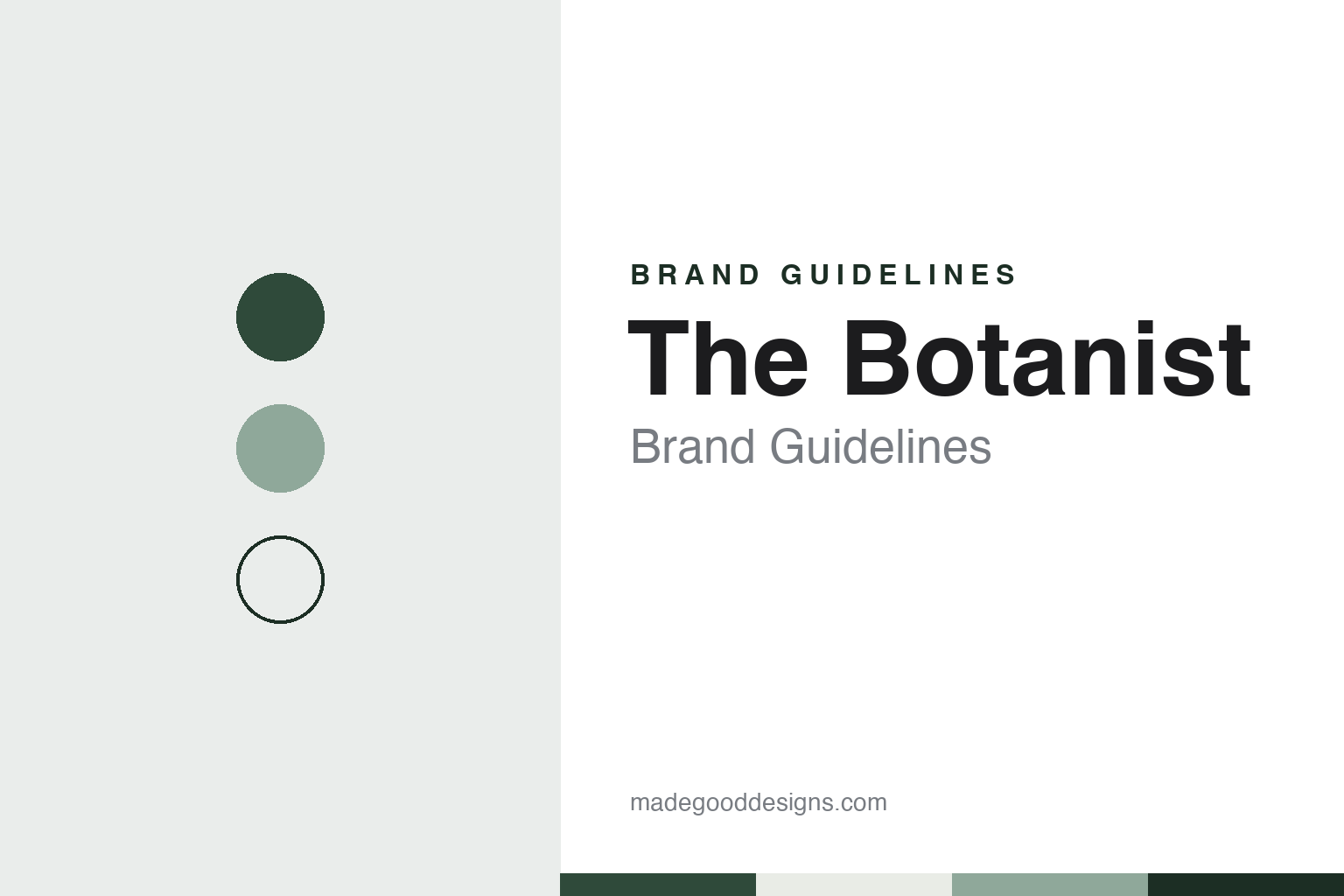
The Botanist Brand Guidelines
Bruichladdich’s Islay dry gin from a Lomond still called Ugly Betty.
Aa
Two constants: an Islay green, peat and sea-glass palette and a botanical serif register. Abstract homage — not a The Botanist product or mark; no bottle, label or logo is reproduced.
A gin from a whisky island
A revived distillery, a master distiller and a salvaged still.
The Botanist is a dry gin made at the Bruichladdich Distillery on the shore of Loch Indaal, on the Hebridean island of Islay, Scotland — an island far better known for its peated single malt whisky. The company says the gin was first distilled in 2010 and launched in 2011, and calls it the first gin ever created on Islay; English Wikipedia describes it as one of two gins now made on the island.
The gin came out of a distillery revival. Bruichladdich, which the company says was built by the Harvey brothers in 1881 and mothballed in 1994, was bought on 19 December 2000 by a group of private investors led by the wine merchant Mark Reynier, English Wikipedia says; the plant was dismantled and rebuilt between January and May 2001. The company names Reynier, Simon Coughlin and the master distiller Jim McEwan, who had worked at Bowmore, as the team behind that restart, and credits McEwan with the idea of an Islay gin.
The equipment was salvaged too. English Wikipedia says the last authentic Lomond still — a design that sits between a pot still and a column still — was recovered during the demolition of the Inverleven distillery at Dumbarton and installed at Bruichladdich in 2010, where McEwan modified it for gin. The distillery calls the still “Ugly Betty” and dates it to 1959; English Wikipedia gives 1955. The company says the spirit is distilled slowly, at low pressure, and English Wikipedia puts a run at about 17 hours.
The first owners did not keep the distillery for long. On 23 July 2012 Rémy Cointreau announced an agreement to buy The Bruichladdich Distillery Company, with The Botanist included, its press release said; a French regulatory filing of September 2012 confirmed the acquisition. The gin had already reached the United States: Shanken News Daily reported in July 2012 that the importer Winebow had rolled it out there the previous autumn.
Colour
Twenty-two plants, named in Latin on the glass.
The brand is built on a number. The Botanist uses 31 botanicals: nine classic gin botanicals — the company lists roots, barks, peels, berries and seeds — and 22 wild plants hand-foraged on Islay itself, from the hills, coastline and fields of the island. The name, English Wikipedia says, honours two local botanists who helped to develop the recipe; drinks writers have identified them as Dr Richard and Mavis Gulliver, who are said to have introduced McEwan to around 33 island plants from which 22 were chosen. Today the company names Kate Hannett and James Donaldson as its professional foragers. The spirit is reduced to 46% ABV with Islay spring water, the company says.
The bottle carries the recipe. When Rémy Cointreau took the gin into travel retail in March 2014, The Spirits Business reported that it would appear in a new round bottle in the Bruichladdich style, with the names of all 22 island botanicals embossed on the glass in Latin. A US trademark filing for the design describes those names as eleven horizontal rows of transparent embossed capitals on the front, with matching rows on the back, together with the number “22.”
The distillery has also tied the gin to its environmental credentials. The B Corp directory lists Bruichladdich as a certified B Corporation since May 2020, and the company says it was the first Scotch whisky and gin distillery in Europe to be certified.
The advertising has leaned on the same glass. In February 2023 The Drum reported on “Look Further,” a campaign led by the Glasgow agency Thirst, with computer-generated imagery by Framestore, in which the bottle acts as a lens through which to see the island; it ran in markets including the UK, the US, Germany, France and Australia.
Typography
Design and documentation.
The seven brands in this group are all gin and vodka names: The Botanist, Bulldog, Malfy, Gin Mare, Brockmans, Cîroc and Skyy. Gin and vodka brands in general sit at many different points in the trade, from small distilleries that still carry a founder’s name to labels that now belong to much larger drinks groups, and a single brand can be sold everywhere from a corner shop to a cocktail bar.
A gin or vodka brand’s identity is usually carried less by the spirit itself than by a bottle, a name and the place it promises, because the company behind the name may have changed hands, moved its production or grown far beyond the place where it started. That makes the questions behind each name worth asking plainly: who started it, who owns it now, and where its gin or vodka is actually distilled and bottled.
Each guide separates what independent sources record from what the company says about itself — its founding story, its owners over time, where its spirit is made and how its bottles and labels have changed — and marks plainly what rests only on the company’s own word.
Aa
A botanical serif for an island gin with its ingredients in Latin. (Specimen set in Fraunces, a serif STAND-IN; NOT The Botanist logo.)
The Botanist
A whisky distillery’s second spirit.
Ownership has been stable since 2012: The Botanist sits in Rémy Cointreau’s portfolio as part of the Bruichladdich group, and the company says the gin is still distilled at Bruichladdich on Islay. The company says Adam Hannett took over from Jim McEwan as master distiller in 2016, and the company continues to describe the gin as hand-foraged on Islay and distilled in Ugly Betty.
The gin has grown well beyond its island. English Wikipedia, citing the Drinks International Brands Report, says The Botanist was the seventh-bestselling gin brand in the world in 2024. The travel-retail launch of March 2014, The Spirits Business reported, began in Dufry stores in Italy, Switzerland and Russia, with a wider global release to follow; Matthew Hodges of Rémy Cointreau’s travel-retail arm told the magazine that the gin’s unusual composition, distinctive packaging and provenance should appeal to travellers.
For a design guide, The Botanist shows how a recipe can become a pack: a round bottle that lists 22 plants in Latin and a story told through a salvaged still. Compare Hendrick’s, another Scottish gin from a whisky company, and Monkey 47, a gin that also counts its botanicals. For this guide we use an Islay green, peat and sea glass with a serif, an unofficial interpretation; no product or logo is reproduced.
Explore & save
Keep The Botanist’s identity on hand — save it to a board in the Made Good inspiration library.
The Botanist identity set
Pin The Botanist Islay green, peat and sea-glass palette and the botanical serif register to your own board.