Eden Brothers Brand Guidelines
Sabine Randon’s Asheville seed and bulb shop.
Aa
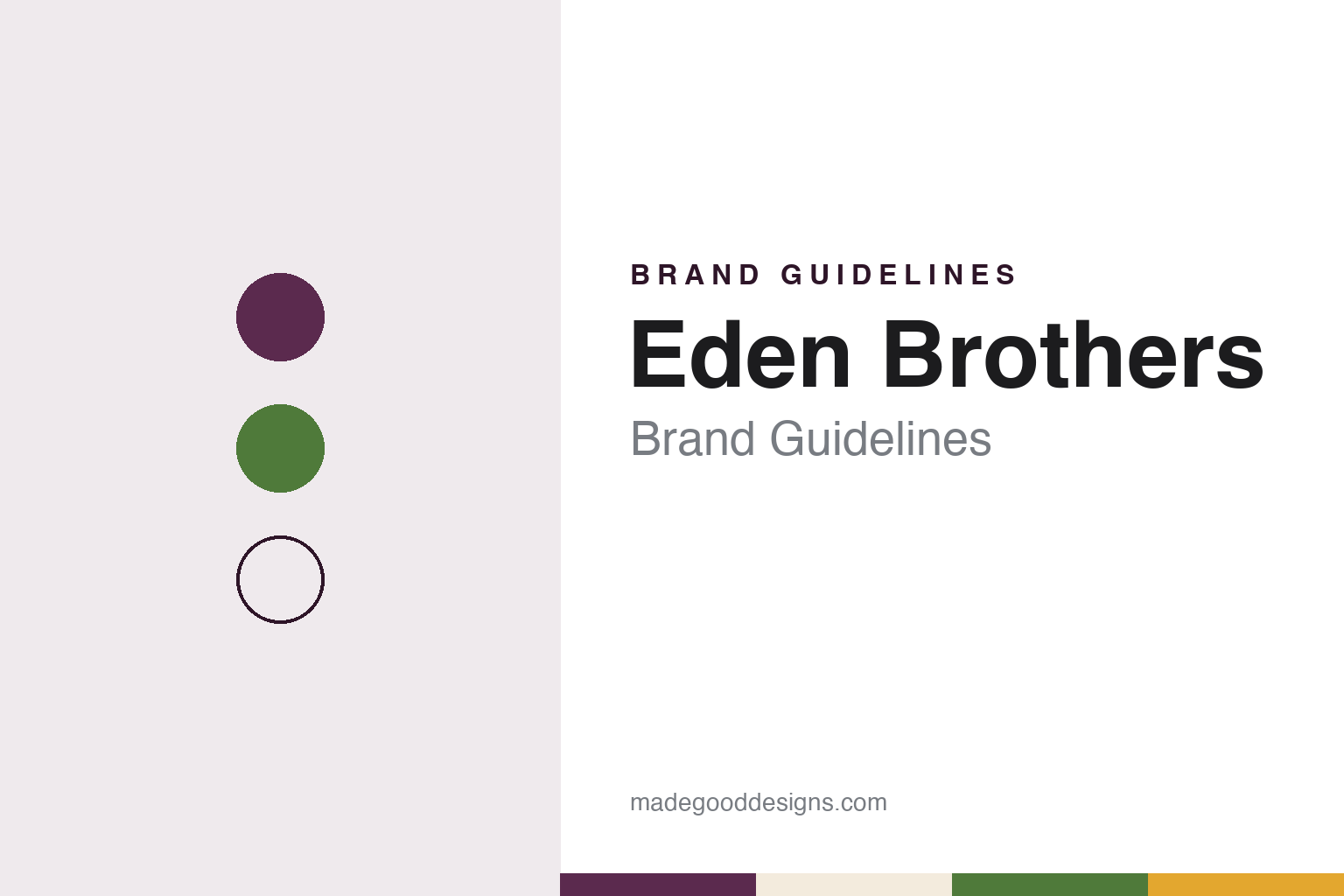
Two constants: an Eden Brothers plum, green and gold palette and a florist’s serif register. Abstract homage — not an Eden Brothers product or mark; no packet, logo or photograph is reproduced.
An online catalogue
A founder from luxury retail and a love of flowers.
Eden Brothers is a seed and bulb retailer based in Asheville, in the mountains of western North Carolina. Both the company and its investor give its founding year as 2009 and its founder as Sabine Randon, whom a January 2025 announcement by Kian Capital Partners described as “a former luxury retail executive.” The company’s own About page says she grew up in France, spent her early career in luxury retail, and later moved to the United States, founding Eden Brothers “out of her deep love of flowers.” In January 2026 she put it in her own words in a Kian release: “I founded Eden Brothers because of my deep passion for flowers and gardening.”
The business was built as an online shop rather than a printed catalogue. An archived copy of edenbrothers.com from January 2009 already shows the name “Eden Brothers Seed Company,” with a copyright line covering 2008 to 2009. By October 2009 the site was selling flower and wildflower seed, herb seed and flower bulbs — tulips, daffodils, hyacinths, crocuses, alliums — alongside fruit trees and rose bushes, with vegetable, organic and heirloom seed marked “coming soon.”
Kian’s 2025 announcement called Eden Brothers “a digitally-native business” that sets itself apart through a broad range of seed and bulb lines and a curated customer experience, including how-to content and a website whose photographs help customers plan and picture their gardens.
Colour
Bulbs, wildflower mixes and a gardener’s toolkit.
Eden Brothers sells across the garden year: spring- and autumn-planted flower bulbs, flower seed, wildflower seed, vegetable seed and herb seed. Its homepage says it carries hundreds of heirloom and certified organic seeds as well as rare and hard-to-find varieties, sold by the packet or in bulk, and that its seed is non-GMO. On its About page it says its seeds come with “no fillers,” and that it supports the Safe Seed Pledge, the commitment for seed sellers not to knowingly sell genetically engineered seed.
Wildflower mixes are the range most closely tied to the company itself. Kian’s 2025 announcement said Eden Brothers’ wildflower mixes were “developed in-house by its knowledgeable floriculture experts,” and the company says it blends them in-house. Its website sorts them by purpose, by region of the United States — including a North Carolina mix — and by colour, with colour mixes carrying names such as “Mellow Yellow” and “Purple Rain.”
For bulbs, the company says it works with growers it trusts for dahlias and peonies, that its bulbs grow at flower farms until they are ready, and that they are then held in temperature-controlled storage before shipping; these are the company’s descriptions of its own handling. Its website also hosts “The Gardener’s Toolkit,” a library of growing guides, and the company says its Garden Support Team, which answers customers’ questions, is based in Asheville.
The company frames its approach in three values — joy, care and stewardship — and says it supports pollinators and songbirds through gardening.
Typography
Seed houses and their names.
The seven brands in this group are all garden seed houses: Stokes Seeds, Jung Seed, Richters, Pinetree Garden Seeds, Premier Seeds Direct, Eden Brothers and Harris Seeds. Seed houses in general sit at many different points in the trade, from family firms that still carry a founder’s name to catalogue names that now belong to larger groups, and a single brand can be sold everywhere from a garden centre rack to a grower’s order book.
A seed brand’s identity is usually carried less by a single packet than by a name, a catalogue and the place it promises, because the company behind the name may have changed hands, moved its trial grounds or grown far beyond the place where it started. That makes the questions behind each name worth asking plainly: who started it, who owns it now, and where its seed is actually grown, tested and packed.
Each guide separates what independent sources record from what the company says about itself — its founding story, its owners over time, where its seed comes from and how its packets and catalogues have changed — and marks plainly what rests only on the company’s own word.
Aa
A soft, high-contrast serif for a flower-led seed shop. (Specimen set in Cormorant Garamond, a serif STAND-IN; NOT the Eden Brothers logo.)
Eden Brothers
From founder-run to investor-backed.
Eden Brothers took outside owners in the winter of 2024–25. On 9 January 2025 Kian Capital Partners, a private investment firm with offices in Atlanta and Charlotte, announced that, “in partnership with management,” it had completed the acquisition of Eden Brothers. Kian’s portfolio page gives the closing date as 19 December 2024 and lists the deal as a buyout giving it control. Randon, the announcement said, would keep a significant ownership stake and continue to run the business day to day. Kian Principal Caldwell Zimmerman added that the firm was proud to support a western North Carolina business after the destruction left by Hurricane Helene, which struck the region in September 2024. The release set out the plan under the new owner: new products and sales channels, a stronger digital presence, a larger library of growing content and operational improvements. No terms were disclosed.
A year later the leadership changed. On 13 January 2026 Kian announced that Michael Hollenstein, previously chief executive of DecksDirect and before that of the reading-glasses company eyebobs, had become Eden Brothers’ chief executive, and that Randon was moving into the role of Chief Product Officer to focus on the company’s products. The same release named three further hires: a chief financial officer who had held the same role at the online plant retailer Fast Growing Trees, a vice president of operations from the wholesale nursery Sun Bulb Company, and a vice president of marketing. Kian said Eden Brothers was looking for add-on acquisitions in the home, lawn and garden industries.
For a design guide, Eden Brothers shows how an online seed shop can make photography, flower varieties and seasonal planting guides the core of its identity rather than a printed catalogue. Compare Park Seed, a seed house in neighbouring South Carolina, and True Leaf Market, another American seed seller that grew up online. For this guide we use tulip plum, meadow green and sunflower gold with a serif, an unofficial interpretation; no product or logo is reproduced.
Explore & save
Keep Eden Brothers’s identity on hand — save it to a board in the Made Good inspiration library.
Eden Brothers identity set
Pin the Eden Brothers plum, green and gold palette and the florist’s serif register to your own board.