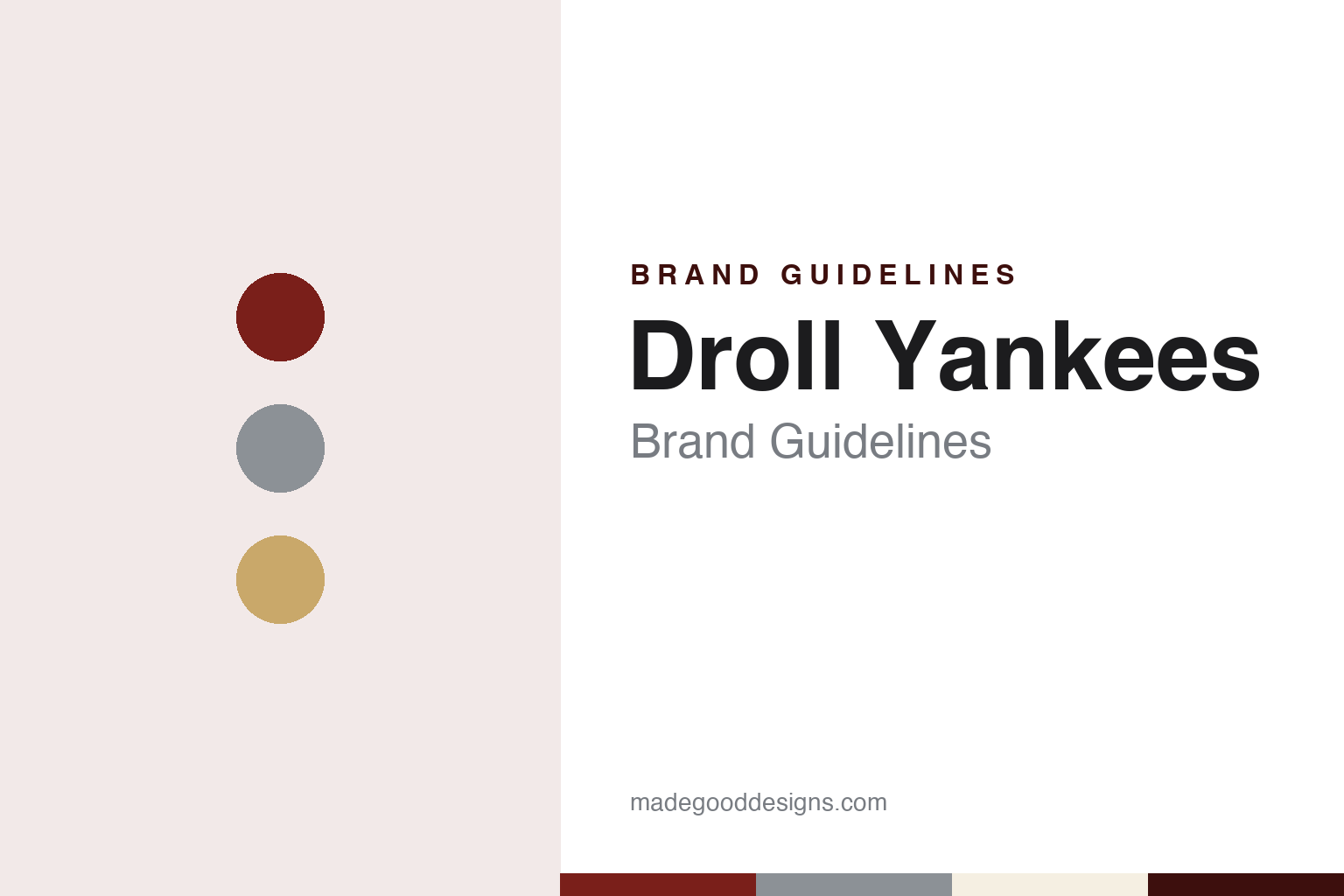
Droll Yankees Brand Guidelines
The tube-feeder maker that began with talking records in 1960.
Aa
Two constants: a barn red, pewter and seed tan palette and a New England serif register. Abstract homage — not a Droll Yankees product or mark; no feeder, logo or pack is reproduced.
Talking records
Two friends, a Balzac title and a business that began with sound.
Droll Yankees did not start with bird feeders. The company’s own history says that in 1960 Peter Kilham and his boyhood friend Alan Bemis started the business to make “talking records” of old New England, recorded stories in the humour of “Down East” Maine. Both men, the company says, had grown up in Boston, and both wanted the word “Yankees” in the name.
The rest of the name came from a library. As the company tells the story, Kilham was living in Providence, Rhode Island, at the time and went to the Brown University library, where he leafed through the card catalogue looking for a word to pair with “Yankees.” He stopped when he reached Balzac’s Droll Stories.
The talking records, the company says, had only limited success. Kilham, whom it describes as an amateur naturalist as well as an artist, inventor and entrepreneur, turned the equipment bought for the recorded stories to nature recordings, with the aim of creating what the company calls a “picture in sound.” It says his first nature recording, Birds on a May Morning, was used for many years by the Boston broadcaster WGBH to open its 7 a.m. Morning Pro Musica programme.
Colour
Leftover tubing and a feeder called the A-6F.
The feeder came out of another job. According to the company, Kilham had done work for a professor at the Rhode Island School of Design that left him with scraps of plastic tubing. Watching the birds one Sunday, he thought of turning the tubing into a new kind of feeder, and a few minutes in his workshop produced a prototype of plastic and cardboard that he filled with seed and hung in a nearby tree. The company says it was soon full of birds. That prototype, it says, was the forerunner of the A-6F, a tube feeder produced from 1969.
Through the 2010s the brand built its message around where its feeders were made and who sold them. Archived versions of drollyankees.com from 2012 and 2013 give the company’s address as Plainfield, Connecticut, and carry a “Made in USA” line. From 2015 the home page said its feeders were made in the U.S.A. and that its products carried a tag reading “Made in America by American Hands.” A 2012 page set out what the company called “Golden Rule” customer service, saying Droll Yankees was committed to supporting the independent retailer and that its products were not found in the discount merchandiser market.
The same archived site shows how far the range had grown beyond the first tube. Its 2012 menus list squirrel-proof feeders, thistle (nyjer) feeders, hummingbird and fruit feeders, window feeders and nest boxes, along with support pages for a feeder called the Flipper. Other 2012 menu headings included Microban-protected products, team-sports feeders and a section called “Made by American Hands.” The 2013 “About us” section carried pages titled “Make A World of Difference,” shortened to MAWD, and “How We Think Green,” and the site ran a blog under the name “Betsy’s Blog.” By 2019, under Classic Brands, the online shop had added categories for replacement tubes and parts, accessories for what it called the “Yankee Family” of feeders, and a section for products made in the USA, while keeping a page on “The Droll Yankees® Story.” The company says Kilham cared about quality materials and designs that birds loved and people found easy to use, and its 2013 history describes keeping to those standards as the company’s aim.
Typography
Design and documentation.
The seven brands in this group all make food or feeders for wild birds: Haith’s, Jacobi Jayne, Peckish, Gardman, CJ Wildlife, Droll Yankees and Brome Bird Care. Wild bird care brands in general sit at many different points in the trade, from family firms that still carry a founder’s name to labels that now belong to much larger garden or pet groups, and a single brand can be sold everywhere from a garden centre to a hardware store or a mail-order catalogue.
A wild bird care brand’s identity is usually carried less by a single product than by a name, a pack and a promise about the birds it is meant for, because the company behind the name may have changed hands, moved its production or grown far beyond the place where it started. That makes the questions behind each name worth asking plainly: who started it, who owns it now, and where its seed or feeders are actually made.
Each guide separates what independent sources record from what the company says about itself — its founding story, its owners over time, where its products are made and how its packs and marks have changed — and marks plainly what rests only on the company’s own word.
Aa
A New England serif for a brand named after a Balzac title. (Specimen set in Libre Caslon Text, a serif STAND-IN; NOT the Droll Yankees logo.)
Droll Yankees
From Plainfield to Denver to Pennsylvania.
Ownership changed twice in the following decade. Archived copies of drollyankees.com credit Droll Yankees Inc. in their copyright line until 2017; by June 2018 the footer read Classic Brands LLC, while still giving the Plainfield address. Classic Brands was a bird-feeder company based in Denver, Colorado, founded in 2010 by Bob Donegan, according to the advisory firm Oaklins, which reported in March 2019 that FrontRange Capital Partners, Brass Ring Capital and the management team had sold Classic Brands to Merit Capital Partners and Aiglon Capital. Oaklins listed Droll Yankees as one of four Classic Brands names, alongside More Birds, Stokes Select and Squirrel-X. Archived copies of the Droll Yankees site from 2021 and September 2022 give a Classic Brands customer-service address in Denver.
The name moved on again. An archived copy of drollyankees.com from September 2023 carries a copyright line for Woodstream Corporation, with an address in Lancaster, Pennsylvania.
The name needs a little care online. “Yankees” is also the name of the New York baseball team, which has no connection to the feeder brand; the brand’s own site is drollyankees.com.
For a design guide, Droll Yankees shows a brand whose name comes from a Balzac title and whose signature product began as leftover tubing in a New England workshop. Compare Brome Bird Care, the maker of Squirrel Buster feeders, and Kaytee, the Chilton seed firm owned by Central Garden & Pet. For this guide we use barn red, pewter and seed tan with a serif, an unofficial interpretation; no product or logo is reproduced.
Explore & save
Keep Droll Yankees’s identity on hand — save it to a board in the Made Good inspiration library.
Droll Yankees identity set
Pin the Droll Yankees barn red, pewter and seed tan palette and the New England serif register to your own board.