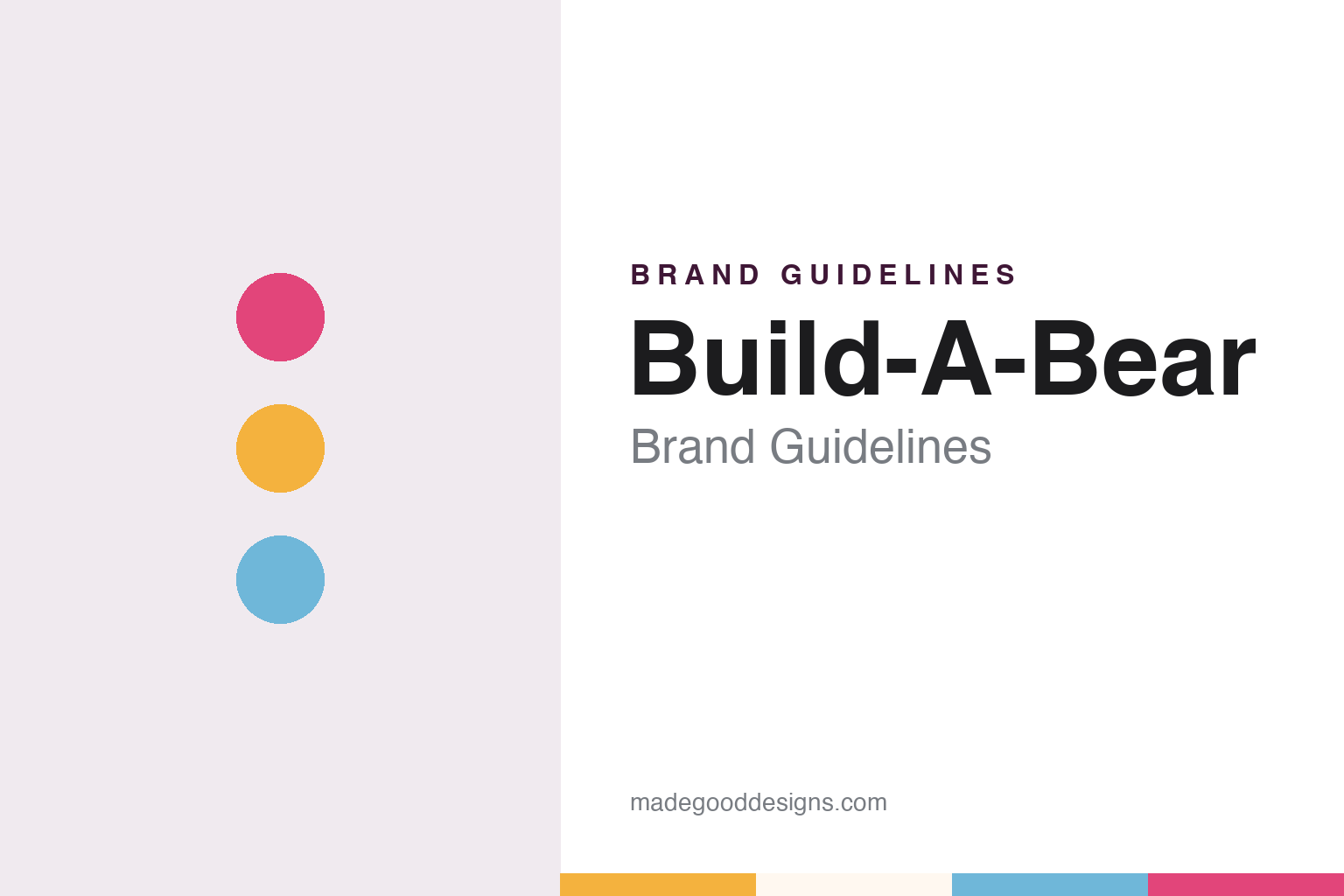
Build-A-Bear Brand Guidelines
A shop where the customer finishes the toy.
Aa
Two constants: a heart pink, honey and sky palette and a rounded display sans register. Abstract homage — not a Build-A-Bear product or mark; no toy, store or logo is reproduced.
A retail idea tested on children
The concept came before the toy.
Build-A-Bear began as a shop format rather than a toy. English Wikipedia says that in the mid-1990s Maxine Clark, who had been president of the shoe retailer Payless ShoeSource, left that job and began developing ideas for interactive retail stores inspired by experiences she remembered from her own childhood. Wikipedia says she presented several concepts to a group of children, and that the make-your-own-bear idea was the one chosen; according to Clark, the children responded to it most positively.
The company, Build-A-Bear Workshop, was founded in St. Louis, Missouri, in 1997; the Wikipedia infobox gives the date as 27 October 1997. Wikipedia says the company hired Adrienne Weiss Co. of Los Angeles to help develop the retail concept, and that the first store opened at the Saint Louis Galleria in Richmond Heights, Missouri. A second followed in Overland Park, Kansas, in August 1998.
The idea at the centre of the brand is that the customer completes the product. Wikipedia describes a process in which shoppers choose a stuffed animal and then select sounds, scents, clothing and accessories for it, and it notes that the company has its own word, “Bearaphenalia”, for the accessories and related merchandise sold alongside the animals, from stationery and stickers to T-shirts.
Colour
Dolls, games and a virtual town.
Build-A-Bear tried its formula on other kinds of toys early on. Wikipedia says doll shops were part of the original business plan and that the company began testing a make-your-own-doll concept in 2004, opening the first Friends 2B Made store near Pittsburgh, Pennsylvania, that November and a second in Columbus, Ohio. It says the company announced plans to close the concept in 2008, and that by October 2009 the standalone stores had either closed or been converted into Build-A-Bear Workshop stores.
The brand also moved on screen. Wikipedia says The Game Factory released a Build-A-Bear Workshop video game for the Nintendo DS in 2007, followed by a Wii title in 2008. In October 2007, it says, the company launched Build-A-Bearville, an online game developed with Frima Studio in which players created characters and explored virtual locations; some products carried codes for virtual items, though buying them was not required to play. Wikipedia says the company announced in January 2015 that the game would close on 31 March 2015. It also records bears sold with scan tags for the video game Kinectimals: Now with Bears!.
Fast food carried the name further still. Wikipedia says Build-A-Bear has partnered with McDonald’s on several Happy Meal promotions: US restaurants offered a collection of Build-A-Bear Workshop toys in 2006, the promotion returned in 2007 with mini stuffed animals, and further promotions were documented in 2013 and 2015.
Licensed characters have become a large part of the shelf. Wikipedia mentions products based on My Little Pony and One Direction in the years after 2013, and partnerships with Disney, Nintendo, Pokémon and Marvel in the late 2010s and early 2020s. It also records an in-house brand for pre-teens, Kabu, launched in August 2018 with characters drawn in a Japanese kawaii style, and the creation of Build-A-Bear Entertainment, a production division, in 2019.
Typography
Design and documentation.
The brands in this group all make dolls, plush animals or character toys: playthings built around a named figure, a family of characters or a ritual of choosing and dressing a companion. Doll and character-toy brands sit at many different points in the trade, from names that began with a single designer or a single shop to labels that now belong to much larger toy, greeting-card or entertainment groups, and a single character can be licensed to several different makers over the years.
A character-toy brand’s identity is usually carried less by a single product than by a name, a face and a familiar set of colours on the box, because the company behind the character may have changed hands, licensed it out or moved its production far from where it started. That makes the questions behind each name worth asking plainly: who created it, who owns it now, and where its toys are actually designed and made.
Each guide separates what independent sources record from what the company says about itself — its founding story, its owners over time, where its toys are made and how its marks have changed — and marks plainly what rests only on the company’s own word.
Aa
A rounded, friendly display sans. (Specimen set in Baloo 2, a rounded-sans STAND-IN; NOT the Build-A-Bear logo.)
Build-A-Bear
A public company, three slogans and a move downtown.
Build-A-Bear Workshop is a listed company. Wikipedia says Clark took it public in 2004, and its infobox gives the listing as the New York Stock Exchange under the ticker BBW. Wikipedia says the company opened an international franchise location in Sheffield, England, and licensed Hasbro to produce a home bear-stuffing kit. Clark retired as chief executive in 2013, it says, and was succeeded by Sharon Price John; Wikipedia adds that the company announced John’s retirement in March 2026 and that Chris Hurt, previously chief operations and experience officer, succeeded her on 11 June 2026.
The words around the bear have changed more than once. Wikipedia says the slogan was “Where Best Friends Are Made” from 1997 to 2013, that the company then adopted “The Most Fun You’ll Ever Make”, and that a brand refresh in 2024 introduced “The Stuff You Love”. The headquarters moved too: Wikipedia says that in 2020 the company relocated from Overland, Missouri, to downtown St. Louis.
The audience has widened with the range. Wikipedia says that in the early 2020s the company turned more attention to adult customers through licensed and nostalgia-based products and online exclusives, including an online-only collection called After Dark that drew media attention in January 2024, and that it extended its pyjama range to adult sizes through a Build-A-Bear Pajama Shop. In March 2026, Wikipedia says, Build-A-Bear began a wholesale partnership with Walmart, selling ranges such as Mini Beans and a Bluey collection made with BBC Studios; it says the Mini Beans carry hang tags inspired by the birth certificates of the store experience, and the company’s signature heart insert.
For a design guide, Build-A-Bear shows how a retailer can make the ritual of the shop — choosing, stuffing, naming, dressing — the core of its identity, with slogans and characters changing around it. Compare the German house in our Steiff brand guidelines and an American plush maker in our Gund brand guidelines. For this guide we use heart pink, plum, honey and sky with a rounded display sans, an unofficial interpretation; no product or logo is reproduced.
Explore & save
Keep Build-A-Bear’s identity on hand — save it to a board in the Made Good inspiration library.
Build-A-Bear identity set
Pin the Build-A-Bear heart pink, honey and sky palette and the rounded display sans register to your own board.