Kurt Adler Brand Guidelines
A post-war importer that went all in on Christmas.
Aa
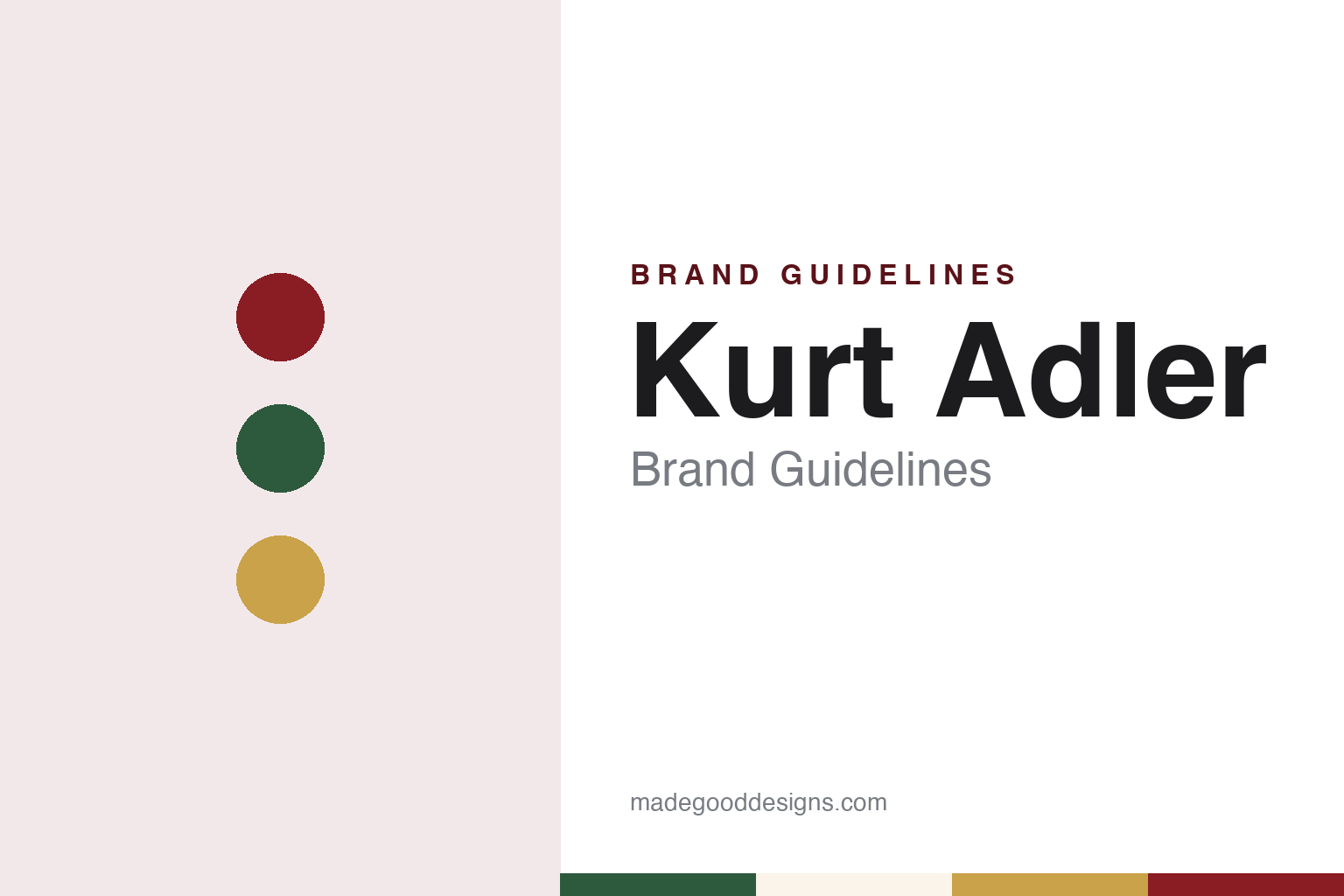
Two constants: a nutcracker red, spruce and tinsel gold palette and a festive display serif register. Abstract homage — not a Kurt Adler product or mark; no ornament, nutcracker or logo is reproduced.
From Würzburg to Manhattan
An Army procurement job became a trade.
Kurt Adler is the trading name of Kurt S. Adler, Inc., a holiday decorations company based in New York City that says it has been family-run since 1946. English Wikipedia says its founder, Kurt Stephan Adler, was born into a Jewish family in Würzburg, Germany, and was sent by his parents to live in Manhattan as a teenager, with sponsorship from an uncle in the United States, to escape Nazi Germany. Wikipedia says he learned English, attended high school, and was joined by his parents and sister in 1938.
The war gave him the skills the business would run on. Wikipedia says Adler served as a shipping clerk in the United States Army during the Second World War. The company’s own account says he worked in the Army’s procurement department, securing goods from around the world, and learned logistics and sourcing there. After the war, the company says, he tried his hand at exporting general goods to countries that needed products, and then, as European economies began to recover, changed direction to importing. In the company’s words, Kurt S. Adler, Inc. “as we know it” began after the end of the Second World War.
Wikipedia gives a flavour of that early trade, saying Adler imported and exported products such as pottery, glassware and pineapples. The turn to Christmas came through a single kind of object: Wikipedia says that after importing hand-carved angels from Bavaria, Adler realised that focusing on Christmas items could pay, and the business followed that path from then on.
Colour
European craft for American trees.
The company dates its ornament business to the 1950s. Kurt S. Adler, Inc. says the first ornaments it offered were handmade angels from East and West Germany, and that the line was then expanded with glass ornaments from Czechoslovakia, hanging ceiling decorations from Germany and miniature lights from Italy. Wikipedia adds that Adler began selling artificial trees from Nuremberg in the 1950s and miniature light strands from Italy in the late 1960s, and that he sold European figurines and snow globes to American retailers, pieces that often became collectors’ items.
Licensed characters became part of the mix. Wikipedia says Adler used licensed images from Walt Disney and Warner Brothers on Christmas decorations, and the company today lists licences including Disney and Coca-Cola alongside its own lines. Among those lines it names Santa’s World, Steinbach, Fabriche, Noble Gems and Hollywood Nutcrackers, and it describes a range running from tree ornaments, hand-crafted nutcrackers and lighting to garlands, stockings, nativity sets and table pieces. It describes those ranges as a mix of the latest trends and classic pieces, sourced from factories in several countries.
The calendar has widened beyond December. Wikipedia says the company sells items for Christmas, Halloween, Easter, Thanksgiving and Hanukkah, that it retires about half of its items each year in favour of new ones, and that it has offices in Hong Kong and Taiwan. The company says it shows its ranges at trade shows through the year and in showrooms across the United States that are open year-round, and that it also develops custom souvenir items for other companies.
The portfolio is presented as a set of named houses rather than one catalogue. Alongside Santa’s World and Steinbach, the company’s website lists brands including Bellissimo, Jingle Bright and Kringle Klaus, plus a lighting system it calls USB PowerConnect+, and it describes its aim as bringing tradition and new trends in holiday decorating from around the world. The same site places the line “Family run since 1946” beside its product menus, so the founding date works as part of the brand’s presentation as well as its history.
Typography
Design and documentation.
Christmas decor and ornament brands occupy an unusual corner of the home trade. Their products are bought for a few weeks of the year but kept for many more, unpacked from the same boxes each December and often handed down within a family, so a name in this field is asked to stand for continuity as much as for novelty.
Much of the category leans on borrowed tradition: mouth-blown glass, carved figures, village scenes and old-fashioned lettering that point back to older European workshop traditions. Behind that look, the companies themselves may be family firms, importers, designers who work with makers elsewhere, or businesses that have changed owners several times, and the place a brand calls home is not always the place its pieces are made.
Each guide separates what independent sources record from what a company says about itself — who founded it and where, who owns it now, where its pieces are produced and how its packaging and marks have looked over time — and marks plainly what rests only on the company’s own word.
Aa
A high-contrast festive display serif. (Specimen set in DM Serif Display, a serif STAND-IN; NOT the Kurt Adler logo.)
Kurt Adler
A family company in its third generation.
Ownership has stayed in the family. Wikipedia says Kurt Adler died at his home in Manhattan in November 2004 and that the company is now run by his children. Kurt S. Adler, Inc. names them as Howard, Clifford and Karen, and says Kurt Adler’s grandchildren have since joined, making it a third-generation family business. The company keeps its headquarters in New York City alongside a distribution centre, and Wikipedia says it marked 75 years in business in 2021.
The founder’s reputation travelled with the brand. Wikipedia says that in 2002 the magazine Austrian, Swiss & German Life called him “America’s Father Christmas” in a tribute to his effect on the Christmas business in the United States. The company itself frames its purpose around memory, saying it believes an ornament holds sentimental value and lets people relive a moment year after year. It also says it tries to make employees, customers and suppliers feel part of that family, and that some customers and staff have been with it for decades.
For a design guide, Kurt Adler shows how a founder’s name can serve as the umbrella for many seasonal lines, each with its own register, while the family story carries the continuity. Compare a Minnesota village-collectibles brand in our Department 56 brand guidelines and a glass-ornament maker in our Old World Christmas brand guidelines. For this guide we use nutcracker red, spruce and tinsel gold with a serif, an unofficial interpretation; no product or logo is reproduced.
Explore & save
Keep Kurt Adler’s identity on hand — save it to a board in the Made Good inspiration library.
Kurt Adler identity set
Pin the Kurt Adler nutcracker red, spruce and tinsel gold palette and the festive display serif register to your own board.


