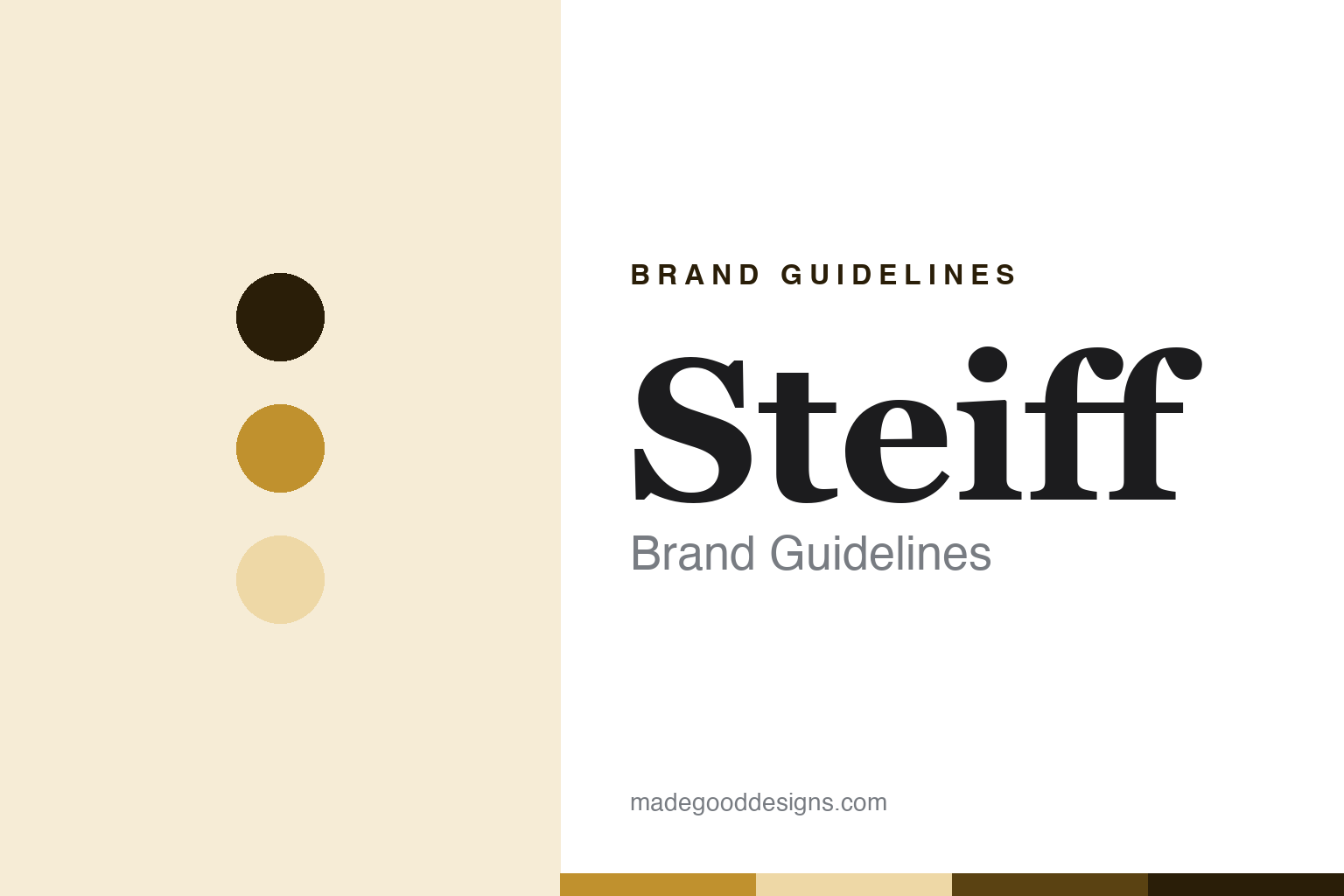
Steiff Brand Guidelines
The teddy bear’s inventor.
Aa
Two constants: a mohair-gold palette and a heritage-serif register. Abstract homage — not a Steiff product or mark; no bear, button, tag or logo is reproduced.
The teddy bear’s inventor
Steiff is the German house that invented the teddy bear in 1902 and the “Button in Ear” — now majority-owned by Ravensburger, with the family retaining a minority.
Steiff opens the plush round as its inventor node — the German house that made the first teddy bear and the first anti-counterfeit toy mark, a 145-year-old family firm that in 2026 sold majority control to a fellow toy maker. Its answer to a round about who owns the soft toys and where they are made is a heritage-and-ownership one: the origin of the teddy bear, now under a new majority owner, still made in Germany.
Its identity is the teddy bear’s inventor. The 1902 bear, the Button in Ear and the 2026 Ravensburger majority are the story here. First bear, new owner. The teddy bear’s inventor.
(Honest notes, so the founding, the ownership and the making are framed accurately, with corrections. Steiff sells mohair bears and soft toys as its heroes — the jointed teddy bear it originated and its mohair collectibles; we report its language as the brand’s own. On origin: Steiff was founded in 1880 by Margarete Steiff, a seamstress, in Giengen an der Brenz, Germany, beginning with felt, and the first teddy bear, the Bear 55 PB, was designed in 1902 by her nephew Richard Steiff and shown at the Leipzig fair in 1903. On the mark: the metal Button in Ear was introduced in 1904 by another nephew, Franz Steiff, as an anti-counterfeit mark, so we credit Franz, not Richard, for the button, and we note the yellow ear tag marks standard lines while a white tag marks limited editions. On ownership, corrected and dated: as of 2026 Steiff is majority-owned by Ravensburger, the games and toys maker, in a deal announced in June 2026 and cleared by the German competition regulator in September 2026, with the founding Steiff family retaining a significant minority through its holding company, so we say majority Ravensburger with a family minority and treat the sale as a succession and growth move rather than distress, and we do not call it foundation-owned. On where it is made, corrected: Steiff exited China around 2008 and now makes in Germany and Tunisia, with Cambodia reported, running its own weaving mill and hand-crafting premium mohair pieces in Giengen. On IP, with a nuance: Steiff protects the Button in Ear and yellow tag, but a 2014 EU court refused its attempt to register the button’s position as a trademark, so we describe the button and tag and do not reproduce them. There is no official brand hex; these tones are an unofficial interpretation.)
Colour
Steiff lives in a mohair gold. Click a swatch to copy the hex.
Steiff’s identity is inventor-heritage, newly Ravensburger-majority and German-made — a mohair gold, an ink, a pale honey, a deep amber, and a paper. The palette leans mohair gold and deep amber: a warm, heritage register that nods to mohair and a 145-year craft rather than a loud logo colour or the trademarked tag. It signals the teddy bear’s inventor — inventor-heritage, newly Ravensburger-majority and German-made. The honest caveat: with no official brand hex, and the yellow tag its protected mark, these values are a warm, unofficial interpretation, not first-party colours.
The lesson is a mohair gold signals a heritage, hand-crafted identity. Steiff’s world is the mohair bear. For designers, it is a reminder that a warm gold and a pale honey can carry a heritage, craft brand — a mohair tone held as an accent, not a reproduced tag. Because a warm hue can fail as small text, keep type dark and let the colour live in the accents, palette and band. The takeaways: date the founding to 1880 and the first bear to 1902; credit Franz Steiff for the 1904 Button in Ear; correct the ownership to majority Ravensburger with a family minority since 2026; correct the making to Germany and Tunisia, not China; and describe the button and tag rather than reproduce them.
Typography
The register is a heritage serif — inventor-heritage, newly Ravensburger-majority, German-made.
Steiff’s identity carries an inventor-heritage, newly-Ravensburger-majority, German-made spirit — the origin of the teddy bear under a new owner. A heritage serif captures the mood: classic, editorial and long-lived, the register of an 1880 house. Set in a mohair-gold palette, the heritage serif feels warm and established — exactly the personality Steiff carries. It behaves like a made, crafted thing rather than a loud logo, mirroring a plush-nap and a tuft-gradient. (Steiff’s real products, the name, the button and the yellow tag are things we describe but do not reproduce, and the exact typeface is not ours to use.) Because it is not ours to use, the honest description is “a heritage-serif brand,” shown here in a stand-in. The type behaves like the brand: inventor-heritage, newly Ravensburger-majority and German-made.
Aa
A heritage-serif brand — warm and established. (Specimen set in Fraunces, a heritage-serif STAND-IN; NOT the Steiff logo, button or yellow tag.)
The soft-toy node
Steiff stands for the teddy bear’s inventor.
Steiff opens the round as its inventor node. A mohair-gold palette, a heritage serif and an 1880 founding make one thing — the teddy bear’s inventor — the whole identity: inventor-heritage, newly Ravensburger-majority and German-made. The 1902 bear is the pitch, the Button in Ear is the mark, and the 2026 Ravensburger majority is the fresh turn. The point is the origin of the teddy bear under a new majority owner, in a round about who owns the soft toys and where they are made.
Put to work, the identity is the brand told straight, the ownership corrected and the making described. A brand in this spirit would date the founding to 1880 and the first bear to 1902, credit Franz Steiff for the 1904 button, correct the ownership to majority Ravensburger with a family minority since 2026, and correct the making to Germany and Tunisia. A reader in this spirit would keep the facts right: Steiff originated the teddy bear, the Bear 55 PB of 1902, and the metal Button in Ear of 1904; it was founded in 1880 by Margarete Steiff in Giengen; it is, as of 2026, majority-owned by Ravensburger with the founding family retaining a significant minority; it exited China around 2008 and makes in Germany and Tunisia; and the 2014 EU court refused its button-position trademark. Steiff opens the round, before Merrythought. The honest editorial moves are to date the founding, to credit the right nephew, to correct the ownership, and to describe the mark.
For designers and brand-builders, Steiff opens the soft-toy node: own an origin story — and update a very recent ownership change. The lessons: a brand can be the origin of a whole category, here Steiff and the teddy bear; a founding is dated to 1880 and Margarete Steiff, the first bear to 1902 by Richard Steiff, and the Button in Ear to 1904 by Franz Steiff, not conflated; an ownership is corrected to majority Ravensburger with a family minority since 2026, cleared by the regulator in September 2026, rather than the outdated assumption of a purely family- or foundation-owned house, and framed as succession not distress; a making is corrected to Germany and Tunisia, since Steiff exited China around 2008; and the IP is handled with nuance, describing the Button in Ear and yellow tag while noting the 2014 EU court refused the button’s positional mark. It is also a reminder to stay precise: Steiff is the Ravensburger-majority, German-made inventor of the teddy bear — with the palette here an unofficial interpretation and the protected button and tag never reproduced. The hook is that origin: Steiff invented the teddy bear and made the metal Button in Ear the world’s first anti-counterfeit toy mark, a 145-year-old German house that in 2026 sold majority control to Ravensburger. Read that way, Steiff is less a single bear than the teddy bear’s inventor: inventor-heritage, newly Ravensburger-majority, German-made. The lesson for a brand is that owning an origin and updating the ownership honestly reinforce each other, and dating the founding keeps the story earned. Steiff made the-teddy-bear’s-inventor the identity — proof that an origin story can open a round.
Explore & save
Keep Steiff’s identity on hand — save it to a board in the Made Good inspiration library.
Steiff identity set
Pin the mohair-gold palette and the heritage-serif register to your own board.