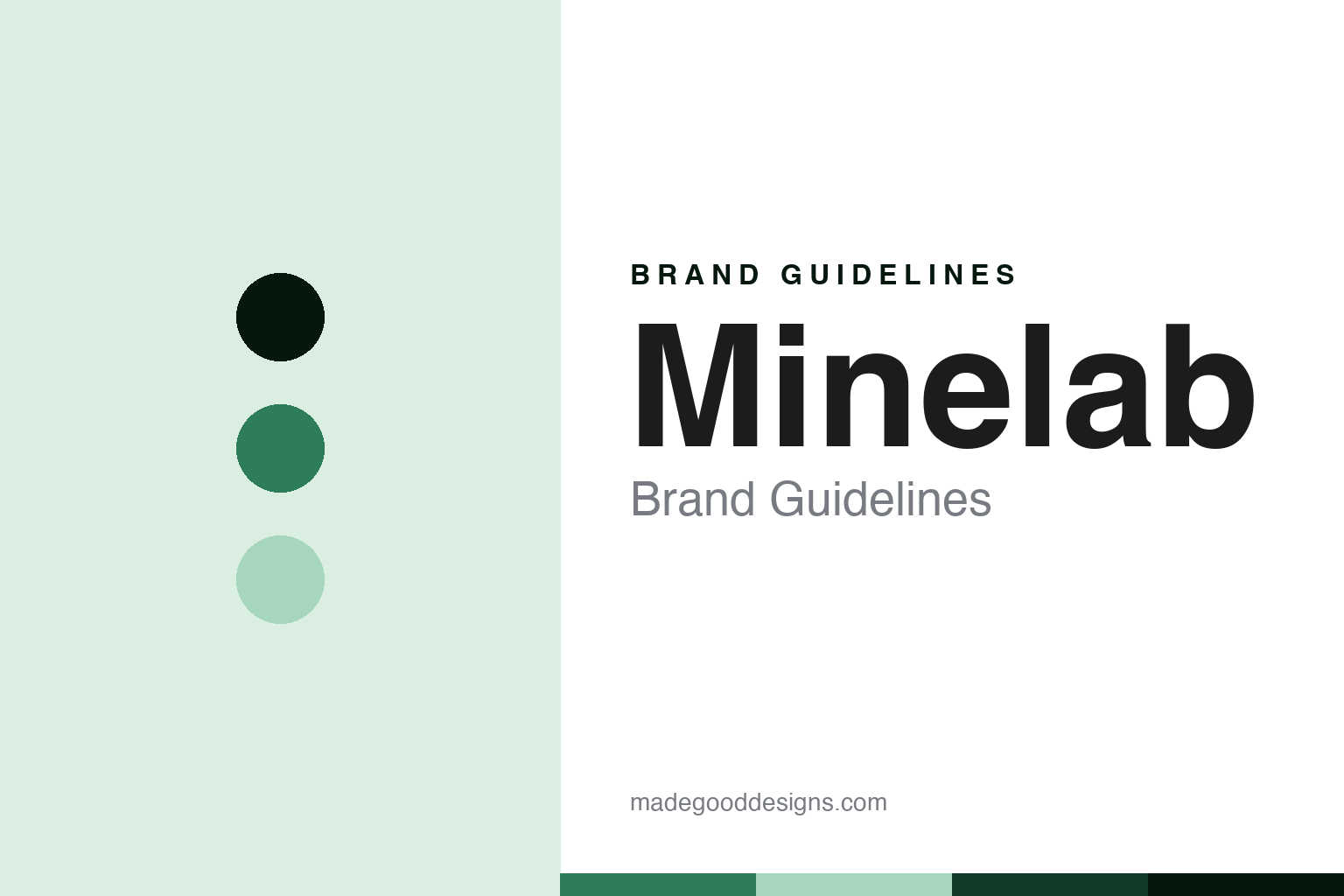
Minelab Brand Guidelines
The high-end, under Codan.
Aa
Two constants: a prospect-green palette and a prospect-sans register. Abstract homage — not a Minelab product or mark; no detector, coil or logo is reproduced.
The high-end, under Codan
Minelab is a 1985 Adelaide maker of gold-prospecting and multi-frequency detectors — owned since 2008 by the Australian electronics group Codan.
Minelab follows White’s as the round’s high-end node — a 1985 Adelaide maker of gold-prospecting and multi-frequency detectors, owned since 2008 by an Australian electronics group whose defence arm also supplies landmine-clearance equipment. Its answer to a round about who owns the detectors is the corporate one: a premium brand inside a listed electronics company.
Its identity is the high-end, under Codan. The 1985 founding, the Codan ownership and the gold-and-multi-frequency tech are the story here. Premium, corporate-owned. The high-end, under Codan.
(Honest notes, so the founding, the ownership, the making and a sensitive line are framed accurately, with hedges. Minelab sells premium detectors as its heroes — the Equinox and Manticore multi-frequency machines and the gold-prospecting GPX and GPZ; we report its language as the brand’s own. On origin: Minelab was founded in 1985 in Adelaide, South Australia, growing from a predecessor electronics firm, and its founder is widely credited as the physicist and engineer Bruce Candy, which we treat as widely reported rather than primary-confirmed, built to handle Australia’s heavily mineralised soils. On ownership: Minelab is owned by Codan Limited, a listed Australian communications and electronics company, which acquired it in 2008. On where it is made: Codan lists operations in Adelaide, Cork in Ireland and Naperville in Illinois, and since the exact per-product assembly location is not clearly public we flag it. On the tech, with one correction: its Multi-IQ multi-frequency runs in the Equinox and Manticore, while gold prospecting uses the GPX, which is pulse induction, and the GPZ 7000, which uses Minelab’s own ZVT rather than classic pulse induction. On a sensitive line, carefully framed: through Codan’s Countermine division Minelab supplies landmine-detection equipment used in military and humanitarian clearance, which we frame as supplying detection equipment rather than saying Minelab conducts demining. A patent suit it filed against Nokta appears in that brand’s notes. Its designs and the Minelab name are IP we describe but do not reproduce; there is no official brand hex; these tones are an unofficial interpretation.)
Colour
Minelab lives in a prospect green. Click a swatch to copy the hex.
Minelab’s identity is premium, Codan-owned and gold-capable — a prospect green, an ink, a pale green, a deep green, and a paper. The palette leans prospect green and deep green: a serious, field register that nods to gold country and a technical instrument rather than a loud logo colour. It signals the high-end, under Codan — premium, Codan-owned and gold-capable. The honest caveat: with no official brand hex, and a red-and-black identity documented, these values are a field, unofficial interpretation, not first-party colours.
The lesson is a prospect green signals a serious, field identity. Minelab’s world is the gold field and the mineralised ground. For designers, it is a reminder that a serious green and a pale green can carry a premium, technical brand — a field tone held as an accent, not a product shot. Because a mid hue can fail as small text, keep type dark and let the colour live in the accents, palette and band. The takeaways: date the founding to 1985 in Adelaide and hedge the Bruce Candy attribution; note the Codan ownership since 2008; flag the assembly location; correct the GPX-versus-GPZ technology; and frame the demining line as supplying equipment.
Typography
The register is a prospect sans — premium, Codan-owned, gold-capable.
Minelab’s identity carries a premium, Codan-owned spirit — a high-end instrument in a listed group. A prospect sans captures the mood: clean, exact and technical, the register of a gold-country instrument. Set in a prospect-green palette, the prospect sans feels serious and precise — exactly the personality Minelab carries at the high end. It behaves like a made, field-tested thing rather than a loud logo, mirroring a pulse-gradient and a discrimination-band. (Minelab’s real products and the name are things we describe but do not reproduce, and the exact typeface is not ours to use.) Because it is not ours to use, the honest description is “a prospect-sans brand,” shown here in a stand-in. The type behaves like the brand: premium, Codan-owned and gold-capable.
Aa
A prospect-sans brand — serious and precise. (Specimen set in Manrope, a prospect-sans STAND-IN; NOT the Minelab logo or products.)
The metal-detector node
Minelab stands for the high-end, under Codan.
Minelab sits fifth in the round as its high-end node. A prospect-green palette, a prospect sans and a 1985 founding make one thing — the high-end, under Codan — the whole identity: premium, Codan-owned and gold-capable. The 1985 founding is the pitch, the Codan ownership is the frame, and the gold-and-multi-frequency tech is the substance. The point is a premium brand inside a listed electronics company, in a round about who owns the detectors.
Put to work, the identity is the brand told straight, the founder hedged and a sensitive line framed carefully. A brand in this spirit would date the founding to 1985 in Adelaide, hedge the Bruce Candy attribution, note the Codan ownership since 2008, correct the GPX-versus-GPZ technology, and frame the demining line as supplying equipment. A reader in this spirit would keep the facts right: Minelab sells the Equinox and Manticore and the gold GPX and GPZ; it was founded in 1985 in Adelaide; it is owned by Codan since 2008; the GPX is pulse induction while the GPZ uses ZVT; and through Codan’s Countermine division it supplies landmine-detection equipment. Minelab sits after White’s Electronics and before Nokta. The honest editorial moves are to date the founding, to hedge the founder, to name the owner, to correct the tech, and to frame the demining carefully.
For designers and brand-builders, Minelab carries the metal-detector node: name a corporate owner — and frame a sensitive line precisely. The lessons: a brand can be the premium node of its category inside a larger group, here Minelab under Codan; a founding is dated to 1985 in Adelaide, South Australia, with the founder, widely credited as physicist Bruce Candy, treated as reported rather than primary-confirmed; an ownership is named as Codan Limited since the 2008 acquisition; a making is flagged, since Codan lists operations in Australia, Ireland and the US and the exact per-product assembly is not public; a technology point is corrected, the GPX being pulse induction and the GPZ using Minelab’s own ZVT; and a sensitive line is framed precisely, that through Codan’s Countermine division Minelab supplies detection equipment used in landmine and UXO clearance, rather than saying Minelab itself conducts demining. It is also a reminder to stay precise: Minelab is the Codan-owned high-end of the detector aisle — with the palette here an unofficial interpretation and a patent suit it filed noted under Nokta. The hook is that standing: Minelab is the high-end, under Codan, a 1985 Adelaide maker of gold-prospecting and multi-frequency detectors, owned since 2008 by the Australian electronics group whose defence arm also supplies landmine-clearance equipment. Read that way, Minelab is less a single detector than the high-end, under Codan: premium, Codan-owned, gold-capable. The lesson for a brand is that naming a corporate owner and framing a sensitive line precisely reinforce the honesty, and dating the founding keeps it earned. Minelab made the-high-end-under-Codan the identity — proof that a precisely-framed corporate node can hold a round.
Explore & save
Keep Minelab’s identity on hand — save it to a board in the Made Good inspiration library.
Minelab identity set
Pin the prospect-green palette and the prospect-sans register to your own board.