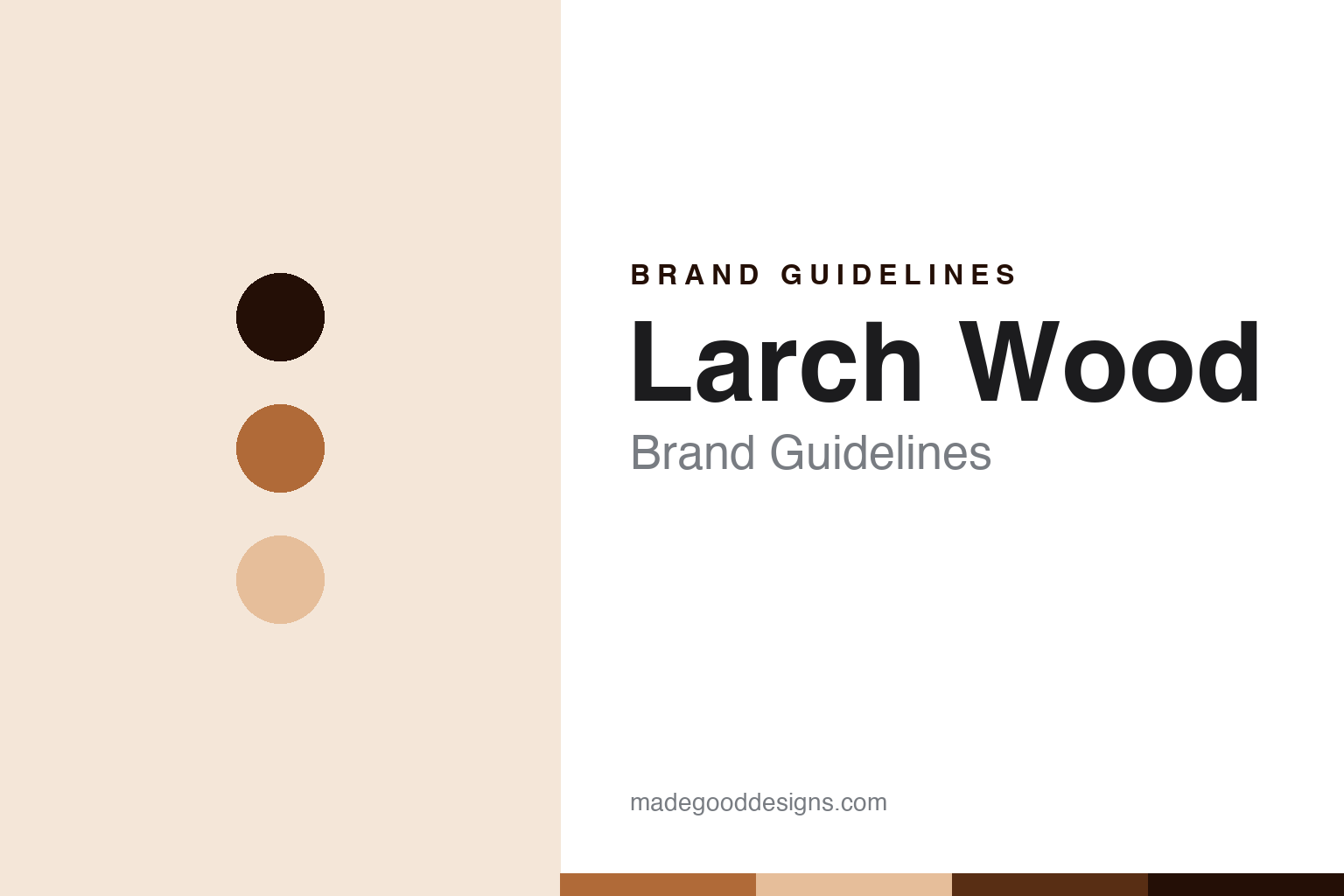
Larch Wood Brand Guidelines
Cape Breton end-grain larch.
Aa
Two constants: a larch-sienna palette and a craft-sans register. Abstract homage — not a Larch Wood product or mark; no board, block or logo is reproduced.
Cape Breton end-grain larch
Larch Wood is the Nova Scotia flooring maker turned end-grain-larch craftshop — handmaking golden-grained tamarack boards in East Margaree.
Larch Wood follows the Boardsmith as the round’s Canadian-craft node — a Cape Breton workshop that set out to make flooring, pivoted to end-grain cutting boards, and handmakes them from a golden-grained local larch that most board makers never touch. Its answer to a round about the material and where it is made is a place-and-material one: a genuine Nova Scotia maker, working a distinctive local wood.
Its identity is Cape Breton end-grain larch. The flooring pivot, the local larch and the East Margaree making are the story here. Flooring to boards. Cape Breton end-grain larch.
(Honest notes, so the founding, the material and the claims are framed accurately, with one thing left unnamed. Larch Wood sells end-grain cutting boards as its heroes — from Eastern Canadian larch, with a bold, varied grain and golden hues; we report its language as the brand’s own. On origin: Larch Wood was founded in 2003 in East Margaree, on Cape Breton Island, Nova Scotia, by a group of carpenters and woodworkers, and we do not name an individual founder since none is verified, and it started making flooring before pivoting to end-grain cutting boards after a couple of years. On the material: the boards are end-grain larch, the species Larix laricina, known locally as tamarack. On the workshop: it is independent and privately held, handmaking in East Margaree with roughly two dozen craftspeople, and recently reselling Japanese chef’s knives. On claims, attributed: the wood’s antimicrobial and rot-resistant qualities are attributed to a regional agency rather than a lab finding, its sustainability comes from local small-woodlot sourcing where it says it pays woodland owners more than market value, and there is no FSC certification stated. Its designs and the Larch Wood name are IP we describe but do not reproduce; there is no official brand hex; these tones are an unofficial interpretation.)
Colour
Larch Wood lives in a larch sienna. Click a swatch to copy the hex.
Larch Wood’s identity is flooring-pivoted, independent and Nova-Scotia-made — a larch sienna, an ink, a pale larch, a deep sienna, and a paper. The palette leans larch sienna and deep sienna: a warm, timber register that nods to golden larch grain and a Cape Breton workshop rather than a loud logo colour. It signals Cape Breton end-grain larch — flooring-pivoted, independent and Nova-Scotia-made. The honest caveat: with no official brand hex, these values are a timber, unofficial interpretation, not first-party colours.
The lesson is a larch sienna signals a local-material, craft identity. Larch Wood’s world is the golden larch board. For designers, it is a reminder that a warm sienna and a pale larch can carry a local, craft brand — a wood tone held as an accent, not a product shot. Because a warm hue can fail as small text, keep type dark and let the colour live in the accents, palette and band. The takeaways: date the founding to 2003 in East Margaree and leave the founder unnamed; note the flooring-to-boards pivot; credit the local larch and the Nova Scotia making; and attribute the antimicrobial and sustainability lines.
Typography
The register is a craft sans — flooring-pivoted, independent, Nova-Scotia-made.
Larch Wood’s identity carries a flooring-pivoted, independent, Nova-Scotia-made spirit — a local workshop working a local wood. A craft sans captures the mood: clean, honest and grounded, the register of a maker in a small place. Set in a larch-sienna palette, the craft sans feels warm and direct — exactly the personality Larch Wood carries. It behaves like a cut, made thing rather than a loud logo, mirroring a knot-ring and an end-grain-grid. (Larch Wood’s real products and the name are things we describe but do not reproduce, and the exact typeface is not ours to use.) Because it is not ours to use, the honest description is “a craft-sans brand,” shown here in a stand-in. The type behaves like the brand: flooring-pivoted, independent and Nova-Scotia-made.
Aa
A craft-sans brand — warm and direct. (Specimen set in Sora, a craft-sans STAND-IN; NOT the Larch Wood logo or products.)
The cutting-board node
Larch Wood stands for Cape Breton end-grain larch.
Larch Wood sits third in the round as its Canadian-craft node. A larch-sienna palette, a craft sans and a 2003 founding make one thing — Cape Breton end-grain larch — the whole identity: flooring-pivoted, independent and Nova-Scotia-made. The flooring pivot is the pitch, the local larch is the material, and the East Margaree workshop is the pride. The point is a genuine Nova Scotia maker working a distinctive local wood, in a round about the material and where it is made.
Put to work, the identity is the brand told straight, the founder left unnamed and the claims attributed. A brand in this spirit would date the founding to 2003 in East Margaree, leave the founder unnamed, note the flooring-to-boards pivot, credit the local larch, and attribute the antimicrobial and sustainability lines. A reader in this spirit would keep the facts right: Larch Wood sells end-grain boards from Eastern Canadian larch; it was founded in 2003 in East Margaree, Cape Breton, by a group of woodworkers, starting in flooring; it is independent and privately held, handmaking in Nova Scotia; and its antimicrobial and sustainability lines are attributed, with no FSC stated. Larch Wood sits after the Boardsmith and before Hasegawa. The honest editorial moves are to date the founding, to leave the founder unnamed, to note the pivot, and to attribute the claims.
For designers and brand-builders, Larch Wood carries the cutting-board node: work a distinctive local material — and don’t name a founder you can’t verify. The lessons: a brand can pivot into its category, here Larch Wood from flooring to end-grain boards; a founding is dated to 2003 in East Margaree, Cape Breton, and the founder is left unnamed as a group of woodworkers rather than an unverified individual; a material is credited as end-grain Eastern Canadian larch, the tamarack most board makers never use; a making is credited as handmade in Nova Scotia by roughly two dozen craftspeople; and the claims are attributed, the antimicrobial and rot-resistant qualities to a regional agency rather than a lab, and the sustainability to local small-woodlot sourcing, with no FSC certification stated. It is also a reminder to stay precise: Larch Wood is the independent, Nova-Scotia-made end-grain larch brand — with the palette here an unofficial interpretation and the “self-healing end-grain” treated as a general property rather than a brand phrase. The hook is that pivot: Larch Wood set out to make flooring in Cape Breton and pivoted to end-grain cutting boards, handmade in East Margaree from local tamarack, a golden-grained wood most board makers never touch. Read that way, Larch Wood is less a single board than Cape Breton end-grain larch: flooring-pivoted, independent, Nova-Scotia-made. The lesson for a brand is that working a distinctive local material and leaving an unverified founder unnamed reinforce the honesty, and dating the founding keeps it earned. Larch Wood made Cape-Breton-end-grain-larch the identity — proof that a distinctive local material can anchor a node.
Explore & save
Keep Larch Wood’s identity on hand — save it to a board in the Made Good inspiration library.