The Boardsmith Brand Guidelines
The artisan end-grain board.
Aa
Two constants: a walnut palette and a craft-serif register. Abstract homage — not a Boardsmith product or mark; no board, block or logo is reproduced.
The artisan end-grain board
The Boardsmith is the end-grain workshop that outlived its founder, David Smith (d.2020) — now handmaking blocks in Frisco, Texas under John Loftis.
The Boardsmith follows John Boos as the round’s artisan node — an end-grain cutting-board workshop founded by a craftsman in North Carolina, whose founder has died and whose brand now handmakes blocks in Texas under new ownership. Its answer to a round about the material and where it is made is a workshop one: a genuine artisan operation, made by hand, carried on after its founder.
Its identity is the artisan end-grain board. The founder’s craft, his death and the Texas continuation are the story here. Founder gone, workshop on. The artisan end-grain board.
(Honest notes, so the founding, the ownership and the making are framed accurately, with a sensitive correction. The Boardsmith sells end-grain butcher-block boards as its heroes — in hard maple, black walnut and black cherry; we report its language as the brand’s own. On origin: the Boardsmith was founded in 2005 by David Smith in High Point, North Carolina, a furniture town, having built his first butcher block in 1993. On ownership and a sensitive fact: the brand was acquired in 2015 by John Loftis, the founder of LoneStar Artisans, with David Smith mentoring the transition, and David Smith died in April 2020, so we frame Smith as the founder and originator, who died in 2020, and John Loftis as the current owner, and we note it is still an independent artisan workshop, now run as a family operation. On where it is made, corrected: it is now made in-house in Frisco, Texas, so we do not say North Carolina for current production. On the craft: it uses FAS-grade hardwoods and Smith’s signature offset end-grain gluing with hidden rubber feet. On claims, attributed: its FSC-source and food-safe-glue and mineral-oil lines are manufacturer statements, and we could not verify an NSF certification, so we do not assert one. Its designs and the Boardsmith name are IP we describe but do not reproduce; there is no official brand hex; these tones are an unofficial interpretation.)
Colour
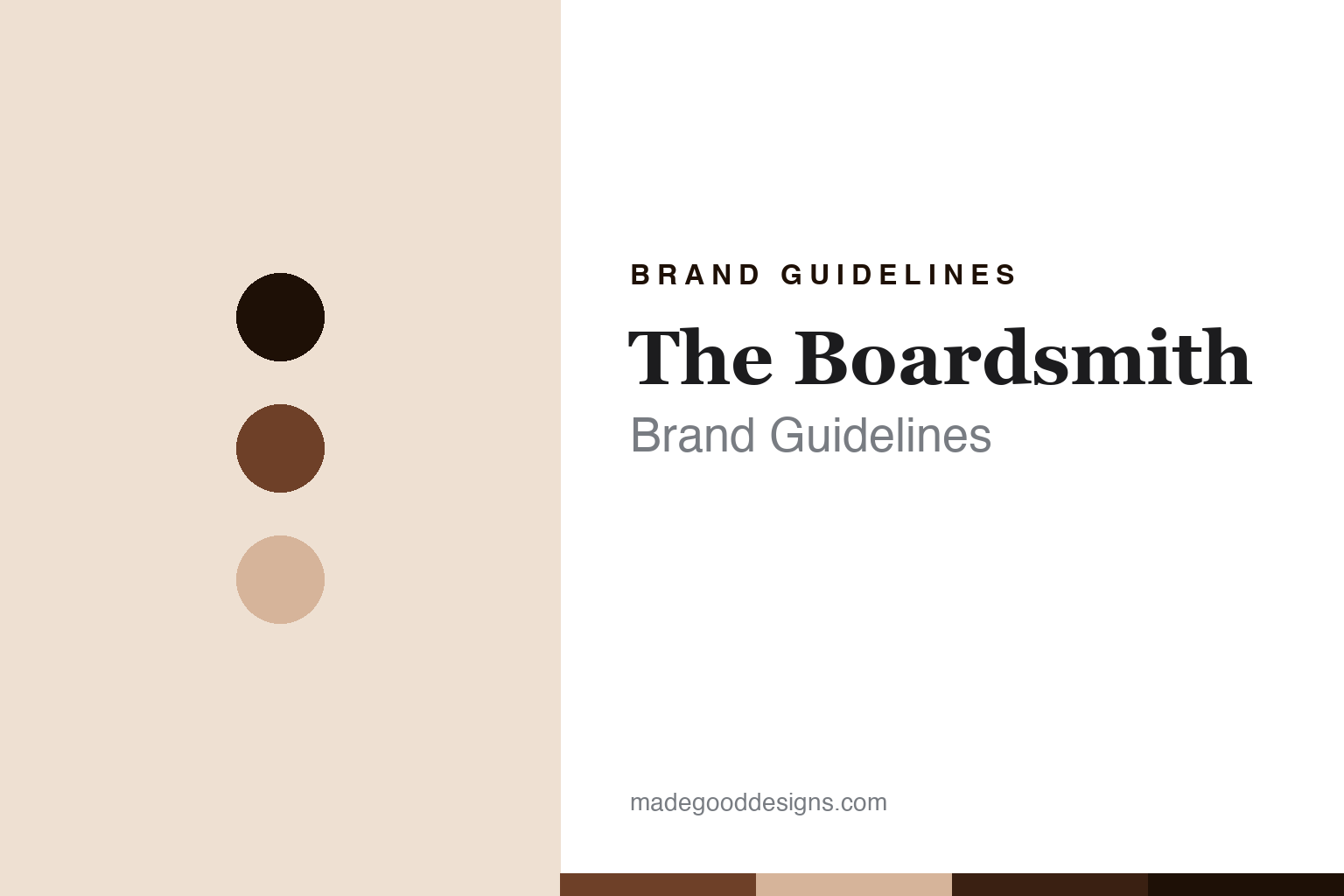
The Boardsmith lives in a walnut. Click a swatch to copy the hex.
The Boardsmith’s identity is artisan-founded, new-ownership and Texas-made — a walnut, an ink, a pale walnut, a deep walnut, and a paper. The palette leans walnut and deep walnut: a rich, hardwood register that nods to end-grain black walnut and a hand workshop rather than a loud logo colour. It signals the artisan end-grain board — artisan-founded, new-ownership and Texas-made. The honest caveat: with no official brand hex, these values are a hardwood, unofficial interpretation, not first-party colours.
The lesson is a walnut signals a hand-made, artisan identity. The Boardsmith’s world is the end-grain block. For designers, it is a reminder that a rich walnut and a pale walnut can carry an artisan, workshop brand — a hardwood tone held as an accent, not a product shot. Because a dark hue can fail as small text, keep type dark and let the colour live in the accents, palette and band. The takeaways: date the founding to 2005 and David Smith in North Carolina; note Smith died in 2020 and John Loftis owns it since 2015; correct the making to Frisco, Texas; credit the offset end-grain craft; and keep the glue and FSC lines as manufacturer statements, with NSF unverified.
Typography
The register is a craft serif — artisan-founded, new-ownership, Texas-made.
The Boardsmith’s identity carries an artisan-founded, new-ownership, Texas-made spirit — a workshop carried on. A craft serif captures the mood: warm, editorial and hand-made, the register of a maker’s bench. Set in a walnut palette, the craft serif feels rich and grounded — exactly the personality the Boardsmith carries. It behaves like a glued, made thing rather than a loud logo, mirroring a grain-arc and an end-grain-grid. (The Boardsmith’s real products and the name are things we describe but do not reproduce, and the exact typeface is not ours to use.) Because it is not ours to use, the honest description is “a craft-serif brand,” shown here in a stand-in. The type behaves like the brand: artisan-founded, new-ownership and Texas-made.
Aa
A craft-serif brand — rich and grounded. (Specimen set in Cormorant Garamond, a craft-serif STAND-IN; NOT the Boardsmith logo or products.)
The cutting-board node
The Boardsmith stands for the artisan end-grain board.
The Boardsmith sits second in the round as its artisan node. A walnut palette, a craft serif and a 2005 founding make one thing — the artisan end-grain board — the whole identity: artisan-founded, new-ownership and Texas-made. The founder’s craft is the pitch, his death is the turn, and the Texas continuation is the honest frame. The point is a genuine artisan operation carried on after its founder, in a round about the material and where it is made.
Put to work, the identity is the brand told straight, the ownership handled sensitively and the making corrected. A brand in this spirit would date the founding to 2005 and David Smith, note his death in 2020 and John Loftis’ ownership since 2015, correct the making to Frisco, Texas, and keep the glue and FSC lines as manufacturer statements. A reader in this spirit would keep the facts right: the Boardsmith sells end-grain boards in maple, walnut and cherry; it was founded in 2005 by David Smith in High Point, North Carolina, who built his first board in 1993; the brand was acquired in 2015 by John Loftis of LoneStar Artisans, and David Smith died in 2020; it is now handmade in Frisco, Texas; and its FSC-source and NSF status are, respectively, a company claim and unverified. The Boardsmith sits after John Boos and before Larch Wood. The honest editorial moves are to date the founding, to handle the ownership sensitively, to correct the making, and to keep the claims attributed.
For designers and brand-builders, the Boardsmith carries the cutting-board node: carry a maker’s name honestly after they are gone. The lessons: a brand can outlive its founder, here the Boardsmith after David Smith; a founding is dated to 2005 and David Smith in High Point, North Carolina, who built his first board in 1993; an ownership is handled sensitively, since Smith died in 2020 and the brand was acquired in 2015 by John Loftis of LoneStar Artisans, so Smith is framed as the founder and originator and Loftis as the current owner; a making is corrected to Frisco, Texas, not North Carolina; a craft is credited as FAS-grade hardwoods and offset end-grain gluing; and claims are attributed, the FSC-source and food-safe-glue lines as manufacturer statements, with no NSF asserted. It is also a reminder to stay precise: the Boardsmith is the Loftis-owned, Texas-made artisan end-grain brand founded by David Smith — with the palette here an unofficial interpretation and the founder’s death stated plainly and respectfully. The hook is that continuity: the Boardsmith is an end-grain workshop that outlived its founder, David Smith having built his first board in 1993 and died in 2020, the brand bought in 2015 by John Loftis and now handmaking offset end-grain blocks in Frisco, Texas. Read that way, the Boardsmith is less a single board than the artisan end-grain board: artisan-founded, new-ownership, Texas-made. The lesson for a brand is that carrying a maker’s name honestly after they are gone keeps the story earned, and dating the founding keeps it accurate. The Boardsmith made the-artisan-end-grain-board the identity — proof that an artisan legacy told honestly can anchor a node.
Explore & save
Keep The Boardsmith’s identity on hand — save it to a board in the Made Good inspiration library.
The Boardsmith identity set
Pin the walnut palette and the craft-serif register to your own board.