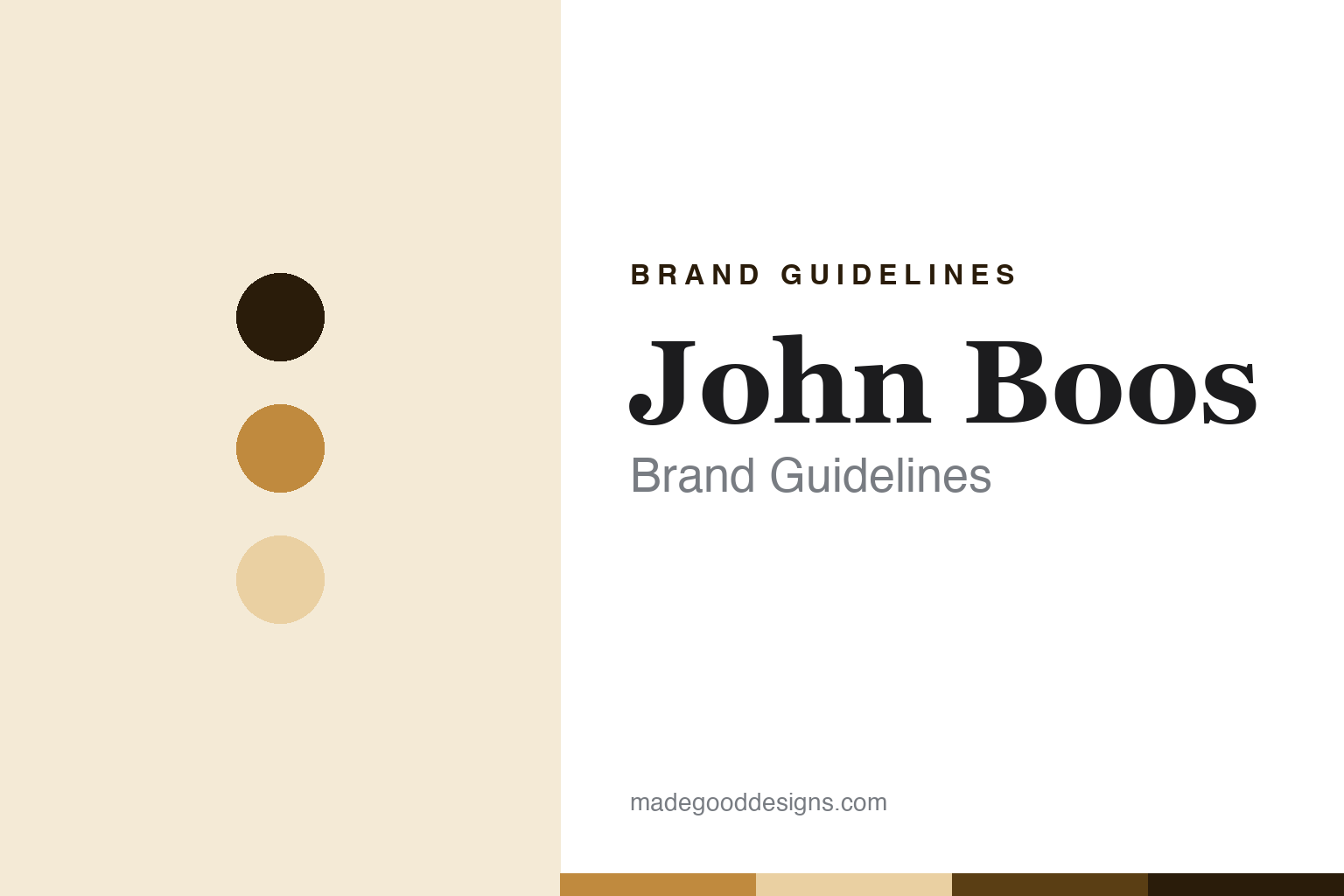
John Boos Brand Guidelines
Maple butcher block since 1887.
Aa
Two constants: a honey-maple palette and a heritage-serif register. Abstract homage — not a John Boos product or mark; no board, block or logo is reproduced.
Maple butcher block since 1887
John Boos is the 1887 blacksmith’s butcher block — whose first “Boos Block” was a three-legged sycamore slab, now a maple-block giant, PE-owned.
John Boos opens the cutting-board round as its heritage node — a maple butcher-block maker that started in an 1887 blacksmith’s shop, whose first block was a sycamore slab for absorbing hammer blows, and which is now a private-equity-backed American institution. Its answer to a round about the material and where it is made is a heritage one: a genuine 138-year-old Illinois maker, still cutting maple at home, now under corporate ownership.
Its identity is maple butcher block since 1887. The blacksmith origin, the Illinois making and the private-equity ownership are the story here. Sycamore first, maple now. Maple butcher block since 1887.
(Honest notes, so the founding, the ownership and the making are framed accurately, with corrections and attributed claims. John Boos sells maple butcher blocks and cutting boards as its heroes — the Boos Block and its end-grain and edge-grain boards, plus its board creams; we report its language as the brand’s own. On origin: John Boos was founded in 1887 in Effingham, Illinois by Conrad Boos, a blacksmith, whose first block was a three-legged sycamore slab built to absorb the shock of his hammer against the anvil, and the company is named after his son John, who filled a butcher’s order, so we credit Conrad as founder and note the first block was sycamore, with maple the modern signature. On ownership, corrected: John Boos is not verifiably family-owned; it was acquired by a private-equity firm, One Mezzanine Capital, in 2001, and is led by a chief executive named in 2024, so we say it is privately held and private-equity-backed since 2001 rather than family-owned, and we note the family-owned language in the press attaches to JK Adams, the Vermont maker Boos itself acquired in 2025. On where it is made: Effingham, Illinois, from North American hard-rock maple. On claims, attributed: its antimicrobial line is a company claim citing research, and since wood-versus-plastic hygiene research is contested we frame it as the company’s claim; its NSF status we report as described rather than assert a standard; and its sustainably-harvested-maple line is a self-claim, with no FSC certification found. Its designs and the registered Boos Block name are IP we describe but do not reproduce; there is no official brand hex; these tones are an unofficial interpretation.)
Colour
John Boos lives in a honey maple. Click a swatch to copy the hex.
John Boos’ identity is blacksmith-born, PE-owned and Illinois-made — a honey maple, an ink, a pale maple, a deep amber, and a paper. The palette leans honey maple and deep amber: a warm, timber register that nods to hard-rock maple and a working shop rather than a loud logo colour. It signals maple butcher block since 1887 — blacksmith-born, PE-owned and Illinois-made. The honest caveat: with no official brand hex, these values are a timber, unofficial interpretation, not first-party colours.
The lesson is a honey maple signals a timber, heritage-craft identity. John Boos’ world is the maple block. For designers, it is a reminder that a warm maple and a pale maple can carry a heritage, timber brand — a wood tone held as an accent, not a product shot. Because a warm hue can fail as small text, keep type dark and let the colour live in the accents, palette and band. The takeaways: date the founding to 1887 and Conrad Boos, noting the first block was sycamore; correct the ownership to private-equity since 2001, not family-owned; credit the Illinois maple making; and attribute the antimicrobial and NSF claims.
Typography
The register is a heritage serif — blacksmith-born, PE-owned, Illinois-made.
John Boos’ identity carries a blacksmith-born, PE-owned, Illinois-made spirit — an old timber name under corporate ownership. A heritage serif captures the mood: classic, editorial and long-lived, the register of an 1887 shop. Set in a honey-maple palette, the heritage serif feels warm and established — exactly the personality John Boos carries. It behaves like a cut, made thing rather than a loud logo, mirroring an end-grain-grid and a grain-arc. (John Boos’ real products and the Boos Block name are things we describe but do not reproduce, and the exact typeface is not ours to use.) Because it is not ours to use, the honest description is “a heritage-serif brand,” shown here in a stand-in. The type behaves like the brand: blacksmith-born, PE-owned and Illinois-made.
Aa
A heritage-serif brand — warm and established. (Specimen set in Fraunces, a heritage-serif STAND-IN; NOT the John Boos logo, Boos Block or products.)
The cutting-board node
John Boos stands for maple butcher block since 1887.
John Boos opens the round as its heritage node. A honey-maple palette, a heritage serif and an 1887 founding make one thing — maple butcher block since 1887 — the whole identity: blacksmith-born, PE-owned and Illinois-made. The blacksmith origin is the pitch, the Illinois making is the pride, and the private-equity ownership is the honest frame. The point is a genuine 138-year-old maker under corporate ownership, in a round about the material and where it is made.
Put to work, the identity is the brand told straight, the ownership corrected and the claims attributed. A brand in this spirit would date the founding to 1887 and Conrad Boos, note the sycamore first block, correct the ownership to private-equity since 2001, credit the Illinois maple making, and attribute the antimicrobial and NSF claims. A reader in this spirit would keep the facts right: John Boos sells the maple Boos Block and end-grain and edge-grain boards; it was founded in 1887 in Effingham, Illinois by the blacksmith Conrad Boos, its first block a sycamore slab, named after his son John; it is privately held and private-equity-backed since 2001, not family-owned; it is made in Illinois from hard-rock maple; and its antimicrobial and sustainability lines are attributed company claims. John Boos opens the round, before the Boardsmith. The honest editorial moves are to date the founding, to correct the ownership, to credit the making, and to attribute the claims.
For designers and brand-builders, John Boos opens the cutting-board node: credit a deep origin — and correct a family-owned assumption. The lessons: a brand can begin as a working tool, here the blacksmith’s shock-absorbing block; a founding is dated to 1887 and Conrad Boos, with the first block noted as sycamore and maple as the modern signature; an ownership is corrected to private-equity ownership since 2001 rather than the assumption of family ownership, with the family-owned press language attached to the JK Adams maker Boos acquired in 2025; a making is credited as Illinois hard-rock maple; and the claims are handled with mild discipline, the antimicrobial line kept as a company claim given the contested wood-versus-plastic hygiene research, the NSF status reported as described, and the sustainably-harvested line kept as a self-claim with no FSC found. It is also a reminder to stay precise: John Boos is the private-equity-backed, Illinois-made heritage maple butcher-block brand — with the palette here an unofficial interpretation and the registered Boos Block name described rather than reproduced. The hook is that origin: John Boos began in 1887 when a blacksmith needed a shock-absorbing block for his anvil, the first Boos Block a three-legged sycamore slab, the maple butcher block coming later, and the 138-year-old name is now private-equity-backed and itself a consolidator. Read that way, John Boos is less a single board than maple butcher block since 1887: blacksmith-born, PE-owned, Illinois-made. The lesson for a brand is that crediting the origin and correcting the ownership reinforce each other, and dating the founding keeps the story earned. John Boos made maple-butcher-block-since-1887 the identity — proof that a deep origin can open a round.
Explore & save
Keep John Boos’s identity on hand — save it to a board in the Made Good inspiration library.
John Boos identity set
Pin the honey-maple palette and the heritage-serif register to your own board.