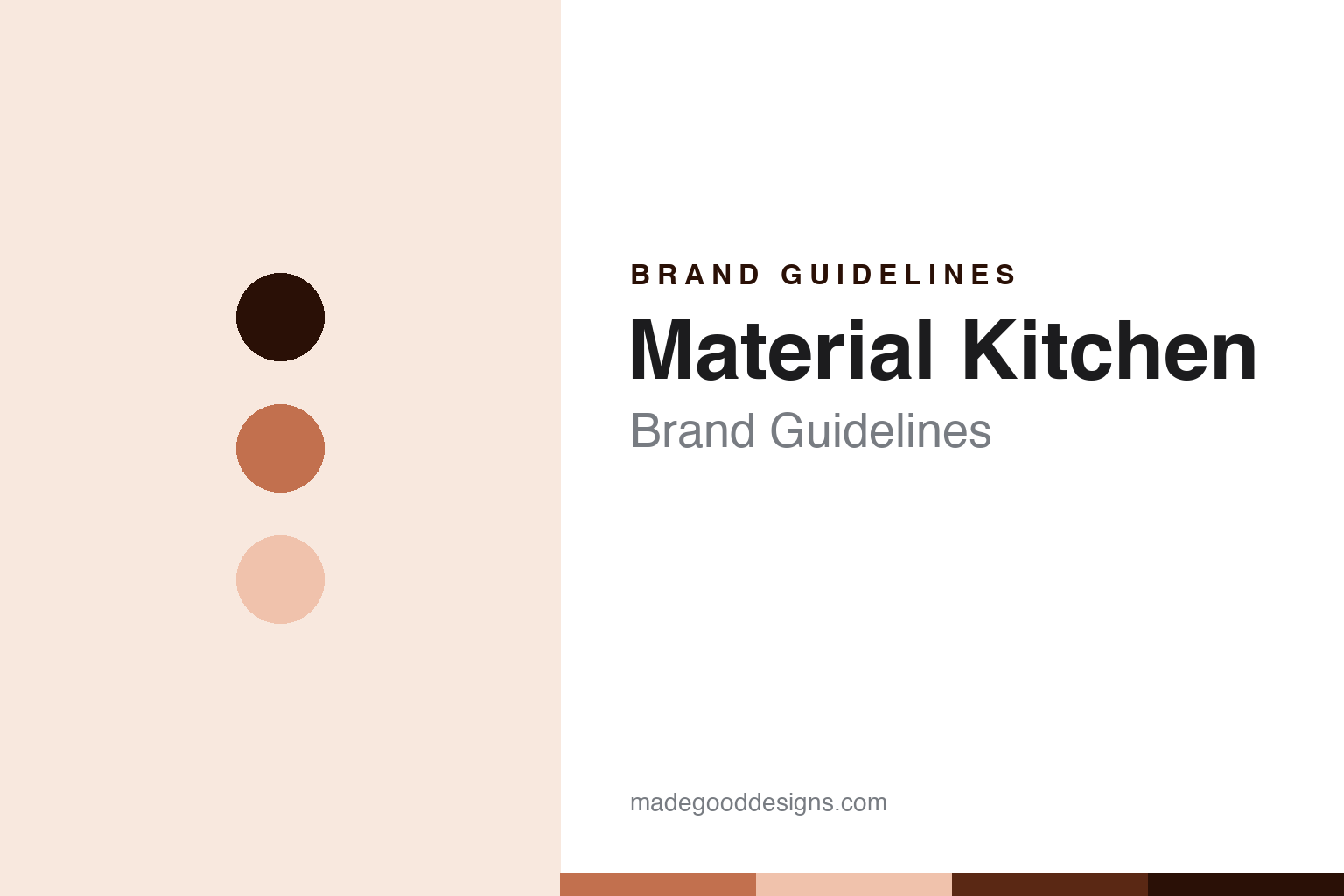
Material Kitchen Brand Guidelines
The recycled reBoard.
Aa
Two constants: a terracotta palette and a design-sans register. Abstract homage — not a Material Kitchen product or mark; no board, block or logo is reproduced.
The recycled reBoard
Material Kitchen is the NYC design-DTC brand whose viral reBoard is a recycled-plastic-and-sugarcane composite — with a separate USDA-biobased board made in Finland.
Material Kitchen closes the cutting-board round as its design-DTC node — a New York direct-to-consumer kitchenware brand whose viral cutting board is a recycled-plastic-and-sugarcane composite, made by two former beauty-industry marketers on a “fewer, better tools” philosophy. Its answer to a round about the material and where it is made is a modern one: a design-led, venture-backed brand with two distinct sustainable boards that must be kept apart.
Its identity is the recycled reBoard. The design-DTC model, the recycled composite and the two-board distinction are the story here. Recycled, and renewable. The recycled reBoard.
(Honest notes, so the founding, the ownership, the materials and the claims are framed accurately, with a key distinction. Material Kitchen sells design-forward kitchenware as its heroes — above all the reBoard cutting board; we report its language as the brand’s own. On origin: Material was co-founded in New York by Eunice Byun, a former Revlon marketer, and David Nguyen, a former Chanel person, started in 2017 and publicly launched in 2018, so we say founded 2017 and launched 2018. On ownership: it is independent but venture and angel-backed, not bootstrapped, with a chief executive in Eunice Byun and no parent, and we treat the funding figures as approximate. On the two boards, the key distinction: the reBoard is a BPA-free composite of pulverised, repurposed kitchenware plastic and renewable sugarcane, its recycled-to-sugarcane ratio reported rather than certified, and its country of manufacture we could not verify, so we do not assert it is made in China; the separate, newer MK Free Board is a bioplastic that is USDA-certified biobased and made in Finland, so we keep the Finland and USDA facts with the MK Free Board and not the reBoard. On claims, separated: the reBoard’s recycled and renewable line is a company claim with no named third-party certification we could verify, the USDA-biobased certification applies only to the MK Free Board, and we found no NSF for the reBoard. Its designs, the registered reBoard name and the Material name are IP we describe but do not reproduce; there is no official brand hex; these tones are an unofficial interpretation.)
Colour
Material Kitchen lives in a terracotta. Click a swatch to copy the hex.
Material Kitchen’s identity is design-DTC, VC-backed and two-board-distinct — a terracotta, an ink, a pale clay, a deep rust, and a paper. The palette leans terracotta and deep rust: a warm, modern register that nods to a colourful, design-led kitchenware brand rather than a loud logo colour. It signals the recycled reBoard — design-DTC, VC-backed and two-board-distinct. The honest caveat: with no official brand hex, these values are a modern, unofficial interpretation, not first-party colours.
The lesson is a terracotta signals a design-led, DTC identity. Material Kitchen’s world is the design object in the kitchen. For designers, it is a reminder that a warm terracotta and a pale clay can carry a design-led, DTC brand — a modern tone held as an accent, not a product shot. Because a mid hue can fail as small text, keep type dark and let the colour live in the accents, palette and band. The takeaways: date the founding to 2017 and the launch to 2018 by two ex-beauty marketers; describe ownership as venture-backed; keep the reBoard and the MK Free Board distinct; and do not assert the reBoard’s country of manufacture or an NSF it lacks.
Typography
The register is a design sans — design-DTC, VC-backed, two-board-distinct.
Material Kitchen’s identity carries a design-DTC, VC-backed, two-board-distinct spirit — a design brand with two sustainable materials. A design sans captures the mood: clean, current and considered, the register of a modern DTC brand. Set in a terracotta palette, the design sans feels warm and modern — exactly the personality Material carries. It behaves like a designed, made thing rather than a loud logo, mirroring a sawn-line and a grain-gradient. (Material’s real products, the reBoard name and the Material name are things we describe but do not reproduce, and the exact typeface is not ours to use.) Because it is not ours to use, the honest description is “a design-sans brand,” shown here in a stand-in. The type behaves like the brand: design-DTC, VC-backed and two-board-distinct.
Aa
A design-sans brand — warm and modern. (Specimen set in Jost, a design-sans STAND-IN; NOT the Material Kitchen logo or products.)
The cutting-board node
Material Kitchen stands for the recycled reBoard.
Material Kitchen closes the round as its design-DTC node. A terracotta palette, a design sans and a 2017 founding make one thing — the recycled reBoard — the whole identity: design-DTC, VC-backed and two-board-distinct. The design-DTC model is the pitch, the recycled composite is the material, and the two-board distinction is the disciplined detail. The point is a design-led, venture-backed brand with two distinct sustainable boards, in a round about the material and where it is made.
Put to work, the identity is the brand told straight, the ownership described and the two boards kept distinct. A brand in this spirit would date the founding to 2017 and the launch to 2018, describe ownership as venture-backed, keep the reBoard and MK Free Board distinct, and decline to assert the reBoard’s country of manufacture. A reader in this spirit would keep the facts right: Material sells the design-forward reBoard; it was co-founded in New York by Eunice Byun and David Nguyen, started 2017 and launched 2018; it is independent but venture and angel-backed; its reBoard is a recycled-plastic-and-sugarcane composite with a reported ratio and an unverified country of manufacture; and its USDA-biobased, Finland-made board is the separate MK Free Board. Material Kitchen closes the round, after Epicurean. The honest editorial moves are to date the founding, to describe the ownership, to keep the two boards distinct, and to avoid unverified claims.
For designers and brand-builders, Material Kitchen closes the cutting-board node: keep two products distinct — and don’t assert what you cannot verify. The lessons: a brand can turn a board into a design object and a sustainability story, here Material’s reBoard; a founding is dated to 2017 and a launch to 2018, co-founded in New York by Eunice Byun, a former Revlon marketer, and David Nguyen, a former Chanel person; an ownership is described as independent but venture and angel-backed rather than bootstrapped, with funding figures kept approximate; two products are kept distinct, the reBoard a recycled-plastic-and-sugarcane composite with a reported ratio and an unverified country of manufacture, and the separate MK Free Board a USDA-certified biobased bioplastic made in Finland, so the Finland and USDA facts are not misattributed to the reBoard; and claims are handled with care, the reBoard’s recycled-and-renewable line a company claim with no verified third-party certification and no NSF, distinct from the MK Free Board’s USDA-biobased certification. It is also a reminder to stay precise: Material Kitchen is the independent, venture-backed, design-DTC recycled-composite board brand — with the palette here an unofficial interpretation, the registered reBoard name described rather than reproduced, and the generic Material name disambiguated. The hook is that pairing: Material turned a cutting board into a design object and a sustainability story, its viral reBoard a recycled-plastic-and-sugarcane composite from a New York DTC brand built on “fewer, better tools,” with a separate USDA-biobased board made in Finland. Read that way, Material Kitchen is less a single board than the recycled reBoard: design-DTC, VC-backed, two-board-distinct. The lesson for a brand is that keeping two products distinct and not asserting the unverifiable reinforce the honesty, and dating the founding keeps it earned. Material Kitchen made the-recycled-reBoard the identity — proof that honest product distinctions can close a round.
Explore & save
Keep Material Kitchen’s identity on hand — save it to a board in the Made Good inspiration library.
Material Kitchen identity set
Pin the terracotta palette and the design-sans register to your own board.