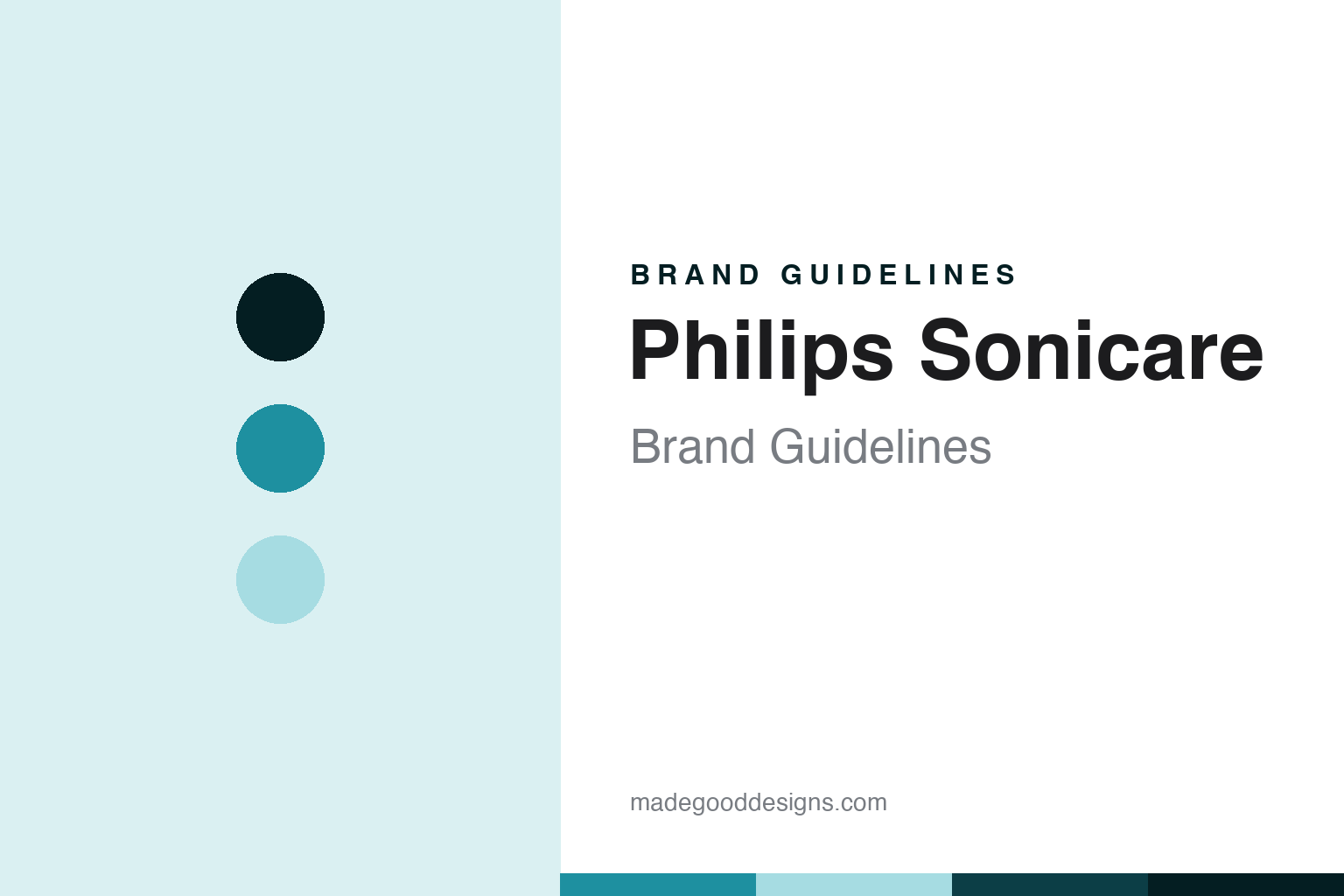
Philips Sonicare Brand Guidelines
Sonic, from Philips.
Aa
Two constants: a sonic-teal palette and a sonic-sans register. Abstract homage — not a Philips Sonicare product or mark; no toothbrush, brush head or logo is reproduced.
The sonic sweep, from Philips
Philips Sonicare is the 1992 University of Washington spin-out that invented sonic brushing — bought by Philips in 2000 and enforced through patents.
Philips Sonicare follows Oral-B as the round’s sonic giant — the brand that invented sonic brushing out of a university lab, was bought by Philips, and has enforced its sonic patents against rivals including Oral-B. Its answer to a round about who owns the brushes and what the claims mean is a patent-and-conglomerate one: an inventor spin-out inside a global electronics company, its evidence claims kept to what a dental body accepts, per model.
Its identity is the sonic sweep, from Philips. The 1992 invention, the Philips ownership and the sonic patents are the story here. Sweep, not spin. The sonic sweep, from Philips.
(Honest notes, so the founding, the ownership, the making and the claims are framed accurately, with attribution and one thing kept separate. Philips Sonicare sells sonic toothbrushes as its heroes — the DiamondClean flagship and the ProtectiveClean; we report its language as the brand’s own. On origin: in 1987 the engineer David Giuliani partnered with University of Washington professors David Engel and Roy Martin to form GEMTech, developing a piezoelectric transducer, and the Sonicare toothbrush was introduced in 1992, the company later renamed Optiva; Giuliani is a co-inventor, not the sole one, and he died in 2022. On ownership: Philips acquired the company in 2000, forming Philips Oral Healthcare, and the parent is Royal Philips of Amsterdam. On where it is made: developed in the US, it is reported to be made predominantly in China with some European and Indonesian production, which we attribute as reported and varying by model. On the claims, the point of this round: the ProtectiveClean carries the American Dental Association’s Seal of Acceptance, which is the one independently-accepted claim, but we could not confirm the DiamondClean’s Seal, and since the Seal is model-specific and can change we do not assert it beyond the ProtectiveClean; the thirty-one-thousand-strokes and superior-cleaning lines are attributed to Philips. On disputes, as allegations: a class action over an alleged shaft defect was ultimately dismissed. On a crucial separation: Philips’ large CPAP recall of 2021 was in a different, respiratory division, not Sonicare, so we keep the toothbrush entirely clear of it. Its designs and names are IP we describe but do not reproduce; there is no official brand hex; these tones are an unofficial interpretation.)
Colour
Philips Sonicare lives in a sonic teal. Click a swatch to copy the hex.
Philips Sonicare’s identity is sonic-inventing, Philips-owned and claims-disciplined — a sonic teal, an ink, a pale teal, a deep teal, and a paper. The palette leans sonic teal and deep teal: a clean, technical register that nods to a sonic, engineered brand rather than a loud logo colour. It signals the sonic sweep, from Philips — sonic-inventing, Philips-owned and claims-disciplined. The honest caveat: with no first-party brand hex confirmed, these values are a technical, unofficial interpretation, not first-party colours.
The lesson is a sonic teal signals an engineered, sonic identity. Sonicare’s world is the sonic sweep. For designers, it is a reminder that a sonic teal and a pale teal can carry an engineered, conglomerate brand — a technical tone held as an accent, not a product shot. Because a mid hue can fail as small text, keep type dark and let the colour live in the accents, palette and band. The takeaways: credit the 1992 University of Washington invention and Giuliani as co-inventor; note Philips since 2000; state the ADA Seal only for the ProtectiveClean; attribute the stroke and cleaning claims; and keep the CPAP recall entirely separate.
Typography
The register is a sonic sans — sonic-inventing, Philips-owned, claims-disciplined.
Philips Sonicare’s identity carries a sonic-inventing, Philips-owned, claims-disciplined spirit — an inventor spin-out inside a giant. A sonic sans captures the mood: clean, exact and engineered, the register of a technical product. Set in a sonic-teal palette, the sonic sans feels precise and modern — exactly the personality Sonicare carries. It behaves like a made, engineered thing rather than a loud logo, mirroring a sonic-wave and a pulse-ring. (Sonicare’s real products and names are things we describe but do not reproduce, and the exact typeface is not ours to use.) Because it is not ours to use, the honest description is “a sonic-sans brand,” shown here in a stand-in. The type behaves like the brand: sonic-inventing, Philips-owned and claims-disciplined.
Aa
A sonic-sans brand — precise and modern. (Specimen set in Manrope, a sonic-sans STAND-IN; NOT the Philips Sonicare logo or products.)
The oral-care node
Philips Sonicare stands for the sonic sweep, from Philips.
Philips Sonicare sits second in the round as its sonic giant. A sonic-teal palette, a sonic sans and a 1992 invention make one thing — the sonic sweep, from Philips — the whole identity: sonic-inventing, Philips-owned and claims-disciplined. The invention is the pitch, the Philips ownership is the frame, and the sonic patents are the point. The point is an inventor spin-out inside a global electronics company, its claims kept honest, in a round about who owns the brushes and what the claims mean.
Put to work, the identity is the brand told straight, the invention credited and the claims attributed. A brand in this spirit would credit the 1992 University of Washington invention, note Philips since 2000, state the ADA Seal only for the ProtectiveClean, attribute the stroke claims, and keep the CPAP recall separate. A reader in this spirit would keep the facts right: Sonicare sells the DiamondClean and ProtectiveClean; it was invented in 1992 out of the University of Washington by GEMTech, David Giuliani a co-inventor; it was bought by Philips in 2000; it is reported to be made predominantly in China; its ProtectiveClean carries the ADA Seal, the DiamondClean’s status unconfirmed; and its 31,000-strokes claim is attributed marketing. Sonicare sits after Oral-B and before Suri. The honest editorial moves are to credit the invention, to note the owner, to state the Seal precisely, and to keep the CPAP recall separate.
For designers and brand-builders, Sonicare carries the oral-care node: credit an invention — and keep an unrelated recall out of the story. The lessons: a brand can be an inventor spin-out inside a giant, here Sonicare inside Philips; an invention is credited to 1992 and the University of Washington GEMTech team, with Giuliani a co-inventor rather than the sole one; an ownership is noted as Philips since 2000; a making is attributed as reported, predominantly China with some Europe and Indonesia; and the claims are handled with discipline, the ADA Seal stated only for the ProtectiveClean since the DiamondClean’s status is unconfirmed and the Seal is model-specific, while the 31,000-strokes and superior-cleaning lines are attributed to Philips. It is also a reminder to stay precise: Sonicare is the Philips-owned, sonic electric-toothbrush brand — with the palette here an unofficial interpretation, the alleged shaft-defect class action noted as dismissed, and, crucially, Philips’ 2021 CPAP recall kept entirely separate as a different division. The hook is that invention: Sonicare invented sonic brushing out of a university lab in 1992, was bought by Philips in 2000, and has enforced its sonic patents against rivals including Oral-B. Read that way, Sonicare is less a single brush than the sonic sweep, from Philips: sonic-inventing, Philips-owned, claims-disciplined. The lesson for a brand is that crediting an invention and keeping an unrelated recall out of the story reinforce the honesty, and stating the Seal precisely keeps it earned. Philips Sonicare made the-sonic-sweep-from-Philips the identity — proof that a precisely-scoped claim can anchor a node.
Explore & save
Keep Philips Sonicare’s identity on hand — save it to a board in the Made Good inspiration library.
Philips Sonicare identity set
Pin the sonic-teal palette and the sonic-sans register to your own board.