Oral-B Brand Guidelines
The round head, P&G-owned.
Aa
Two constants: a clinical-blue palette and a clinical-sans register. Abstract homage — not an Oral-B product or mark; no toothbrush, brush head or logo is reproduced.
The round head, P&G-owned
Oral-B is the 1950 California periodontist’s brush — now a Procter & Gamble giant whose oscillating-rotating round head is the opposite of Sonicare’s sonic sweep.
Oral-B opens the toothbrush round as its round-head giant — the brand that put a spinning round head on the electric toothbrush, founded by a periodontist in 1950 and now owned by Procter & Gamble, with a mechanism that is the technical opposite of Sonicare’s sonic sweep. Its answer to a round about who owns the brushes and what the claims mean is a conglomerate one: an old clinical name inside a consumer-goods giant, its evidence claims kept to what a dental body actually accepts.
Its identity is the round head, P&G-owned. The 1950 founding, the P&G ownership and the oscillating-rotating head are the story here. Round, not sonic. The round head, P&G-owned.
(Honest notes, so the founding, the ownership, the making and the claims are framed accurately, with corrections and attribution. Oral-B sells electric toothbrushes as its heroes — the iO series with its magnetic drive and the Genius and SmartSeries; we report its language as the brand’s own. On origin: the first Oral-B toothbrush was designed and patented in 1950 in California by Dr. Robert W. Hutson, a periodontist, its name from “Oral Brush,” and Hutson sold the business around 1960. On ownership, corrected: Gillette acquired Oral-B in 1984, and Procter & Gamble acquired Gillette, and with it Oral-B, in a deal that closed in 2005, so we say P&G since 2005, not 2006, and name Procter & Gamble of Cincinnati as the parent. On where it is made: much of the electric range is made at P&G’s plant in Marktheidenfeld, Germany, used as a premium signal, while brush heads and sonic units are reported to be made across the USA, Mexico, India and Shanghai, which we attribute as reported and varying by model. On the claims, which are the point of this round: the iO series carries the American Dental Association’s Seal of Acceptance, which is the one independently-accepted claim and which we state in the ADA’s own terms, that the product is safe and has shown efficacy in removing plaque and helping prevent and reduce gingivitis when used as directed; the marketing lines, that it removes up to a hundred per cent more plaque or is the number-one dentist-recommended brand, are attributed to Oral-B rather than asserted, and we could not verify the number-one substantiation. On disputes, as allegations: there are class actions over charcoal-whitening claims, a Crest gum-repair toothpaste, and the app’s biometric data. Its designs and product names are IP we describe but do not reproduce; there is no official brand hex; these tones are an unofficial interpretation.)
Colour
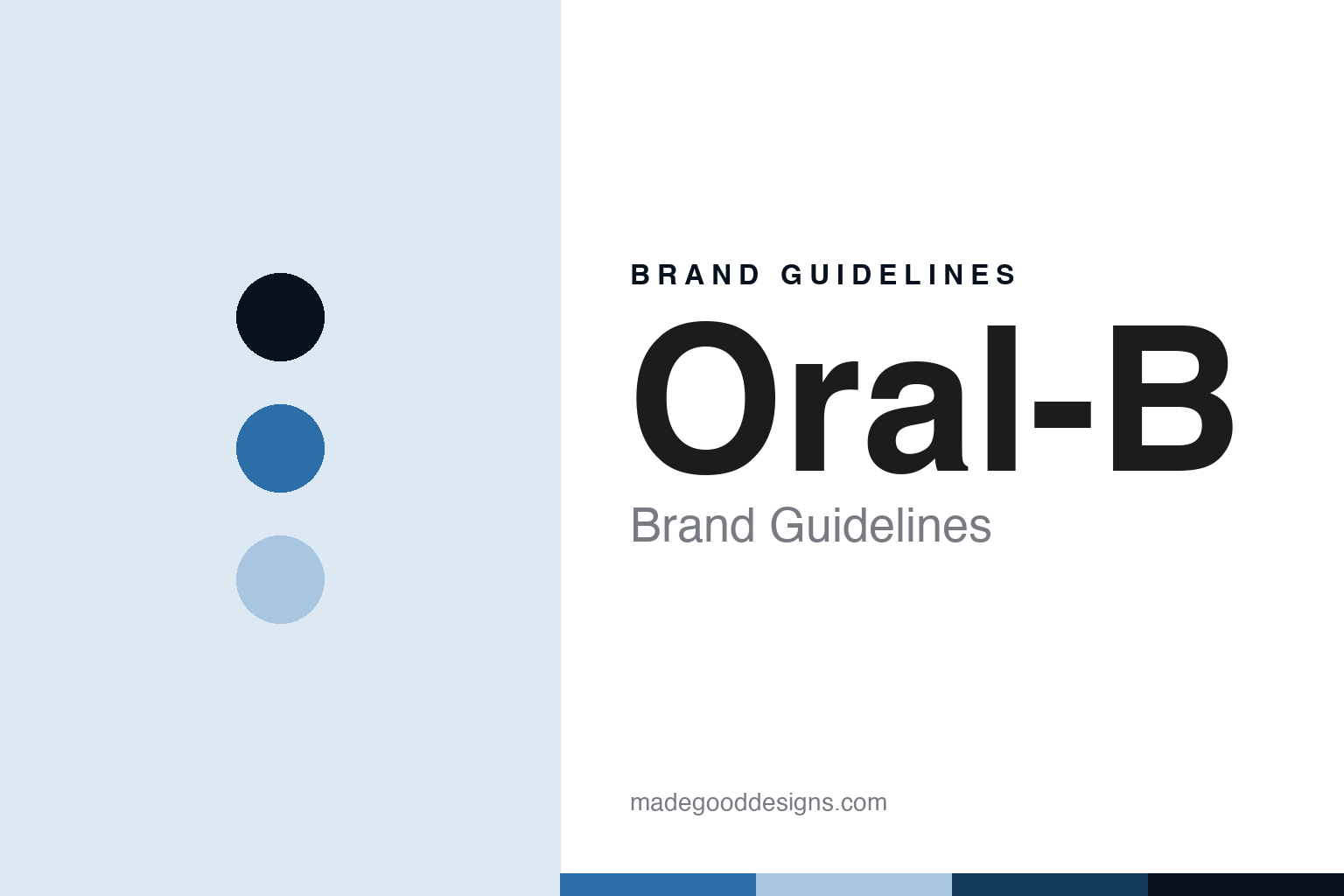
Oral-B lives in a clinical blue. Click a swatch to copy the hex.
Oral-B’s identity is round-headed, P&G-owned and claims-disciplined — a clinical blue, an ink, a pale blue, a deep blue, and a paper. The palette leans clinical blue and deep blue: a clean, dental register that nods to a clinical, evidence-led brand rather than a loud logo colour. It signals the round head, P&G-owned — round-headed, P&G-owned and claims-disciplined. The honest caveat: with no first-party brand hex confirmed, these values are a clinical, unofficial interpretation, not first-party colours.
The lesson is a clinical blue signals a dental, evidence-led identity. Oral-B’s world is the clinical brush. For designers, it is a reminder that a clinical blue and a pale blue can carry a dental, conglomerate brand — a clean tone held as an accent, not a product shot. Because a mid hue can fail as small text, keep type dark and let the colour live in the accents, palette and band. The takeaways: credit the 1950 Hutson founding; correct the ownership to P&G via Gillette in 2005; note the German-made premium range; state the ADA Seal in the ADA’s own words for the iO; and attribute the marketing plaque claims rather than assert them.
Typography
The register is a clinical sans — round-headed, P&G-owned, claims-disciplined.
Oral-B’s identity carries a round-headed, P&G-owned, claims-disciplined spirit — a clinical brand under a giant. A clinical sans captures the mood: clean, plain and precise, the register of a dental product. Set in a clinical-blue palette, the clinical sans feels exact and dependable — exactly the personality Oral-B carries. It behaves like a made, tested thing rather than a loud logo, mirroring an oscillation-arc and a pulse-ring. (Oral-B’s real products and names are things we describe but do not reproduce, and the exact typeface is not ours to use.) Because it is not ours to use, the honest description is “a clinical-sans brand,” shown here in a stand-in. The type behaves like the brand: round-headed, P&G-owned and claims-disciplined.
Aa
A clinical-sans brand — exact and dependable. (Specimen set in Archivo, a clinical-sans STAND-IN; NOT the Oral-B logo or products.)
The oral-care node
Oral-B stands for the round head, P&G-owned.
Oral-B opens the round as its round-head giant. A clinical-blue palette, a clinical sans and a 1950 founding make one thing — the round head, P&G-owned — the whole identity: round-headed, P&G-owned and claims-disciplined. The 1950 founding is the pitch, the P&G ownership is the frame, and the oscillating-rotating head is the technical point. The point is an old clinical name inside a consumer-goods giant, its claims kept honest, in a round about who owns the brushes and what the claims mean.
Put to work, the identity is the brand told straight, the ownership corrected and the claims attributed. A brand in this spirit would credit the 1950 Hutson founding, correct the ownership to P&G via Gillette in 2005, note the German-made premium range, state the ADA Seal precisely for the iO, and attribute the plaque marketing. A reader in this spirit would keep the facts right: Oral-B sells the iO, Genius and SmartSeries; it was founded in 1950 by the periodontist Robert Hutson in California; it is owned by Procter & Gamble, which acquired Gillette and with it Oral-B in 2005; much of its electric range is made in Germany; its iO carries the ADA Seal, stated in the ADA’s terms, while the “100% more plaque” and “#1 recommended” lines are attributed marketing. Oral-B opens the round, before Philips Sonicare. The honest editorial moves are to credit the founding, to correct the ownership, to state the ADA Seal precisely, and to attribute the marketing.
For designers and brand-builders, Oral-B opens the oral-care node: separate an accepted claim from a marketing claim — and correct the ownership. The lessons: a brand can be a clinical name inside a giant, here Oral-B inside Procter & Gamble; a founding is credited to 1950 and the periodontist Robert Hutson; an ownership is corrected to Gillette in 1984 and then P&G via the Gillette deal that closed in 2005, not 2006; a making is credited as largely German for the premium electric range, with other sites attributed as reported; and the claims are handled with discipline, the ADA Seal of Acceptance stated in the ADA’s own words for the iO as the one independently-accepted claim, while “removes 100% more plaque” and “#1 dentist recommended” are attributed to Oral-B rather than asserted, and the class actions are kept as allegations. It is also a reminder to stay precise: Oral-B is the P&G-owned, round-head electric-toothbrush brand — with the palette here an unofficial interpretation, the “sonic” label avoided given the oscillating-rotating mechanism and the Philips patent history, and the marketing claims attributed. The hook is that mechanism: Oral-B is the round head, a 1950 California periodontist’s brush now a P&G giant, whose spinning head is the technical and litigated-patent opposite of Sonicare’s sonic sweep. Read that way, Oral-B is less a single brush than the round head, P&G-owned: round-headed, P&G-owned, claims-disciplined. The lesson for a brand is that separating an accepted claim from a marketing claim and correcting the ownership reinforce each other, and crediting the founding keeps the story earned. Oral-B made the-round-head-P&G-owned the identity — proof that claims discipline can open a round.
Explore & save
Keep Oral-B’s identity on hand — save it to a board in the Made Good inspiration library.
Oral-B identity set
Pin the clinical-blue palette and the clinical-sans register to your own board.