Fronius Brand Guidelines
The Austrian family’s three divisions.
Aa
Two constants: a molten-orange palette and a precision-sans register. Abstract homage — not a Fronius product or mark; no welder, arc or logo is reproduced.
The Austrian family’s three divisions
Fronius is a 1945 Pettenbach company, still family-owned — that welds (its CMT process a 2005 landmark), makes solar inverters, and builds battery chargers.
Fronius follows ESAB as the round’s family node — an Austrian company still owned by the founding family, high-end in welding and, unusually, spanning three businesses: welding, solar and battery charging. Its answer to a round about who owns the welders is the family one: a private, multi-division Austrian firm whose welding is one of three legs.
Its identity is the Austrian family’s three divisions. The 1945 founding, the family ownership and the three divisions are the story here. Welding, solar, charging. The Austrian family’s three divisions.
(Honest notes, so the founding, the ownership, the divisions and an innovation are framed accurately, with a name correction. Fronius sells welding technology as one of its heroes — the TPS/i platform, the TransSteel series and the CMT process; we report its language as the brand’s own. On origin: Fronius was founded in 1945 in Pettenbach, Austria by Günter Fronius, and remains privately held and family-owned into its third generation. On the leadership, corrected: the chief executive is Elisabeth Engelbrechtsmüller-Strauß, Günter’s granddaughter, since 2012, which corrects the surname Engelbrechtsmüller-Fronius, and the board includes Klaus Fronius and Brigitte Strauß. On the divisions: it runs three business units, Perfect Welding, Solar Energy and Perfect Charging, so it is more than a welding company. On the making: manufacturing is centred in Austria, at Pettenbach, Thalheim near Wels and Sattledt. On the innovation, documented: its CMT, or Cold Metal Transfer, introduced in 2005, gives very low heat input and near-spatter-free welds and is widely used for thin sheet, aluminium and steel-to-aluminium joining, a genuine landmark. Its designs and the Fronius name are IP we describe but do not reproduce; there is no official brand hex; these tones are an unofficial interpretation.)
Colour
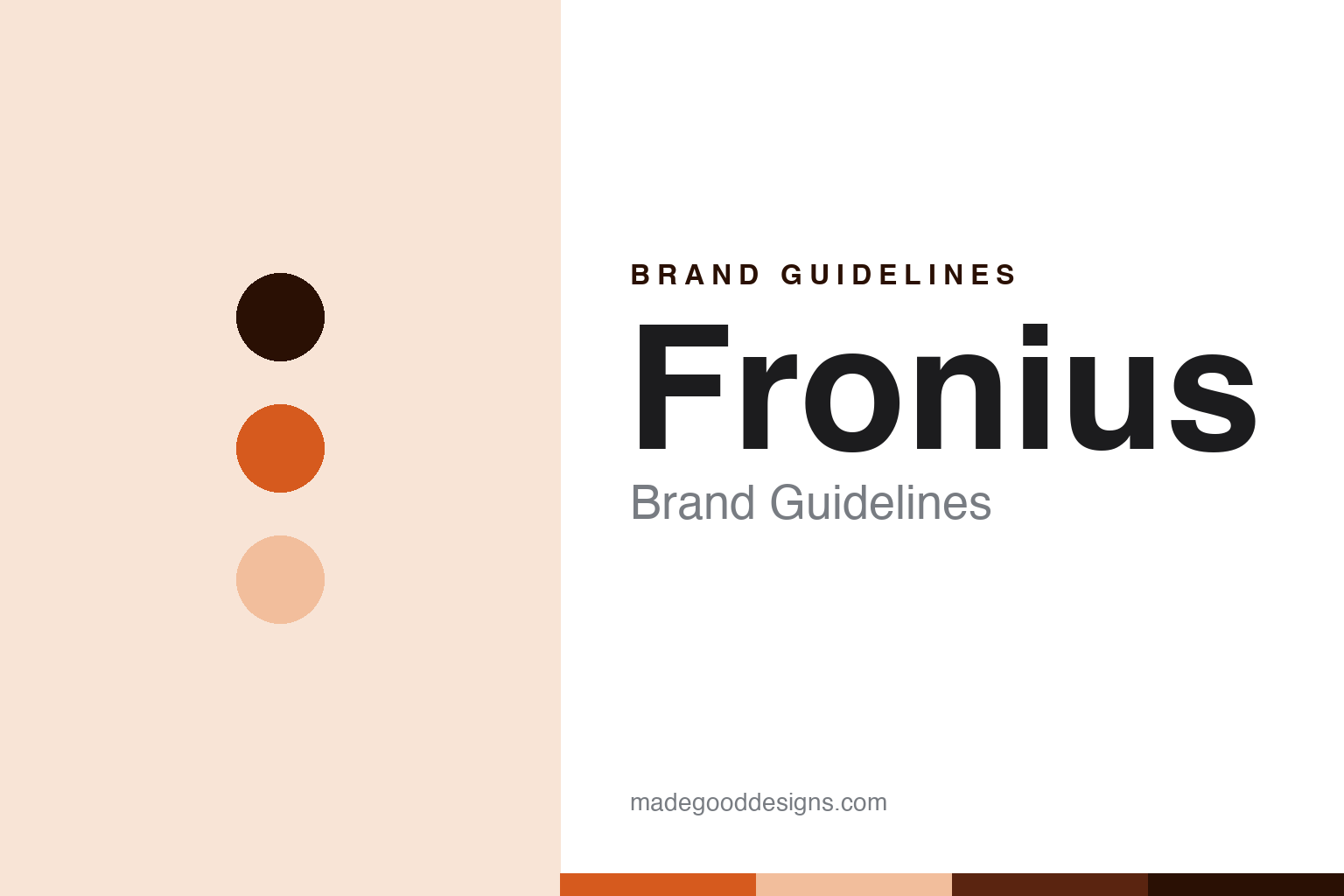
Fronius lives in a molten orange. Click a swatch to copy the hex.
Fronius’ identity is family-owned, three-division and precision-welding — a molten orange, an ink, a pale amber, a deep rust, and a paper. The palette leans molten orange and deep rust: a warm, engineered register that nods to the molten arc and a precision maker rather than a loud logo colour. It signals the Austrian family’s three divisions — family-owned, three-division and precision-welding. The honest caveat: with no official brand hex, these values are an engineered, unofficial interpretation, not first-party colours.
The lesson is a molten orange signals a precision, engineered identity. Fronius’ world is the high-end arc. For designers, it is a reminder that a warm orange and a deep rust can carry a precision, family brand — an engineered tone held as an accent, not a product shot. Because a warm hue can fail as small text, keep type dark and let the colour live in the accents, palette and band. The takeaways: date the founding to 1945 and Günter Fronius in Pettenbach; correct the chief executive’s surname to Engelbrechtsmüller-Strauß; note the family ownership and the three divisions; credit CMT as a 2005 innovation; and say it is made in Austria.
Typography
The register is a precision sans — family-owned, three-division, precision-welding.
Fronius’ identity carries a family-owned, three-division spirit — a precision maker across welding, solar and charging. A precision sans captures the mood: clean, exact and engineered, the register of a high-end industrial firm. Set in a molten-orange palette, the precision sans feels considered and technical — exactly the personality Fronius carries. It behaves like a made, engineered thing rather than a loud logo, mirroring a heat-arc and a molten-gradient. (Fronius’ real products and the name are things we describe but do not reproduce, and the exact typeface is not ours to use.) Because it is not ours to use, the honest description is “a precision-sans brand,” shown here in a stand-in. The type behaves like the brand: family-owned, three-division and precision-welding.
Aa
A precision-sans brand — considered and technical. (Specimen set in Sora, a precision-sans STAND-IN; NOT the Fronius logo or products.)
The welding node
Fronius stands for the Austrian family’s three divisions.
Fronius sits fifth in the round as its family node. A molten-orange palette, a precision sans and a 1945 founding make one thing — the Austrian family’s three divisions — the whole identity: family-owned, three-division and precision-welding. The 1945 founding is the pitch, the family ownership is the frame, and the three divisions are the surprise. The point is a private, multi-division Austrian firm whose welding is one of three legs, in a round about who owns the welders.
Put to work, the identity is the brand told straight, the leadership corrected and the divisions named. A brand in this spirit would date the founding to 1945 and Günter Fronius in Pettenbach, correct the chief executive’s surname to Engelbrechtsmüller-Strauß, note the family ownership and the three divisions, credit CMT as a 2005 innovation, and say it is made in Austria. A reader in this spirit would keep the facts right: Fronius makes the TPS/i and the CMT process, plus solar inverters and battery chargers; it was founded in 1945 by Günter Fronius in Pettenbach; it is family-owned into its third generation, led by Elisabeth Engelbrechtsmüller-Strauß; and it runs three divisions, Perfect Welding, Solar Energy and Perfect Charging. Fronius sits after ESAB and before Everlast. The honest editorial moves are to date the founding, to correct the leadership, to name the divisions, and to credit the innovation.
For designers and brand-builders, Fronius carries the welding node: correct a leadership name — and show a maker is more than one category. The lessons: a brand can be a family firm that spans several categories, here Fronius across welding, solar and battery charging; a founding is dated to 1945 and Günter Fronius in Pettenbach, Austria, still privately held into its third generation; a leadership is corrected, the chief executive Elisabeth Engelbrechtsmüller-Strauß, Günter’s granddaughter since 2012, rather than the surname Engelbrechtsmüller-Fronius, with Klaus Fronius and Brigitte Strauß on the board; a structure is named, the three divisions Perfect Welding, Solar Energy and Perfect Charging, so the maker is more than a welding company; a making is stated as Austria, at Pettenbach, Thalheim near Wels and Sattledt; and an innovation is credited as documented, the 2005 CMT, or Cold Metal Transfer, giving very low heat input and near-spatter-free welds. It is also a reminder to stay precise: Fronius is the family-owned, three-division Austrian precision maker of the welding aisle — with the palette here an unofficial interpretation. The hook is that breadth: Fronius is the Austrian family’s three divisions, a 1945 Pettenbach company, still family-owned, that welds, makes solar inverters and builds battery chargers, its CMT a 2005 landmark. Read that way, Fronius is less a single welder than the Austrian family’s three divisions: family-owned, three-division, precision-welding. The lesson for a brand is that correcting a leadership name and showing a maker is more than one category reinforce the honesty, and dating the founding keeps it earned. Fronius made the-Austrian-family’s-three-divisions the identity — proof that a multi-division family firm can anchor a node.
Explore & save
Keep Fronius’s identity on hand — save it to a board in the Made Good inspiration library.
Fronius identity set
Pin the molten-orange palette and the precision-sans register to your own board.