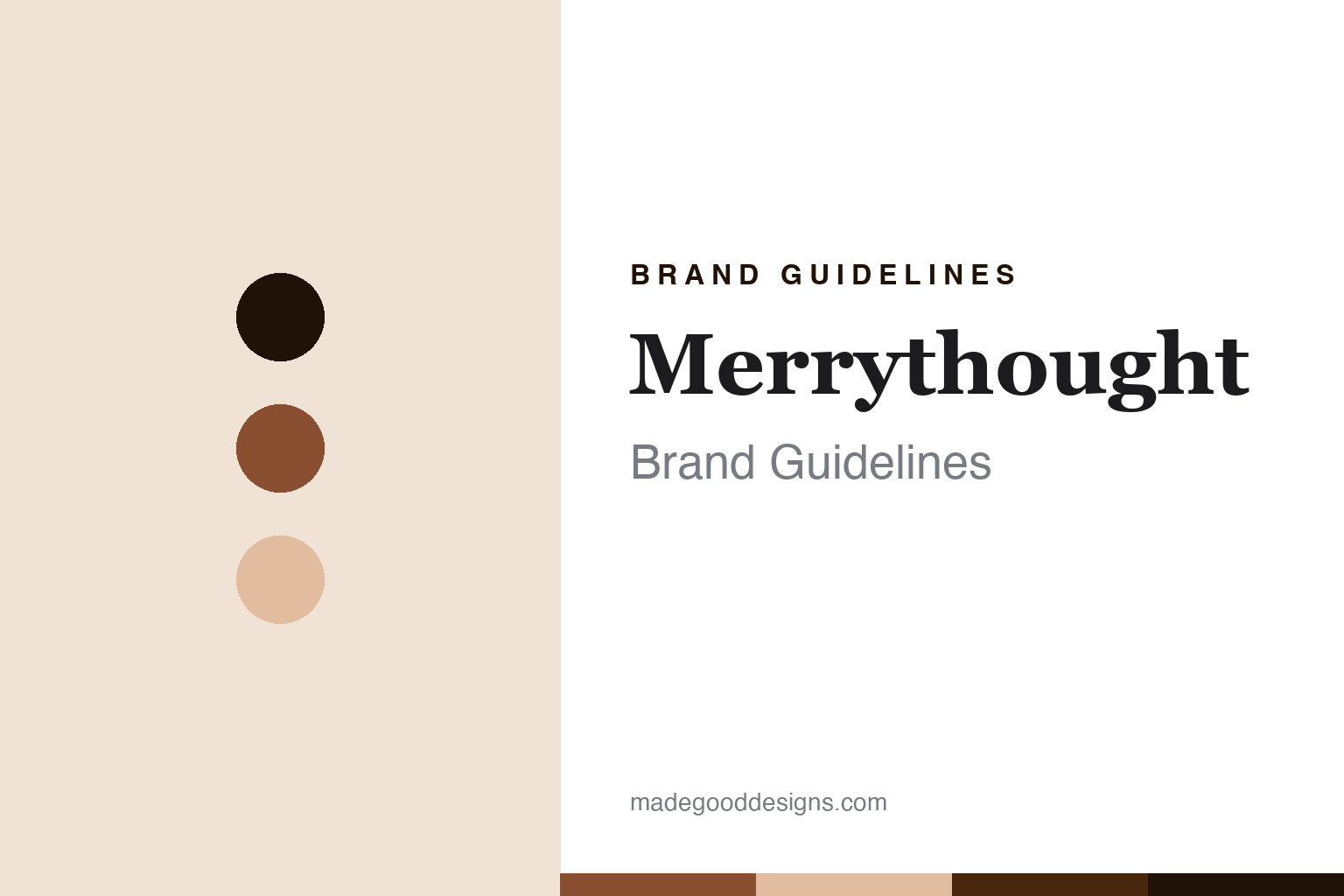
Merrythought Brand Guidelines
Britain’s last teddy factory.
Aa
Two constants: a chestnut palette and a craft-serif register. Abstract homage — not a Merrythought product or mark; no bear, wishbone or logo is reproduced.
Britain’s last teddy factory
Merrythought is the family-run British teddy bear maker on its original Ironbridge site since 1930 — still handmaking bears in England.
Merrythought follows Steiff as the round’s made-in-Britain node — a family teddy bear maker named after the old word for a wishbone, still handmaking bears on its original Shropshire site, and widely described as Britain’s last teddy bear factory. Its answer to a round about who owns the soft toys and where they are made is the most domestic in the set: a family firm, handmaking at home.
Its identity is Britain’s last teddy factory. The 1930 founding, the family ownership and the made-in-England craft are the story here. Family-owned, England-made. Britain’s last teddy factory.
(Honest notes, so the founding, the ownership and the making are framed accurately, with a claim attributed and a myth avoided. Merrythought sells handmade teddy bears as its heroes — above all the Cheeky bear; we report its language as the brand’s own. On origin: Merrythought was founded in 1930, with its first catalogue in 1931, by William Gordon Holmes and George Laxton, who ran a Yorkshire mohair-spinning mill, in Ironbridge, Shropshire, England, its first bear the Magnet in the M series and its name the archaic English word for a wishbone, which is its emblem. On headquarters: Ironbridge, Shropshire, a World Heritage Site, on its original site since 1930. On ownership: Merrythought is still family-owned by the Holmes family into a fourth generation, with the joint managing directors Sarah and Hannah Holmes having taken over after their father Oliver died in 2011, independent and with no parent. On where it is made: it genuinely handmakes its bears in England at Ironbridge, though we note honestly that during the cheap-import pressure of the 2000s it briefly outsourced production before bringing it back in-house. On a claim, attributed: it is widely described as Britain’s last surviving teddy bear factory, its peers having closed or offshored, which we attribute rather than assert. On a myth to avoid: the black mourning Titanic bear belongs to Steiff, not Merrythought, so we do not attribute it here. There is no official brand hex; these tones are an unofficial interpretation.)
Colour
Merrythought lives in a chestnut. Click a swatch to copy the hex.
Merrythought’s identity is family-owned, independent and genuinely England-made — a chestnut, an ink, a pale tan, a deep chestnut, and a paper. The palette leans chestnut and deep chestnut: a warm, teddy-bear register that nods to mohair fur and a hand-made craft rather than a loud logo colour. It signals Britain’s last teddy factory — family-owned, independent and genuinely England-made. The honest caveat: with no official brand hex, these values are a warm, unofficial interpretation, not first-party colours.
The lesson is a chestnut signals a hand-made, heritage-craft identity. Merrythought’s world is the English teddy bear. For designers, it is a reminder that a warm chestnut and a pale tan can carry a family, made-here brand — a teddy tone held as an accent, not a reproduced emblem. Because a warm hue can fail as small text, keep type dark and let the colour live in the accents, palette and band. The takeaways: date the founding to 1930 and Holmes and Laxton in Ironbridge; credit the Holmes family and the fourth generation; credit the genuine England making while noting the brief 2000s outsourcing; attribute the last-factory claim; and keep the Titanic bear with Steiff, not Merrythought.
Typography
The register is a craft serif — family-owned, independent, genuinely England-made.
Merrythought’s identity carries a family-owned, independent, genuinely England-made spirit — a hand-making family firm. A craft serif captures the mood: warm, editorial and traditional, the register of a heritage workshop. Set in a chestnut palette, the craft serif feels grounded and hand-made — exactly the personality Merrythought carries. It behaves like a stitched, made thing rather than a loud logo, mirroring a stitch-line and a plush-nap. (Merrythought’s real products, the name, the Cheeky bear and the wishbone are things we describe but do not reproduce, and the exact typeface is not ours to use.) Because it is not ours to use, the honest description is “a craft-serif brand,” shown here in a stand-in. The type behaves like the brand: family-owned, independent and genuinely England-made.
Aa
A craft-serif brand — grounded and hand-made. (Specimen set in Cormorant Garamond, a craft-serif STAND-IN; NOT the Merrythought logo, Cheeky bear or wishbone.)
The soft-toy node
Merrythought stands for Britain’s last teddy factory.
Merrythought sits second in the round as its made-in-Britain node. A chestnut palette, a craft serif and a 1930 founding make one thing — Britain’s last teddy factory — the whole identity: family-owned, independent and genuinely England-made. The 1930 founding is the pitch, the family ownership is the frame, and the made-in-England craft is the pride. The point is a family firm handmaking at home, the last of its kind, in a round about who owns the soft toys and where they are made.
Put to work, the identity is the brand told straight, the ownership credited and the making described. A brand in this spirit would date the founding to 1930 and Holmes and Laxton, credit the Holmes family and the fourth generation, credit the genuine England making while noting the brief 2000s outsourcing, and attribute the last-factory claim. A reader in this spirit would keep the facts right: Merrythought handmakes teddy bears, above all the 1957 Cheeky; it was founded in 1930 by William Gordon Holmes and George Laxton in Ironbridge, Shropshire, named after the word for a wishbone; it is still family-owned by the Holmes family into a fourth generation, run by Sarah and Hannah Holmes; and it makes its bears in England, having reshored after a brief 2000s outsourcing. Merrythought sits after Steiff and before Gund. The honest editorial moves are to date the founding, to credit the family, to describe the making, and to attribute the claim.
For designers and brand-builders, Merrythought carries the soft-toy node: let a family firm be the made-here independent — and attribute a superlative. The lessons: a brand can stay a family workshop handmaking at home, here Merrythought on its original Ironbridge site; a founding is dated to 1930 and Holmes and Laxton, its name the archaic word for a wishbone and its first bear the Magnet; an ownership is credited as still family-owned by the Holmes family into a fourth generation; a making is credited as genuine English handmaking, with the honest note that it briefly outsourced during the 2000s import pressure before reshoring; and a superlative, being Britain’s last teddy bear factory, is attributed rather than asserted. It is also a reminder to stay precise: Merrythought is the family-owned, England-made British teddy brand — with the palette here an unofficial interpretation, the Cheeky and wishbone described rather than reproduced, and the Titanic mourning bear kept with Steiff. The hook is that survival: Merrythought is Britain’s last teddy bear factory, a family firm named after the old English word for a wishbone, still handmaking the 1957 Cheeky on its original Ironbridge site, four generations on. Read that way, Merrythought is less a single bear than Britain’s last teddy factory: family-owned, independent, genuinely England-made. The lesson for a brand is that a family firm and a home workshop reinforce each other, and attributing a superlative keeps the story honest. Merrythought made Britain’s-last-teddy-factory the identity — proof that a genuine family independent can anchor a node.
Explore & save
Keep Merrythought’s identity on hand — save it to a board in the Made Good inspiration library.
Merrythought identity set
Pin the chestnut palette and the craft-serif register to your own board.